
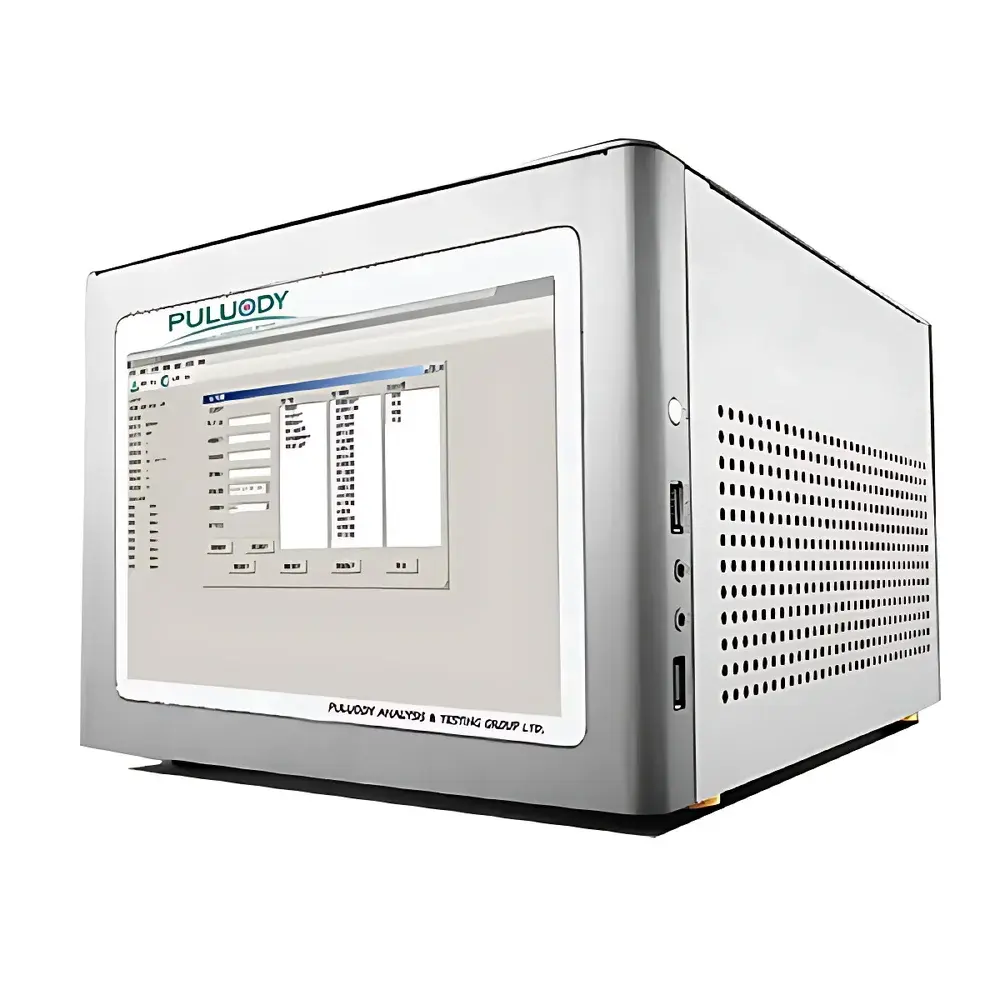
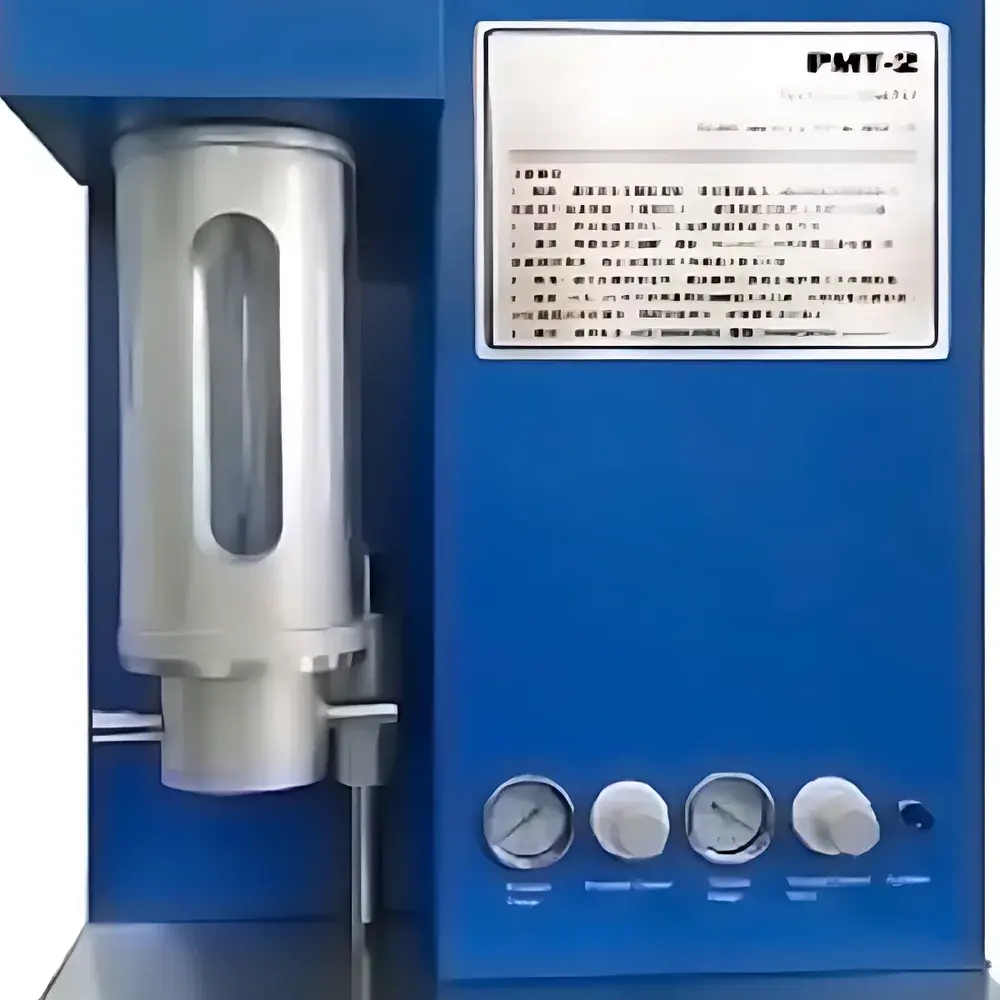
PULUODY PMT-2L Copper Sulfate Liquid Particle Counter
| Brand | PULUODY |
|---|---|
| Origin | Shaanxi, China |
| Manufacturer Type | Authorized Distributor |
| Country of Origin | China |
| Model | PMT-2L |
| Price | USD 31,800 (FOB) |
| Detection Principle | Dual-Laser Narrow-Beam Light Obscuration |
| Sensor Generation | 8th-Generation Dual-Laser Optical Sensor |
| Flow Control | Precision Piston Pump + Electromagnetic Flow Regulation |
| Calibration Standards | JJG 1061, ISO 21501-4, Polystyrene Latex (PSL) Reference Spheres |
| Measuring Range | 1–450 µm |
| Customizable Sub-Ranges | 1–100 µm or 4–70 µm (c), down to 0.1 µm (c) resolution |
| Sampling Accuracy | < ±1% |
| Counting Accuracy | < ±3% (typical) |
| Coincidence Limit | ≤2.5% error at 1000 particles/mL |
| Output | 4–20 mA analog signal with configurable alarm threshold |
| Data Reporting | Particles per mL & ISO 4406 / NAS 1638 contamination codes |
| Interface | Color LCD touchscreen + optional wireless keyboard/mouse |
| Software | V8.3 Integrated Analysis & Calibration Suite (PC & iPad-compatible) |
| Power Supply | 100–265 VAC, 50–60 Hz |
| Compliance | Designed for GLP/GMP-aligned environments |
Overview
The PULUODY PMT-2L Copper Sulfate Liquid Particle Counter is a high-precision optical particle counter engineered for quantitative analysis of insoluble particulate contamination in conductive and non-conductive liquid media—including copper sulfate electrolytes, ultrapure water (UPW), semiconductor process chemicals, electronic cleaning agents, and polymer solutions. It operates on the principle of dual-laser narrow-beam light obscuration (also known as light extinction), where two spatially separated laser beams intersect the sample flow path to enable simultaneous detection and coincidence error correction. This architecture significantly improves counting fidelity in high-concentration suspensions and mitigates false positives caused by transient optical noise or refractive index fluctuations. Unlike conventional single-beam instruments, the 8th-generation dual-laser sensor provides enhanced signal-to-noise ratio and improved sizing linearity across the full 1–450 µm range—particularly critical for monitoring sub-5 µm particles in electroplating baths and CMP slurries where trace metallic particulates directly impact wafer yield and film uniformity.
Key Features
- Dual-laser narrow-beam optical detection system with real-time coincidence correction, enabling reliable quantification up to 1000 particles/mL
- High-stability precision piston pump coupled with electromagnetic flow regulation for volumetric accuracy better than ±1% and repeatable sampling volume delivery
- Modular design supporting both online and offline configurations—compatible with bypass loops, recirculation manifolds, and portable benchtop operation
- V8.3 integrated software platform with independent calibration and analysis modules to eliminate cross-contamination of metrological parameters during routine testing
- Configurable detection thresholds: standard 1–450 µm range; optional user-defined sub-ranges (e.g., 4–70 µm(c) for NAS-classified hydraulic fluids or 1–100 µm for UPW compliance)
- Comprehensive data output including raw count histograms, cumulative distribution curves, ISO 4406 and NAS 1638 coding, and time-series trend logging
- 4–20 mA analog output with programmable alarm thresholds for integration into SCADA and MES systems in semiconductor fabs and electroplating production lines
Sample Compatibility & Compliance
The PMT-2L is validated for use with aqueous electrolyte solutions—including copper sulfate plating baths—and low-viscosity organic solvents commonly employed in microelectronics manufacturing. Its wetted path employs chemically resistant materials (e.g., fused silica flow cell, PTFE/PFA tubing, and 316L stainless steel fittings) compatible with pH 1–12 environments and temperatures up to 50 °C. Instrument validation follows ISO 21501-4 (determination of particle size distribution using light extinction) and national metrological verification procedure JJG 1061. The system supports traceable calibration using NIST-traceable polystyrene latex (PSL) reference standards. For regulated environments, the V8.3 software includes electronic signature capability, audit trail generation, role-based user permissions, and data integrity safeguards aligned with FDA 21 CFR Part 11 and EU Annex 11 expectations.
Software & Data Management
The V8.3 software suite comprises two logically segregated components: the Calibration Module (requiring administrator privileges and cryptographic hash-secured parameter locking) and the Routine Analysis Module (for daily operator use). This separation prevents accidental modification of certified instrument constants during production testing. Data acquisition supports synchronized timestamping, GPS-tagged location metadata (for mobile deployments), and automatic export to CSV, PDF, and XML formats. iPad-native interface enables remote monitoring and ad-hoc sampling without PC dependency. All measurement sessions are archived with full context—including sensor status logs, flow rate history, ambient temperature/humidity, and operator ID—ensuring full traceability for internal audits or third-party certification.
Applications
- Real-time monitoring of copper sulfate electrolyte purity in PCB and IC interconnect electroplating lines
- In-line particle surveillance in ultrapure water distribution networks serving photolithography and etch tools
- Offline cleanliness verification of silicon wafers, glass substrates, and MEMS components post-cleaning
- Validation of nanofiltration and ultrafiltration membrane performance in pharmaceutical-grade water systems
- Quantitative assessment of insoluble microparticles in polymer precursor solutions used in OLED encapsulation
- Contamination diagnostics in reclaimed process chemicals undergoing closed-loop recycling in semiconductor fabs
FAQ
Is the PMT-2L suitable for measuring particles in highly conductive copper sulfate solutions?
Yes—the flow cell and sensor housing are constructed from non-corrosive, electrically isolated materials, and the optical detection method is unaffected by solution conductivity.
Can the instrument be integrated into an existing factory automation system?
Yes—it provides industry-standard 4–20 mA analog output with configurable alarm relays and supports Modbus TCP via optional Ethernet module for PLC interoperability.
Does the system meet ISO 21501-4 requirements for particle counter validation?
Yes—calibration and verification protocols follow ISO 21501-4 Annex B procedures using traceable PSL standards, and documentation packages include uncertainty budgets per GUM guidelines.
What maintenance intervals are recommended for sustained accuracy?
Optical alignment verification every 6 months; flow path cleaning after every 200 hours of operation in aggressive chemistries; annual recalibration by an accredited metrology lab is advised for GLP/GMP compliance.
Is remote software update and diagnostic support available?
Yes—V8.3 supports secure over-the-air updates and encrypted remote desktop assistance via TLS 1.3-secured connection, subject to customer-configured firewall policies.
Related Products






