PULUODY PMT-2LS Electronic-Grade Phosphoric Acid Liquid Particle Counter
| Brand | PULUODY |
|---|---|
| Model | PMT-2LS |
| Detection Principle | Dual-Laser Narrow-Beam Light Scattering |
| Sensor Generation | 8th-Generation Dual-Laser Optical Sensor |
| Detection Range | 0.1–0.5 µm (standard) |
| Sampling Method | Precision Metering Piston Pump |
| Flow Control | Dual-Stage Electromagnetic + Precision Piston Pump |
| Accuracy | ±3% typical |
| Volume Accuracy | ±1% |
| Coincidence Limit | ≤2.5% error at 1000 particles/mL |
| Output | 4–20 mA analog interface with programmable contamination alarm |
| Reporting | Particles per mL & ISO 4406 / NAS 1638 / SAE AS4059 contamination codes |
| Calibration Standards | JJG 1061, ISO 21501-4, NIST-traceable latex spheres |
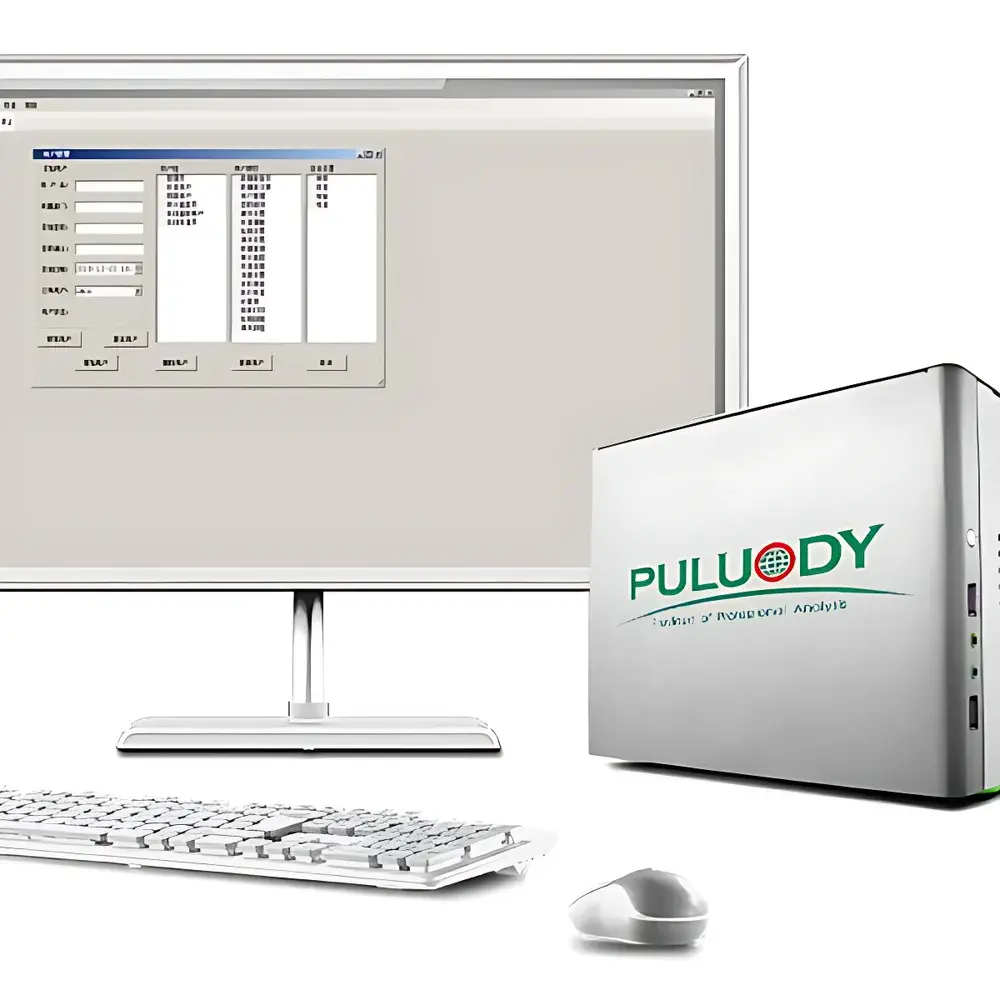
| Software | V8.3 Integrated Analysis & Calibration Software (PC + embedded touchscreen UI) |
| Display | Color LCD touch interface + optional wireless keyboard/mouse |
| Power Input | 100–265 VAC, 50–60 Hz |
| Compliance | Designed for ISO Class 1–5 cleanroom environments |
Overview
The PULUODY PMT-2LS Electronic-Grade Phosphoric Acid Liquid Particle Counter is a purpose-engineered optical particle counter designed specifically for real-time, high-sensitivity monitoring of sub-micron particulate contamination in ultra-pure process liquids used across semiconductor front-end manufacturing. It operates on the principle of dual-laser narrow-beam light scattering—where two spatially separated laser sources illuminate the sample stream simultaneously—enabling robust discrimination of coincident events and significantly improving counting accuracy at low concentrations (<100 particles/mL) and high particle densities (up to 1000 particles/mL). This architecture mitigates signal saturation and pulse broadening artifacts common in single-beam systems, delivering enhanced resolution for particles as small as 0.1 µm(c) in phosphoric acid (H₃PO₄), SC-1/SC-2 cleans, deionized water (DIW), photoresist solvents, and other aggressive chemistries compatible with its wetted-path materials (electropolished 316L SS, fused silica flow cell, and fluoropolymer seals). The instrument meets the stringent metrological requirements defined in ISO 21501-4 for liquid-borne particle counters and aligns with industry practices outlined in SEMI F39 (Particle Counting in Ultrapure Chemicals) and ASTM D7252 (Standard Practice for Determining Particle Contamination in High-Purity Water).
Key Features
- 8th-generation dual-laser narrow-beam optical sensor with independent wavelength alignment and background noise suppression circuitry
- Dual-stage flow control system: precision metering piston pump (±1% volumetric accuracy) coupled with electromagnetic fine-tuning for stable laminar flow across variable viscosity ranges (0.8–5 cP)
- Configurable detection thresholds: standard 0.1–0.5 µm sizing range; extended modes support user-defined channels from 1–100 µm or 4–70 µm(c), including critical 0.1 µm(c) threshold for advanced node etch residue analysis
- Embedded V8.3 analysis software with segregated calibration and measurement modules—ensuring traceable, interference-free data acquisition per ISO/IEC 17025 requirements
- Integrated analog output (4–20 mA) with programmable alarm thresholds, enabling direct integration into factory SCADA and MES platforms for automated process deviation alerts
- Touchscreen HMI with full local operation capability; optional PC-based remote control and data export via USB/Ethernet, supporting CSV, PDF, and XML report formats compliant with internal QA documentation standards
Sample Compatibility & Compliance
The PMT-2LS is validated for use with electronic-grade phosphoric acid (≥99.999% purity), ammonium hydroxide/hydrogen peroxide mixtures (SC-1), hydrochloric acid/hydrogen peroxide (SC-2), sulfuric acid/hydrogen peroxide (SPM), DI water (≤0.055 µS/cm), and low-volatility organic solvents such as PGMEA and EL. Its fluidic path is constructed from electrochemically passivated 316L stainless steel and quartz, ensuring chemical resistance and minimal leachables. The system complies with SEMI C1 (Materials Specifications for Semiconductor Manufacturing Equipment) and supports validation protocols required under ISO 9001, IATF 16949, and FDA 21 CFR Part 11 when deployed with audit-trail-enabled software licensing. Calibration traceability is maintained through NIST-traceable polystyrene latex (PSL) standards certified to ISO 21501-4 and national metrology institute (NIM)-certified reference materials per JJG 1061.
Software & Data Management
The V8.3 software suite provides dual-mode operation: embedded firmware for standalone field deployment and PC-hosted application for centralized fleet management. Calibration routines—including zero-check, sensitivity verification, and size verification—are fully documented with digital signatures and timestamped logs. All raw scatter pulse data is retained alongside processed counts, enabling retrospective re-analysis without loss of fidelity. Export functions support LIMS integration via ASTM E1384-compliant structured data files. Optional 21 CFR Part 11 compliance package includes electronic signatures, role-based access control, and immutable audit trails for all configuration changes, calibration events, and report generation activities—meeting GLP/GMP documentation rigor for qualification in qualified manufacturing environments.
Applications
The PMT-2LS serves as a critical quality gate in semiconductor wafer fabrication for monitoring particle excursions during wet bench processing steps—including post-etch rinse, pre-diffusion cleaning, and post-CMP slurry filtration. It is routinely deployed for: (1) online monitoring of phosphoric acid delivery lines feeding etch tools; (2) periodic verification of point-of-use filter integrity in DI water loops; (3) offline batch certification of reclaimed solvents prior to reuse; (4) qualification of nano-filtration membranes used in chemical recirculation systems; and (5) root-cause analysis of defect excursions linked to chemical particulate load. Its mobility mode supports handheld verification of tank-to-tool transfer lines and mobile cleanroom audits per ISO 14644-1 Class 3–5 verification protocols.
FAQ
What particle size ranges can the PMT-2LS resolve in electronic-grade phosphoric acid?
The instrument reports primary sizing from 0.1 µm(c) to 0.5 µm(c) with certified resolution per ISO 21501-4; extended configurations support user-defined channels between 1–100 µm or 4–70 µm(c) using calibrated PSL standards.
Is the system compatible with aggressive chemistries beyond phosphoric acid?
Yes—it has been validated for SC-1, SC-2, SPM, BOE, DI water, and select photoresist solvents. Wetted material compatibility must be confirmed per SEMI C1 Annex A for each chemical formulation.
Does the PMT-2LS support automated data upload to a central QA database?
Yes—via Ethernet or USB, with configurable export formats (CSV, XML, PDF) and optional LIMS interface modules compliant with ASTM E1384 and HL7 standards.
How is calibration traceability maintained?
Calibration uses NIST-traceable PSL spheres certified to ISO 21501-4, with documentation aligned to JJG 1061 and internal SOP-PC-023 for metrological traceability.
Can the system operate continuously in-line without manual intervention?
Yes—designed for 24/7 unattended operation with automatic self-diagnostic cycles, flow stability monitoring, and configurable alarm thresholds for real-time process feedback.
Related Products