
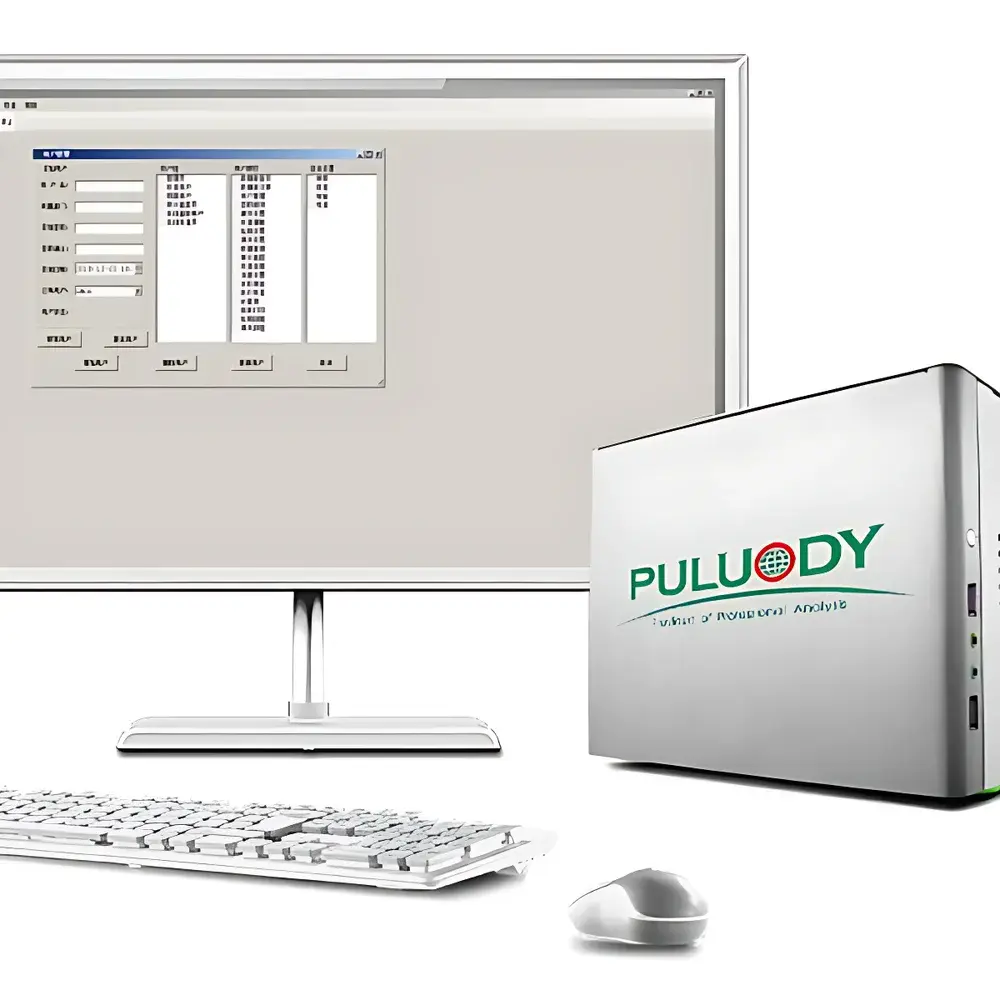
PULUODY PMT-2SD Wet Electronic Chemicals Liquid Particle Counter
| Brand | PULUODY |
|---|---|
| Model | PMT-2SD |
| Detection Principle | Dual-Laser Narrow-Beam Light Scattering |
| Sensor Generation | 8th-Generation |
| Measuring Range | 0.1–0.5 µm & 0.5–5.0 µm (customizable to 1–100 µm or 4–70 µm(c) |
| Sampling Accuracy | <±1% |
| Counting Accuracy | ±3% typical |
| Coincidence Limit | 1000 particles/mL (2.5% coincidence error) |
| Flow Control | Precision Plunger Pump + Electromagnetic Flow Regulation |
| Data Output | 4–20 mA analog interface,超标 alarm output (customizable) |
| Calibration Standards | JJG 1061, ISO 21501, NIST-traceable latex spheres |
| Software | V8.3 Integrated Analysis & Calibration Software (PC + embedded touchscreen UI) |
| Display | Color LCD touch interface + optional wireless keyboard/mouse |
| Power Input | 100–265 VAC, 50–60 Hz |
| Compliance | Designed for ISO 14644-1/2, USP <788>, ISO 8573-4, and semiconductor-grade liquid purity monitoring workflows |
Overview
The PULUODY PMT-2SD Wet Electronic Chemicals Liquid Particle Counter is an engineered solution for high-sensitivity particulate contamination monitoring in ultra-pure process liquids used across semiconductor fabrication, flat-panel display manufacturing, photovoltaics, and advanced electronics assembly. It operates on the principle of dual-laser narrow-beam light scattering—where two spatially separated laser sources illuminate a precisely defined flow path—enabling simultaneous detection of sub-micron and micron-scale particles with minimized optical noise and enhanced signal-to-noise ratio. Unlike single-beam systems, this 8th-generation sensor architecture mitigates Mie scattering interference and improves sizing resolution in low-conductivity, low-refractive-index media such as deionized water, hydrogen peroxide solutions, sulfuric acid baths, ammonium hydroxide, and other wet electronic chemicals (WECs). The instrument supports both online (in-line) and offline (batch) measurement configurations, delivering real-time, continuous particle concentration data (particles/mL) and ISO 11171/ISO 4406-compliant contamination grading—critical for process control, cleaning validation, and yield assurance in Class 1–Class 10 cleanroom environments.
Key Features
- Dual-laser narrow-beam optical sensing system optimized for low-background, high-transparency WECs including SC-1, SC-2, BOE, and DI water
- Precision plunger pump coupled with electromagnetic flow regulation ensures volumetric sampling accuracy better than ±1%, essential for repeatable quantitative analysis
- Configurable detection thresholds: standard ranges of 0.1–0.5 µm and 0.5–5.0 µm; extended options include user-defined bins from 1–100 µm or 4–70 µm(c), with optional 0.1 µm(c) sensitivity mode
- Embedded V8.3 analysis software with separation of calibration routines and test execution—eliminating software-induced bias during routine QC operations
- Integrated color LCD touchscreen interface with optional wireless keyboard/mouse support for flexible lab or fab-floor operation
- Analog 4–20 mA output with programmable alarm thresholds for integration into SCADA, DCS, or MES platforms; configurable over-limit notification via relay or digital I/O
- Compliance-ready architecture: firmware supports audit trails, user access levels, and electronic signature protocols aligned with FDA 21 CFR Part 11 and GLP/GMP documentation requirements
Sample Compatibility & Compliance
The PMT-2SD is validated for use with non-viscous, low-particulate, electrically insulating liquids commonly employed in front-end semiconductor processes—including but not limited to ultrapure water (UPW), hydrogen peroxide (H₂O₂), ammonium hydroxide (NH₄OH), hydrochloric acid (HCl), sulfuric acid (H₂SO₄), and buffered oxide etch (BOE). Its fluidic path employs chemically inert wetted materials (e.g., PFA, quartz, sapphire) compatible with aggressive WEC formulations. Instrument performance adheres to ISO 21501-4 (light extinction and light scattering particle counters), JJG 1061 (Chinese national metrological verification regulation), and supports traceability to NIST-standardized polystyrene latex (PSL) reference materials. Calibration verification may be performed using certified reference suspensions compliant with USP for injectables or ISO 8573-4 for compressed gas purity—making it suitable for cross-industry deployment where liquid purity standards converge.
Software & Data Management
The V8.3 software suite provides dual-mode operation: a standalone PC application for deep statistical analysis (e.g., trend charting, histogram comparison, batch reporting), and an embedded touchscreen interface for rapid setup, real-time monitoring, and pass/fail decision logic at the point of use. All raw count data are timestamped and stored with metadata (operator ID, sample ID, calibration status, environmental conditions). The system logs calibration events, maintenance records, and user actions in a tamper-evident audit trail. Export formats include CSV, PDF, and XML—compatible with LIMS integration and automated report generation. Optional cloud-based remote diagnostics and firmware update capability enable predictive service scheduling without onsite intervention.
Applications
- Real-time monitoring of UPW distribution loops in semiconductor fabs to detect filter breakthrough or piping corrosion events
- Offline verification of chemical bath cleanliness prior to wafer immersion—ensuring no residual catalyst particles compromise gate oxide integrity
- Validation of nano-filtration and ultrafiltration membrane performance in WEC recirculation systems
- Quantitative assessment of particle shedding from polishing pads, carriers, and dispensing nozzles in TFT-LCD and OLED production lines
- Contamination mapping of silicon wafers, glass substrates, and precision optics during cleaning and rinsing stages
- Supporting ISO 14644-1 cleanroom classification through periodic liquid sampling at critical process points
FAQ
What particle size ranges does the PMT-2SD support out-of-the-box?
Standard configuration covers 0.1–0.5 µm and 0.5–5.0 µm channels; custom binning from 1–100 µm or 4–70 µm(c) is available upon request.
Can the instrument be integrated into a factory automation system?
Yes—via 4–20 mA analog output, digital relay alarms, and Modbus TCP/IP (optional module) for seamless connection to PLCs, SCADA, or MES.
Is calibration traceable to international standards?
Calibration uses NIST-traceable PSL standards and complies with JJG 1061, ISO 21501-4, and ISO 8573-4 methodologies.
Does the system meet regulatory requirements for pharmaceutical or medical device manufacturing?
While primarily designed for semiconductor-grade WECs, its data integrity features (audit trail, electronic signatures, calibration logging) align with FDA 21 CFR Part 11 and EU Annex 11 expectations when deployed in controlled environments.
What maintenance is required for long-term operational stability?
Annual sensor verification and flow calibration are recommended; quartz flow cell cleaning and pump seal inspection should occur every 6 months under continuous online operation.



