
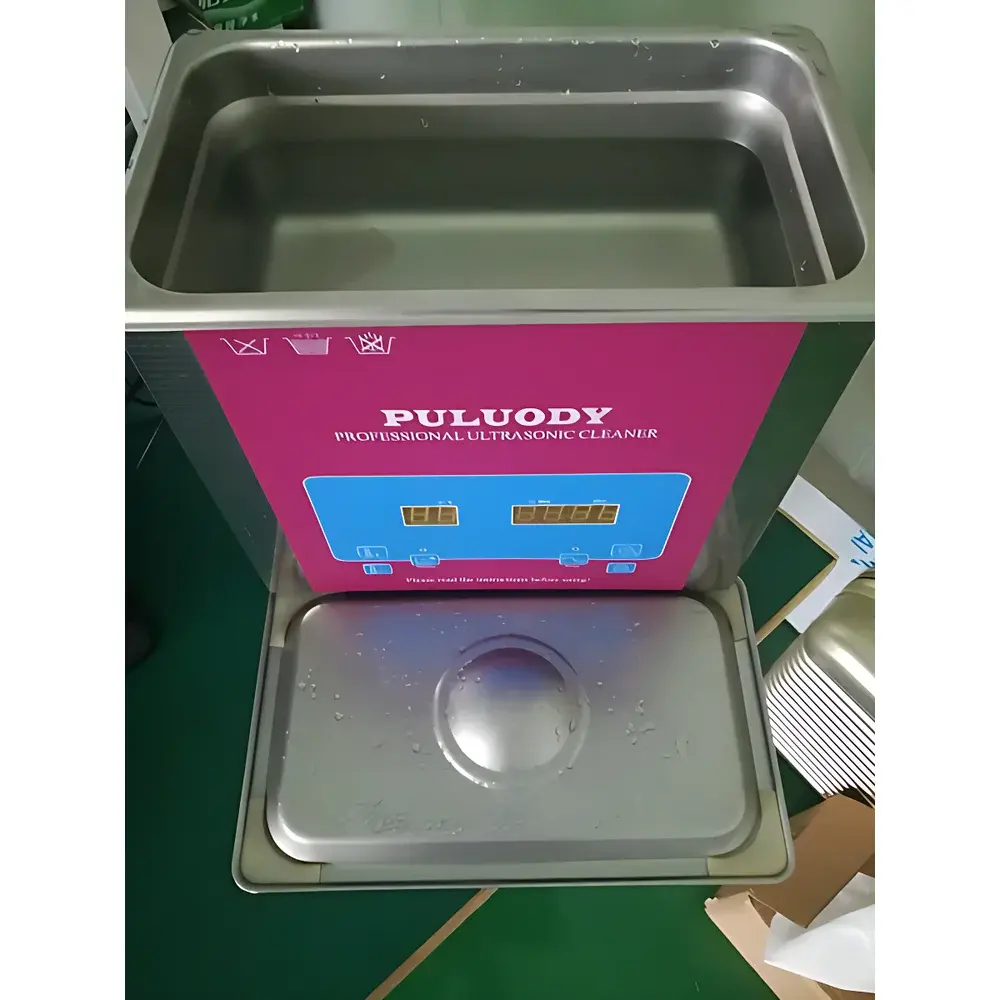
PULUODY PS3200-6L High-Power Ultrasonic Cleaner with Dual-Frequency Degassing & Defoaming Function
| Brand | PULUODY |
|---|---|
| Origin | Shaanxi, China |
| Model | PS3200-6L |
| Capacity | 6 L |
| Ultrasonic Frequency | 53 kHz |
| Ultrasonic Power | ≥200 W |
| Power Adjustment | Yes (40–100%, 1% stepwise) |
| Temperature Control Range | 20–60 °C |
| Heating Power | 150 W |
| Timer Range | 1–199 min |
| Tank Dimensions | 30 × 15 × 15 cm |
| Overall Dimensions | 33 × 18 × 29 cm |
| Power Supply | 220 V / 50 Hz |
| Noise Reduction Lid | Included |
| Manual Drain Valve | Yes |
| Construction | 304 Stainless Steel Tank & Argon-Welded Mesh Basket |
Overview
The PULUODY PS3200-6L is a high-power, dual-frequency ultrasonic cleaner engineered for demanding laboratory and industrial cleaning, degassing, defoaming, and sample preparation applications. Operating at a stable 53 kHz frequency, it utilizes piezoelectric transducer technology to generate cavitation energy within liquid media—enabling efficient removal of particulate contaminants, organic residues, oxides, and entrapped air from complex geometries including blind holes, micro-channels, and porous substrates. Unlike basic single-frequency units, the PS3200-6L incorporates synchronized dual-frequency oscillation timing to enhance cavitation distribution uniformity and suppress standing wave formation—critical for reproducible cleaning performance across heterogeneous sample loads. Its robust architecture supports continuous operation in QC labs, R&D facilities, and precision manufacturing environments where consistent surface cleanliness directly impacts downstream analytical validity (e.g., particle counting, SEM/EDS analysis, thin-film deposition) or functional integrity (e.g., semiconductor wafer processing, optical component assembly).
Key Features
- High-intensity ultrasonic output: ≥200 W nominal power with fine-grained 1% incremental adjustment (40–100% range), enabling precise energy modulation for delicate vs. robust substrates.
- Dual-frequency timed oscillation mode: Alternating excitation cycles improve cavitation cloud homogeneity and reduce localized erosion—particularly beneficial for fragile optics, MEMS devices, and sintered metal filters.
- Integrated temperature control: Digital PID-regulated heating (20–60 °C, ±1 °C accuracy) with real-time LCD display of both setpoint and actual bath temperature; 150 W heating element ensures rapid thermal stabilization without compromising ultrasonic efficiency.
- Intelligent digital timer: 1–199 minute programmable duration with non-volatile memory retention—settings persist through power interruption per IEC 61000-4-11 compliance requirements.
- Acoustically optimized stainless steel tank: 304-grade construction with argon-welded seams and reinforced corners; paired with a corrosion-resistant stainless mesh basket designed for uniform load support and acoustic coupling.
- Passive noise suppression: Removable sound-dampening lid reduces ambient noise to ≤65 dB(A) at 1 m distance—meeting ISO 11201 occupational exposure guidelines for routine lab use.
Sample Compatibility & Compliance
The PS3200-6L accommodates a broad spectrum of materials and components commonly processed in regulated environments, including but not limited to: silicon wafers, sapphire substrates, surgical instruments, stainless steel fluidic manifolds, optical lenses, fiber optic ferrules, printed circuit boards (PCBs), and ceramic MEMS packages. Its stainless steel wetted path and absence of elastomeric seals ensure compatibility with aqueous, alcoholic, and low-surface-tension solvent systems (e.g., IPA, acetone, terpenes). While not certified to UL/CSA or CE for medical device reprocessing, the unit meets general electrical safety standards (GB 4793.1–2019 / IEC 61010-1) and supports GLP/GMP-aligned workflows when operated with documented SOPs, calibration records, and periodic verification of frequency stability and power output per ASTM E1497–22 Annex A1.
Software & Data Management
The PS3200-6L operates via an embedded microcontroller-based interface with backlit LCD panel—no external PC or proprietary software required. All operational parameters (time, temperature, power level) are stored in EEPROM with timestamp-independent retention. Though lacking network connectivity or audit trail functionality out-of-the-box, the device supports integration into validated laboratory informatics systems via optional RS-232 or analog voltage output modules (sold separately), enabling traceable parameter logging compliant with FDA 21 CFR Part 11 Annex 11 requirements when paired with qualified middleware.
Applications
- Pre-analytical sample preparation: Removal of adsorbed particles and biofilms from filtration membranes prior to light obscuration or microscopic particle counting (NAS 1638, ISO 4406, USP ).
- Electronics manufacturing: Cleaning of solder paste residues, flux remnants, and particulate debris from PCB assemblies and semiconductor packaging substrates.
- Biomedical research: Cell lysis, DNA/RNA extraction support, emulsification of lipid nanoparticles, and degassing of viscous hydrogels prior to rheological characterization.
- Mechanical engineering: Decontamination of hydraulic valve components, fuel injector nozzles, and bearing surfaces prior to dimensional metrology or tribological testing.
- Materials science: Surface activation of carbon nanotubes, dispersion of graphene oxide suspensions, and removal of sintering aids from additive-manufactured metal parts.
FAQ
Is the PS3200-6L suitable for cleaning delicate optical components without surface damage?
Yes—when operated at ≤60% power and 40–50 °C with low-surface-tension solvents (e.g., ethanol/water 70:30), it achieves effective cleaning while minimizing pitting risk on coated lenses and AR-treated surfaces.
Can the unit be used for vacuum degassing of resins or adhesives?
It supports atmospheric-pressure degassing and deaeration; however, dedicated vacuum chambers are recommended for full void elimination in high-viscosity polymer systems.
Does the stainless steel tank resist corrosion when used with acidic or alkaline cleaning solutions?
304 stainless steel provides adequate resistance to mild alkaline detergents (pH 10–12) and dilute organic acids (e.g., citric acid ≤5%); prolonged exposure to chlorinated or strong mineral acids is not advised.
What maintenance is required to sustain ultrasonic performance over time?
Monthly inspection of transducer mounting integrity, quarterly descaling of the tank interior using 5% acetic acid solution, and annual verification of generator output stability using a calibrated ultrasonic power meter per ASTM E1000.
Is the drain valve compatible with standard laboratory waste collection systems?
The manually actuated brass valve features a 1/4″ NPT female thread, allowing direct connection to standard PVC or PTFE-lined waste tubing (not included).



