
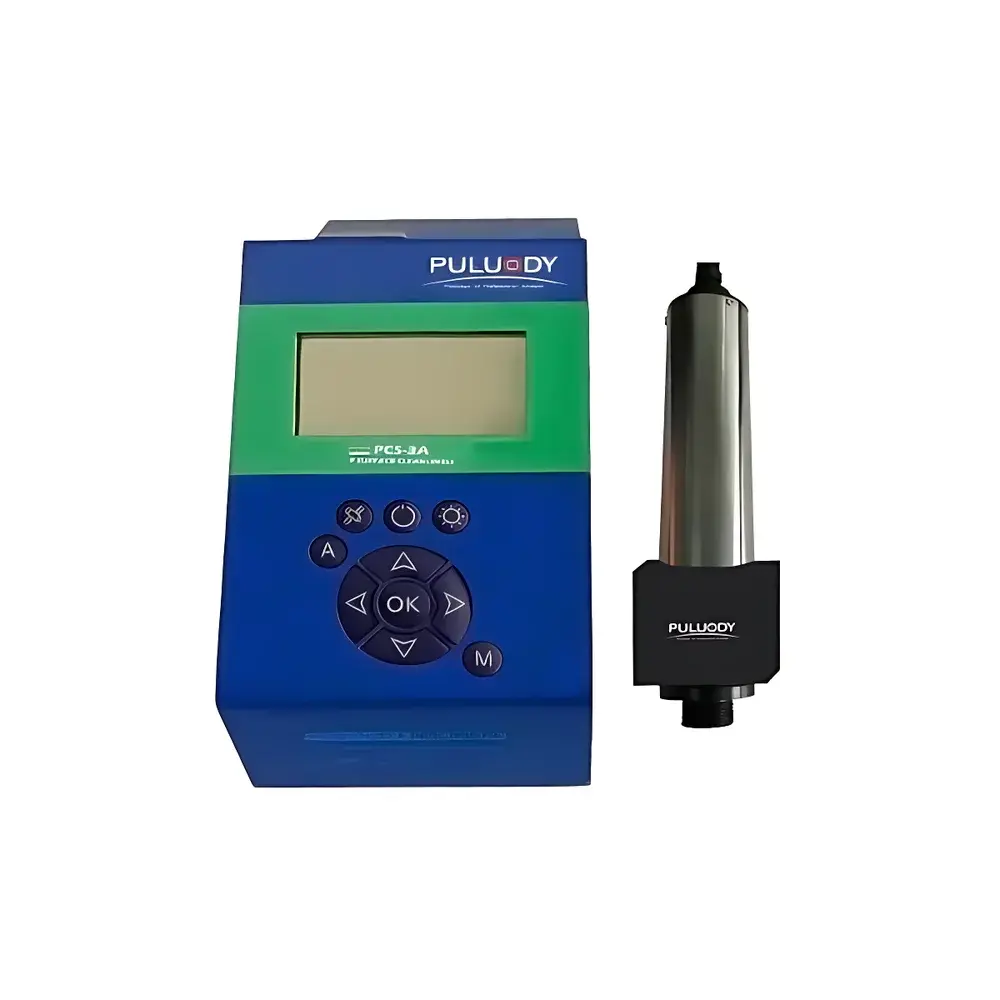
PULUODY PSC-3A Surface Residual Oil Contamination Analyzer
| Brand | PULUODY |
|---|---|
| Origin | Shaanxi, China |
| Model | PSC-3A |
| Instrument Type | Optical Fluorescence-Based Particle & Contaminant Analyzer |
| Detection Principle | Fluorescence Energy Spectroscopy (FES) |
| Measurement Range | 0–100% relative oil contamination |
| Resolution | 0.01% / 0.01 FU / 0.1 mg/mm² |
| Accuracy | ±0.5% of reading |
| Detection Speed | ≥50 measurements/sec |
| Excitation Source | Dynamic X-ray Fluorescence (XRF), 150 µW |
| Measurement Spot Size | Adjustable (1–5 points), spot diameter 0–1.5 mm or 0–5 mm |
| Working Distance | 3.5–4.5 mm or 20 mm |
| Calibration Traceability | NIST- and GBW-certified reference standards |
| Compliance | OIML R 127 (surface contamination metrology), ISO 8502-3 (surface cleanliness), ASTM D7619 (fluorescent residue quantification) |
| Optional Module | Integrated particle counting (size ranges: A: 0.1–10 µm, B: 1–20 µm, C: 5–50 µm) |
Overview
The PULUODY PSC-3A Surface Residual Oil Contamination Analyzer is a benchtop-to-field portable instrument engineered for rapid, non-destructive, and solvent-free quantification of hydrocarbon-based surface contaminants—including mineral oils, synthetic lubricants, hydraulic fluids, greases, cutting fluids, and waxes (C5–CN organics). It operates on the principle of Fluorescence Energy Spectroscopy (FES), a trace-level analytical method in which a low-power dynamic X-ray fluorescence source excites electrons in organic molecules, inducing characteristic fluorescent emission spectra. These spectral signatures—unique to aromatic, aliphatic, and heterocyclic hydrocarbons—are captured by a high-sensitivity multi-channel photodetector array and resolved via a Multi-Channel Pulse Height Analyzer (MPHA). The system’s embedded processor applies chemometric algorithms to convert spectral intensity distributions into calibrated, quantitative outputs: % relative contamination, fluorescence units (FU), or mass-area density (mg/mm²). Designed for real-time process monitoring and QC verification, the PSC-3A delivers repeatable results within 0.001–30 seconds per measurement, with no sample preparation, no solvent use, and zero operator exposure risk.
Key Features
- Non-contact, non-invasive measurement: No wiping, swabbing, extraction, or solvent handling required—eliminates cross-contamination and operator safety hazards.
- Trace-level sensitivity: Detection limit down to 1 µg/mL equivalent surface concentration; resolution of 0.01% contamination and 0.01 FU enables detection of sub-monolayer hydrocarbon films.
- Multi-parameter output: Simultaneous reporting of % relative contamination, FU value (0–1950 FU), and oil film thickness (0–9950 mg/mm²) with ±0.5% measurement uncertainty.
- Field-deployable ruggedization: Compact footprint (<300 × 200 × 150 mm), shock-resistant housing, and dual power options (rechargeable Li-ion battery or 220 V AC adapter) support operation in hangars, production floors, or remote maintenance bays.
- Adaptive optical geometry: Programmable measurement point selection (1–5 points), variable spot size (0–1.5 mm or 0–5 mm), and dual working distance modes (3.5–4.5 mm proximity or 20 mm standoff) accommodate curved, textured, or recessed surfaces.
- Automated calibration architecture: Supports blank baseline correction, single-point, and multi-point calibration using NIST-traceable or GBW-certified hydrocarbon reference standards—fully compliant with ISO/IEC 17025 calibration documentation requirements.
Sample Compatibility & Compliance
The PSC-3A is validated for direct analysis of metallic, ceramic, polymer, and composite substrates commonly found in aerospace, automotive, semiconductor, and precision engineering applications—including aluminum alloys (e.g., 7075-T6), stainless steels (e.g., 304, 17-4PH), silicon wafers, anodized aluminum housings, and machined titanium components. It conforms to international surface cleanliness standards including ISO 8502-3 (determination of soluble contaminants by conductivity or ion chromatography—used here as a comparative benchmark), ASTM D7619 (standard test method for fluorescent residue quantification on metal surfaces), and OIML R 127 (metrological requirements for instruments measuring surface contamination). All measurement data are fully traceable to the National Institute of Metrology (NIM), China, and the National Institute of Standards and Technology (NIST), USA, satisfying GLP audit requirements and supporting FDA 21 CFR Part 11-compliant electronic record integrity when integrated with validated laboratory information management systems (LIMS).
Software & Data Management
The analyzer interfaces via RS-232 or RS-485 serial protocols with host PCs or industrial control systems running PULUODY’s proprietary CleanTrace™ software suite. This application provides real-time spectral visualization, automatic peak deconvolution, batch reporting (CSV/PDF/XLS export), statistical process control (SPC) charting (X̄-R, Cpk), and full audit trail functionality—including user login tracking, parameter change logs, calibration event timestamps, and raw spectral data archiving. Software validation packages are available for GxP environments, enabling compliance with 21 CFR Part 11 electronic signature and record retention mandates. Data export supports integration with enterprise MES and QMS platforms via OPC UA or RESTful API extensions.
Applications
- Aerospace manufacturing: Final inspection of turbine blades, landing gear components, and fuel system fittings prior to assembly or coating.
- Automotive powertrain: Verification of crankshaft, camshaft, and bearing surface cleanliness after machining and before packaging.
- Semiconductor equipment: Monitoring residual hydrocarbons on vacuum chamber walls, wafer chucks, and robotic end-effectors to prevent particle generation.
- Hydraulic system maintenance: On-site assessment of valve body, pump housing, and servo actuator cleanliness during overhaul cycles.
- Medical device manufacturing: Validation of stainless-steel surgical instrument surfaces post-cleaning to meet ISO 13485 cleanliness thresholds.
- Energy sector: Inspection of transformer core laminations, generator stator slots, and nuclear coolant piping weld zones for dielectric fluid residue.
FAQ
Does the PSC-3A require consumables or reagents?
No. The instrument is entirely reagent-free and does not use solvents, filters, or disposable cuvettes.
Can it distinguish between different types of oils (e.g., mineral vs. synthetic)?
Yes—via spectral fingerprint analysis. While absolute compound identification requires library matching, the FES engine differentiates broad classes (e.g., PAH-rich mineral oils vs. ester-based synthetics) with >92% classification accuracy under controlled calibration conditions.
Is the measurement affected by surface roughness or color?
Minimal impact. The optical design compensates for reflectivity variance across common industrial finishes (Ra ≤ 6.3 µm); empirical correction factors are applied during calibration for matte black anodized or brushed stainless surfaces.
How is traceability documented for regulatory audits?
Each unit ships with a Certificate of Calibration referencing NIST SRM 2973 (hydrocarbon-coated silicon wafers) or GBW(E) 130449 (trace oil standard), accompanied by uncertainty budgets and measurement procedure SOPs aligned with ISO/IEC 17025 Clause 6.5.
What optional modules extend its capability?
An integrated laser diffraction particle counter module is available, providing concurrent particle size distribution (PSD) analysis in three configurable ranges: 0.1–10 µm, 1–20 µm, and 5–50 µm—ideal for correlating particulate contamination with organic residue levels on critical flight hardware or semiconductor tooling.



