
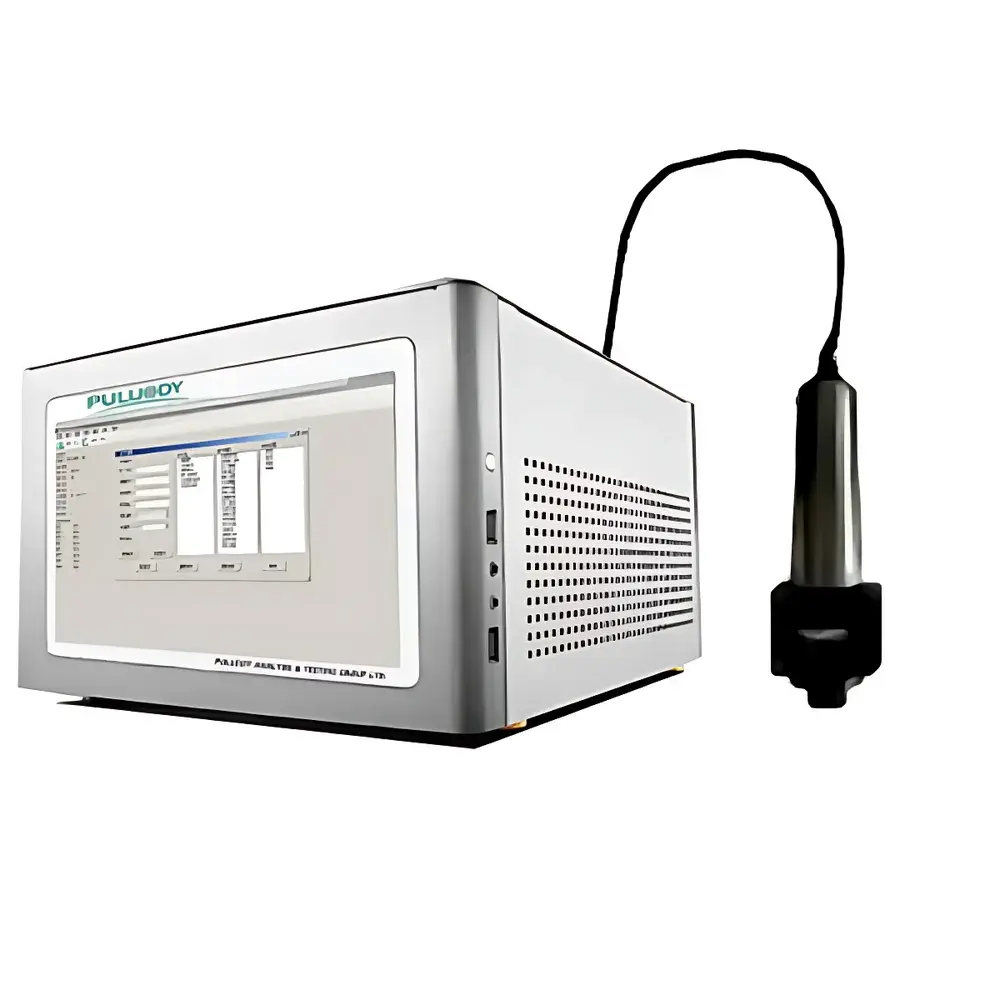
PULUODY PSC-3C Surface Cleanliness Analyzer
| Brand | PULUODY |
|---|---|
| Origin | Shaanxi, China |
| Manufacturer Type | Authorized Distributor |
| Country of Origin | China |
| Model | PSC-3C |
| Price | USD 34,500 (FOB) |
| Sensor | 7th-Generation Dual-Laser Narrow-Beam Particle Detector (Lifetime > 200,000 measurements) |
| Detectable Particle Sizes | Configurable Channels — A: 0.3/2.5/10 µm |
| B | 0.3/(0.5/1.0/2.5/5.0)/10 µm |
| C | 0.3/0.5/1.0/2.5/5.0/10 µm |
| D | 0.5/1.0/1.5/2.0/2.5/3.0 µm |
| Coincidence Error | <5% at 2×10⁶ particles/ft³ |
| Airflow Rate | 2.83 L/min (0.1 cfm), adjustable |
| Sampling Duration | 30 s per measurement |
| Measurement Modes | Timed or Continuous Cycling |
| Alarm Types | User-Defined Particle Count & Mass Thresholds |
| Data Storage | 100,001 records (real-time or scheduled) |
| Communication | RS232, USB, RS485 |
| Power | Rechargeable 4100 mAh Li-polymer battery or 220 V AC adapter |
| Operating Temperature | 5–45 °C |
| Relative Humidity | ≤90% RH (non-condensing) |
| Measurement Points | 1–5 per surface area |
| Calibration Traceability | NIM (China) and NIST (USA) certified reference materials per GBW and ISO/IEC 17025 protocols |
| Compliance | GB/T 16292–1996, ISO 14644-1:2015 |
Overview
The PULUODY PSC-3C Surface Cleanliness Analyzer is an engineered solution for quantitative particulate contamination assessment on solid surfaces in critical manufacturing and maintenance environments. Utilizing seventh-generation dual-laser narrow-beam light scattering detection, the instrument performs rapid, non-destructive extraction and enumeration of airborne-released particles from surfaces via controlled micro-vacuum sampling. Its operational principle conforms to the gravimetric and optical particle counting methodologies defined in ISO 14644-1:2015 (Cleanrooms and associated controlled environments) and GB/T 16292–1996 (Testing methods for airborne particle concentrations in clean rooms). Designed for field-deployable precision, the PSC-3C delivers trace-level sensitivity with a minimum detectable particle size of 0.3 µm and a validated lower limit of quantitation (LLOQ) of 0.1 µm under optimized sampling conditions — enabling compliance-driven verification of cleanliness standards across aerospace, power generation, semiconductor fabrication, and hydraulic system maintenance workflows.
Key Features
- Seventh-generation dual-laser optical detection architecture ensures high signal-to-noise ratio and minimal coincidence error (<5% at 2×10⁶ particles/ft³), supporting reproducible particle sizing across six configurable channel sets.
- Modular particle size binning (e.g., 0.3/0.5/1.0/2.5/5.0/10 µm) allows alignment with industry-specific cleanliness codes such as NAS 1638, ISO 4406, or SAE AS4059.
- Integrated 2.83 L/min (0.1 cfm) volumetric flow pump with real-time flow monitoring and user-adjustable rate — compliant with ISO 14644-1 sampling velocity requirements for Class 5–8 environments.
- Ruggedized portable design (IP54-rated enclosure), shock-absorbing chassis, and extended battery life (4100 mAh Li-polymer, >6 hours continuous operation) enable reliable use in hangars, engine bays, cleanroom vestibules, and offshore platforms.
- Single-button measurement initiation with full data acquisition and report generation completed within 30 seconds — eliminating operator-dependent variability and supporting high-throughput QA/QC screening.
- Traceable calibration framework aligned with national metrology institutes: NIM (China National Institute of Metrology) and NIST (National Institute of Standards and Technology), using GBW-certified and NIST-traceable particle reference standards.
Sample Compatibility & Compliance
The PSC-3C is validated for direct surface analysis of metallic, composite, ceramic, and polymer substrates — including machined engine components, turbine blades, printed circuit boards, hydraulic valve bodies, and semiconductor wafer carriers. Its vacuum-assisted particle lift-off mechanism maintains surface integrity while achieving representative sampling across flat, curved, and recessed geometries. All measurement protocols adhere to GLP-aligned documentation practices, with audit-ready data logs containing timestamp, location ID, operator ID, environmental conditions (T/RH), and calibration status. Instrument performance verification meets ISO/IEC 17025:2017 requirements for testing laboratories, and raw count data satisfies FDA 21 CFR Part 11 electronic record retention criteria when paired with validated PC-based software.
Software & Data Management
The analyzer interfaces with PULUODY CleanTrack™ Desktop Suite (v3.2+), a Windows-based application supporting automated report generation in PDF, CSV, and XML formats. Software features include customizable pass/fail logic engines, multi-point statistical aggregation (mean, SD, max deviation), trend charting across batches or time series, and export-compatible metadata tagging (ISO 14644-1 class mapping, NAS code conversion). Audit trails record all user actions, parameter changes, and calibration events with immutable timestamps. Data encryption (AES-256) and role-based access control ensure compliance with EU GDPR and corporate information security policies. Optional integration with LIMS via HL7 or OPC UA protocols enables seamless data ingestion into enterprise quality management systems.
Applications
- Aerospace: Verification of particulate residue on aircraft fuel system components pre-assembly per SAE ARP1923 and Boeing D6-17487.
- Semiconductor: Monitoring post-cleaning wafer carrier contamination in Class 100 (ISO 5) tool load ports.
- Power Generation: Quantifying wear debris on turbine blade root sections prior to reinstallation.
- Automotive: Final inspection of brake caliper bores and ABS sensor mounting surfaces against OEM ZF-021 or VW TL 52209 specifications.
- Medical Device Manufacturing: Validation of cleaning efficacy for stainless-steel surgical instrument trays per ISO 15883-5.
- Hydraulics: In-field assessment of servo-valve manifold cleanliness after ultrasonic cleaning cycles.
FAQ
Does the PSC-3C require annual recalibration?
Yes — annual recalibration against NIST-traceable particle standards is recommended per ISO/IEC 17025 and internal quality system requirements. Field verification using blank substrate checks is advised before each daily shift.
Can the instrument differentiate between metallic and organic contaminants?
No — the PSC-3C reports total particle counts and mass-equivalent distributions based on light scattering cross-section. Compositional identification requires complementary techniques such as SEM-EDS or FTIR.
Is the airflow rate adjustable for low-flow cleanroom applications?
Yes — the pump speed is digitally controllable from 1.5 to 3.0 L/min in 0.1 L/min increments, allowing adaptation to ISO 14644-1 sampling volume requirements for small-area surfaces.
What is the maximum allowable surface roughness for valid sampling?
Valid results are obtained on surfaces with Ra ≤ 3.2 µm. For Ra > 6.3 µm, a correction factor derived from ISO 14644-1 Annex B must be applied during data interpretation.
How is measurement repeatability verified across multiple operators?
The instrument includes built-in Gage R&R (Gauge Repeatability & Reproducibility) test mode, generating ANOVA-based %R&R statistics per ASTM E2782-19 guidelines using standardized test panels.



