
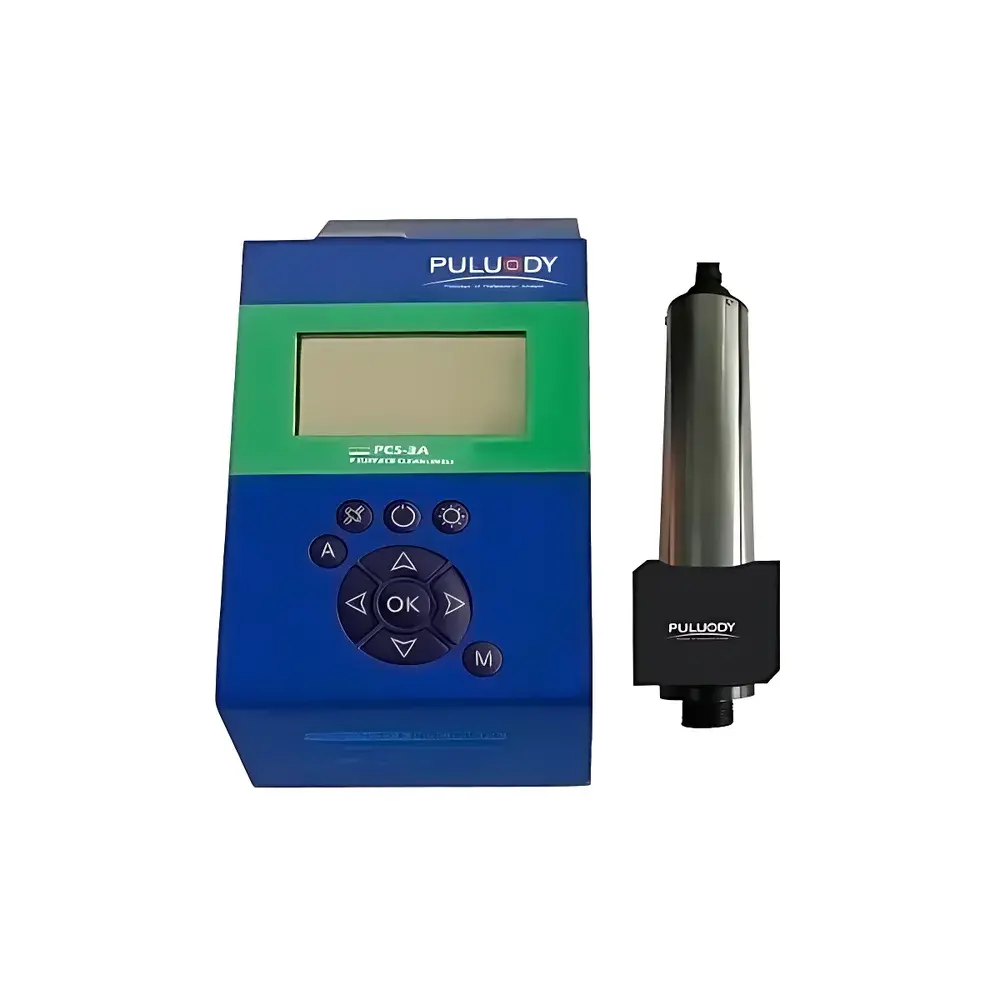
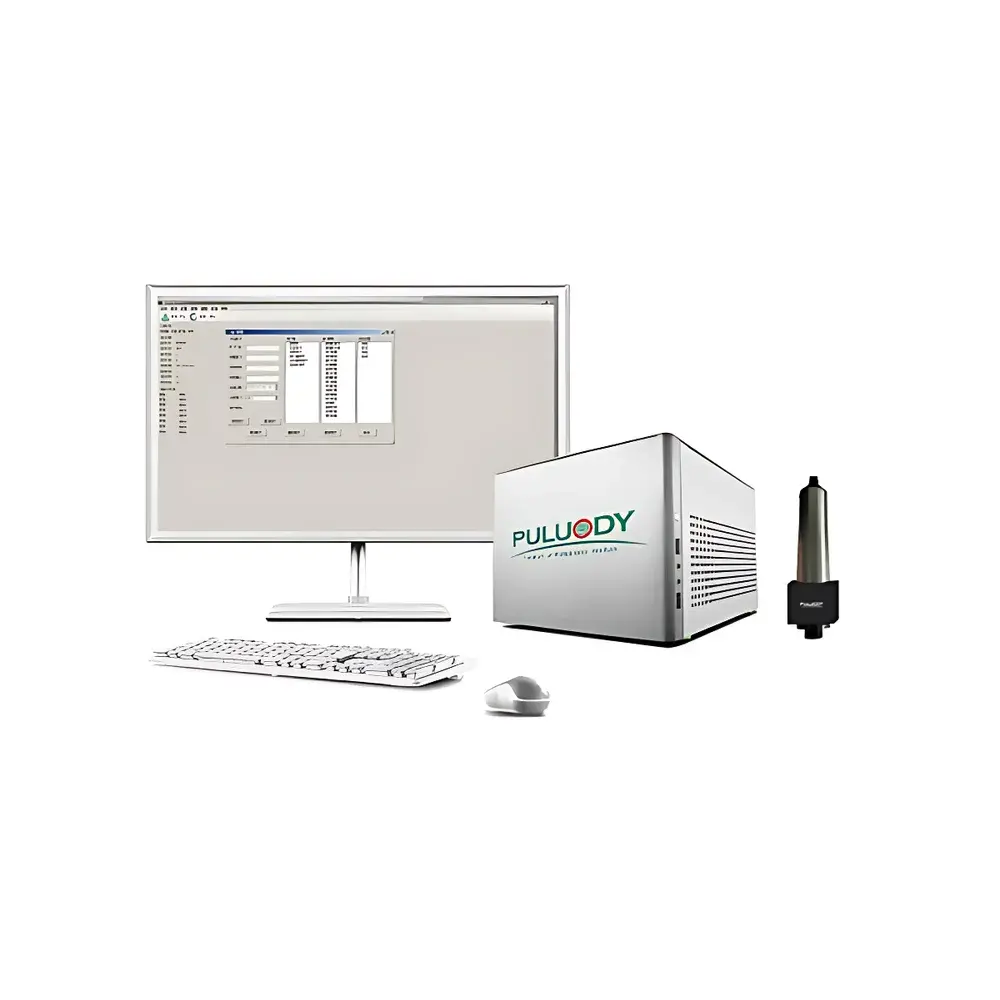
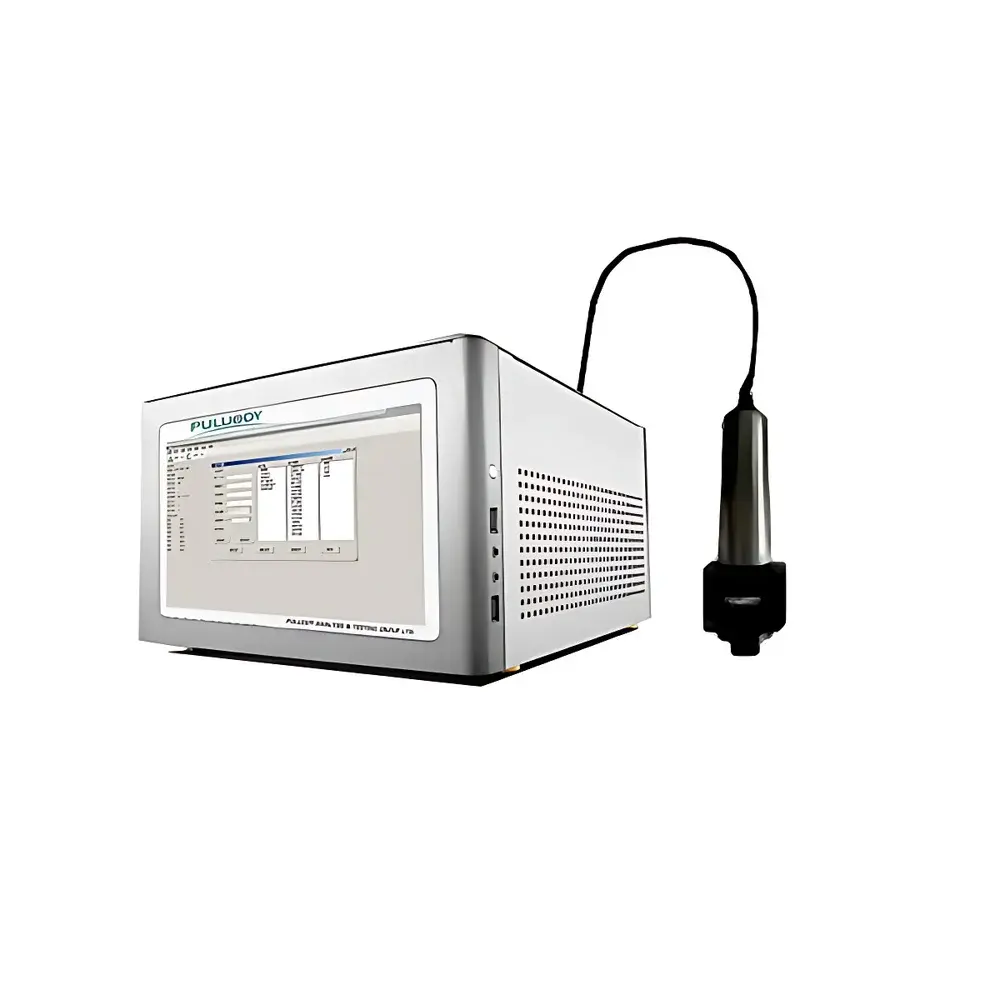
PULUODY PSC Series Fluorescence-Based Surface Oil Contamination Analyzer
| Brand | PULUODY |
|---|---|
| Origin | Shaanxi, China |
| Manufacturer Type | Authorized Distributor |
| Country of Origin | China |
| Model | PSC |
| Pricing | Available Upon Request |
| Detection Limit | 1 µg/mL / 0.01 FU / 0.01% |
| Measurement Speed | ≥50 Hz (up to 1000 data points/sec) |
| Resolution | 0.01% / 0.01 FU / 0.1 mg/mm² |
| Accuracy | ±0.5% of reading |
| Excitation Source | Dynamic X-ray Fluorescence (XRF) with 150 µW output |
| Measurement Spot Size | 0–1.5 mm or 0–5 mm |
| Working Distance | 3.5–4.5 mm or 20 mm |
| Oil Film Thickness Range | 0–9950 mg/mm² |
| Fluorescence Units (FU) Range | 0–1950 FU |
| Calibration Traceability | NIST- or GBW-certified reference materials |
| Compliance | OIML R 111-1 traceable via NIM (China) and NIST (USA) |
| Data Interface | RS-485 or RS-232 |
| Power Supply | Rechargeable battery or 220 V AC adapter |
Overview
The PULUODY PSC Series Fluorescence-Based Surface Oil Contamination Analyzer is an industrial-grade, non-destructive surface cleanliness verification instrument engineered for rapid, quantitative detection of hydrocarbon-based residues—including mineral oils, synthetic lubricants, hydraulic fluids, greases, cutting fluids, and waxes (C5–CN organics)—on metallic and non-porous engineered surfaces. It operates on the principle of selective fluorescence excitation and spectral discrimination: a low-power dynamic X-ray fluorescence (XRF) source induces characteristic fluorescent emission from aromatic and polycyclic hydrocarbon structures present in oil contaminants. The emitted photons are collected by a high-sensitivity energy-resolving detector, digitized via multi-channel pulse height analysis (MPHA), and processed using proprietary algorithms to quantify contaminant mass loading (mg/mm²), relative cleanliness (%), or fluorescence units (FU). Unlike solvent-based wipe tests or gravimetric methods, the PSC requires zero sample preparation, no consumables, and delivers repeatable, operator-independent results in ≤30 seconds per measurement—making it suitable for inline process monitoring, final inspection, and quality gate validation in regulated manufacturing environments.
Key Features
- Non-contact, non-destructive measurement with no solvent use—fully compliant with ISO 14001 and OSHA HAZCOM requirements
- Real-time fluorescence spectral acquisition at ≥50 Hz, supporting up to 1000 data points per second for statistical robustness across heterogeneous surfaces
- Multi-point adaptive sampling (1–5 configurable spots) with automatic spatial averaging and outlier rejection
- Traceable calibration architecture: single- and multi-point calibration supported using NIST SRM 2781 (hydrocarbon-coated steel) or GBW(E) 130462 certified reference standards
- Integrated auto-calibration routine with drift compensation and baseline stabilization over temperature fluctuations (10–40 °C operating range)
- Ruggedized aluminum housing rated IP54; shock-resistant design validated per MIL-STD-810G for field deployment in shipyards, aerospace MRO facilities, and heavy industrial plants
- Modular expansion capability: optional particle contamination module (0.1–50 µm size range) enables concurrent oil + particulate residue assessment per ISO 4406 and ASTM D7619
Sample Compatibility & Compliance
The PSC analyzer is validated for use on machined, ground, polished, or coated metallic substrates—including aluminum alloys (e.g., 2024-T3, 7075-T73), stainless steels (304, 316), titanium (Ti-6Al-4V), and nickel-based superalloys (Inconel 718). It accommodates curved, flat, and recessed geometries within its defined working distance envelope (3.5–4.5 mm standard; 20 mm extended option). Measurement results are traceable to the International Organization of Legal Metrology (OIML) framework through calibration certificates issued by China’s National Institute of Metrology (NIM) and cross-validated against NIST-traceable reference materials. The system meets documentation requirements for GLP and GMP environments: audit trails, electronic signatures, and user-access-level controls align with FDA 21 CFR Part 11 when operated with compliant PC-based software. It supports compliance reporting for aerospace standards including SAE AS1253, ASTM D7619, and Boeing D6-17487.
Software & Data Management
The PSC integrates with PULUODY’s CleanTrack™ PC software (Windows 10/11 compatible), providing full data lifecycle management—from real-time spectral visualization and trend charting to automated report generation in PDF/CSV/XLSX formats. Software features include batch ID assignment, pass/fail threshold mapping per surface class (e.g., Class A–D per ISO 8502-3), statistical process control (SPC) charts (X̄-R, Cpk), and export-ready metadata embedding (operator ID, timestamp, location tag, instrument serial number). All raw spectra and processed results are stored with SHA-256 hash integrity verification. Optional OPC UA server integration enables direct connectivity to MES/SCADA platforms for closed-loop feedback into cleaning process parameters (e.g., ultrasonic bath duration, rinse temperature, air-knife pressure).
Applications
The PSC Series is deployed globally in mission-critical cleanliness-sensitive industries. In aerospace, it verifies residual hydrocarbons on turbine blades, landing gear components, and fuel system fittings prior to coating or assembly—preventing adhesion failure and electrochemical corrosion. In automotive manufacturing, it validates cleaning efficacy after cold forming, machining, and heat treatment of engine blocks, transmission housings, and EV battery enclosures. Power generation facilities apply it to inspect steam turbine discs and generator rotor slots for dielectric contamination. Semiconductor equipment manufacturers use it to qualify vacuum chamber surfaces before thin-film deposition. Additional applications include validation of medical device sterilization trays, validation of pharmaceutical cleanroom tooling, and forensic analysis of lubricant transfer in tribological failure investigations.
FAQ
Does the PSC require periodic recalibration with certified standards?
Yes—annual recalibration using NIST SRM 2781 or equivalent GBW-certified reference materials is recommended for ISO/IEC 17025-compliant labs. Field verification checks can be performed daily using built-in blank reference tiles.
Can the PSC distinguish between different oil types (e.g., mineral vs. synthetic)?
While not a compositional identifier like GC-MS, the PSC’s spectral fingerprinting algorithm provides semi-quantitative differentiation based on fluorescence quantum yield and decay kinetics—enabling empirical classification models trained on known oil libraries.
Is the X-ray source safe for continuous operator use?
Yes—the 150 µW dynamic XRF source emits <0.1 µSv/h at 5 cm distance, well below IEC 62495 and EU Directive 2013/59/Euratom limits for unrestricted occupational exposure.
How is measurement uncertainty quantified and reported?
Total expanded uncertainty (k=2) is calculated per GUM (JCGM 100:2008) incorporating contributions from detector noise, calibration curve fit residuals, spatial heterogeneity, and environmental drift—typically ≤0.8% for oil film thickness at 95% confidence.
What surface roughness range is supported without loss of accuracy?
Validated for Ra ≤ 3.2 µm; for Ra > 6.3 µm, a surface-specific correction factor must be applied during calibration—documented in the instrument’s IQ/OQ protocol.



