
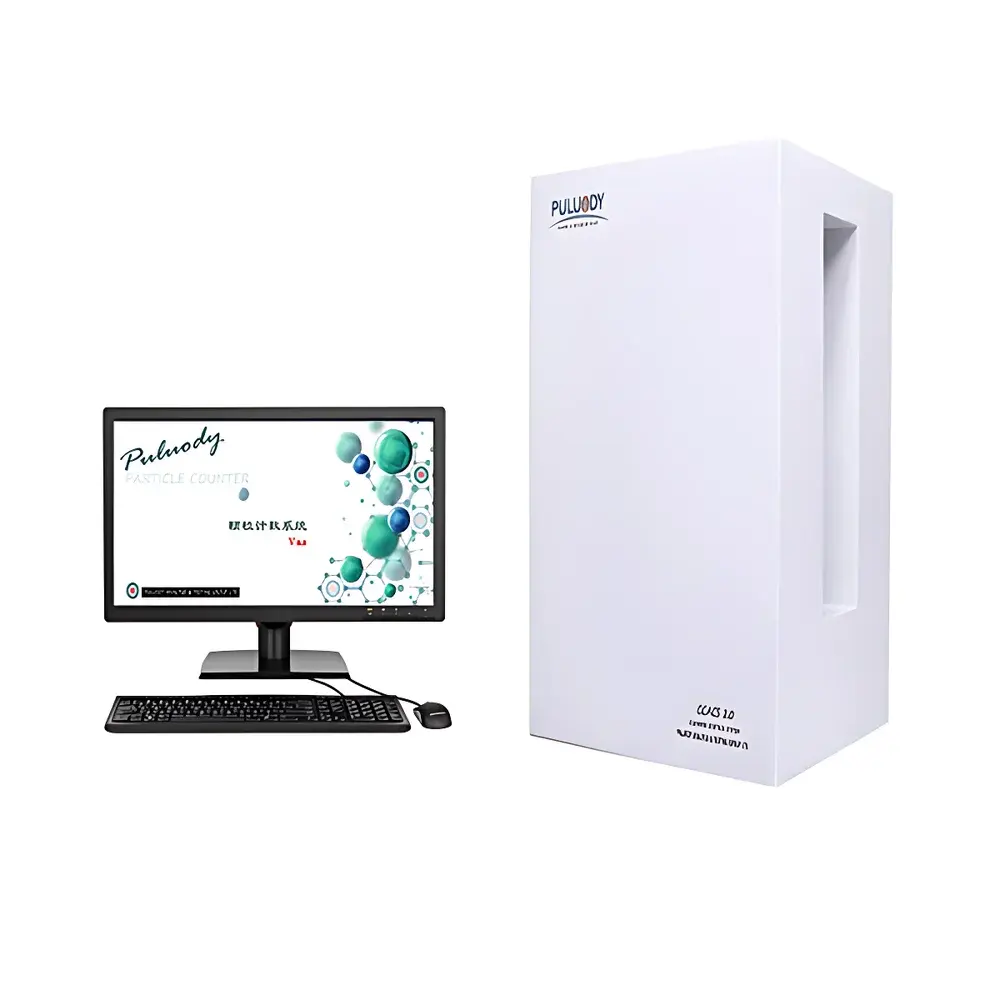
PULUODY PSD-250C Electronic-Grade Liquid Cleanliness Control System
| Brand | PULUODY |
|---|---|
| Origin | Shaanxi, China |
| Manufacturer Type | Authorized Distributor |
| Country of Origin | China |
| Model | PSD-250C |
| Price | USD 1,700 (est.) |
| Particle Detection Range | 0.05–10 µm |
| Sample Throughput Capacity | 1,000 configurable size channels |
| Flow Rate | 5–1500 mL/min |
| Flow Accuracy | < ±1% |
| Sample Volume Handling | 100 mL – 100 L |
| Viscosity Range | 0–99 cSt (offline), up to 500 cSt (pressurized) |
| Fluid Temperature Range | 0–80 °C |
| Ambient Operating Temperature | −15–50 °C |
| Detection Principle | Dual-Laser Obstruction (Light Blockage) |
| Sensor Generation | 8th-Generation Dual-Narrow-Beam Laser Particle Sensor |
| Calibration Standards | GBW Reference Materials, CN-PSL, CN-ISO, CN-NIST Traceable |
| Compliance | ISO 11171, ISO 4406, ASTM D7619, USP <788>, JIS B 9921, SEMI F39, IEC 60404-16 |
| Output Interfaces | RS232 / RS485 (MODBUS RTU), USB, LAN, 4–20 mA analog |
| Software Platform | CCACS 2.0 Integrated Analysis Suite |
| Control Architecture | Industrial PC or Embedded IPC with Military-Grade HMI |
| Display | Color LCD Touchscreen + Keyboard/Mouse Support |
| Reporting | Particles/mL + ISO 4406 / NAS 1638 / SAE AS4059 / GJB 420B Class Codes |
Overview
The PULUODY PSD-250C Electronic-Grade Liquid Cleanliness Control System is an integrated, programmable platform engineered for real-time particulate contamination management in ultra-high-purity liquid process streams. It operates on the principle of dual-laser light obstruction (also known as optical blockage or single-particle optical sensing), where particles suspended in a laminar-flow liquid stream interrupt coherent laser beams, generating pulse signals proportional to particle cross-sectional area. The system combines fluid conditioning, multi-stage filtration, closed-loop recirculation, and high-resolution particle counting into a unified architecture—designed specifically for semiconductor fabrication chemicals, photoresists, ultrapure water (UPW), battery electrolytes, and advanced packaging materials. Unlike conventional offline particle counters, the PSD-250C supports both inline monitoring and automated cleaning validation workflows, enabling continuous cleanliness assurance aligned with SEMI F39, ISO 14644-1 Class 1–5 environments, and ICH Q5A/Q5D bioburden control expectations.
Key Features
- 8th-generation dual-narrow-beam laser sensor with independent wavelength alignment—optimized for refractive index stability across aqueous, organic, and polar aprotic solvents
- Configurable particle sizing matrix: 1,000 discrete detection channels; user-selectable binning (4–128 bins) covering 0.05 µm to 10 µm per ISO 21501-4 and USP requirements
- Integrated triple-stage filtration module: pre-filter (5 µm stainless mesh), precision membrane filter (0.1 µm PTFE), and final polishing stage (0.02 µm ceramic depth filter)
- Programmable recirculation loop with PID-controlled flow regulation (5–1500 mL/min), pressure-compensated volumetric dosing, and temperature-stabilized sample path (0–80 °C)
- Military-grade industrial PC controller compliant with IEC 61000-4 EMC standards; equipped with redundant watchdog timers and non-volatile parameter retention
- Full traceability stack: embedded audit trail per FDA 21 CFR Part 11 Annex 11 guidelines; electronic signatures, version-controlled method storage, and time-stamped calibration logs
Sample Compatibility & Compliance
The PSD-250C accommodates a broad spectrum of low-to-moderate viscosity liquids including deionized water, hydrogen peroxide solutions, TMAH developers, PGMEA photoresist solvents, LiPF6 electrolyte blends, and fluorinated etchants. Its wetted path employs electropolished 316L SS, PFA-lined tubing, and chemically inert ceramic flow cells—validated for compatibility with pH 1–14 and halogenated media. Regulatory alignment includes full support for ISO 4406:2017 (fluid cleanliness codes), ASTM D7619 (semiconductor process chemical purity), SEMI F39-1117 (microcontamination limits for photoresists), and USP (subvisible particle testing for parenterals). Calibration traceability is maintained via NIST-traceable CN-PSL polystyrene latex standards and GBW national reference materials, with annual metrological verification supported by Xi’an Special Metrology & Testing Institute (XSTM).
Software & Data Management
CCACS 2.0 is a modular, Windows-based analysis platform certified for GLP/GMP environments. It integrates seven functional modules: Pre-Filter Logic, Precision Filtration Sequencing, Final Rinse Validation, Real-Time Counting Engine, Curve-Fitting Algorithm (based on Rosin-Rammler distribution modeling), Pass/Fail Threshold Engine (configurable per ISO 11171 acceptance criteria), and Automated Report Generator (PDF/CSV/XML export with digital signature). All data—including raw pulse histograms, flow transients, temperature drift compensation logs, and sensor health diagnostics—are stored in encrypted SQLite databases with SHA-256 hashing. Remote access is enabled via secure HTTPS API endpoints compatible with MES/SCADA integration (OPC UA, MODBUS TCP).
Applications
- Validation of chemical dispensing lines prior to wafer exposure in 300 mm fabs
- In-process monitoring of UPW recirculation loops in cleanroom sub-fab distribution networks
- Batch release testing of photoresist formulations per JEDEC JESD22-A107 and SEMI C12
- Cleanliness qualification of lithium-ion battery electrolyte fill lines under ISO 14644-1 Class 4
- Post-cleaning verification of MEMS device carriers and reticle storage cassettes
- Qualification of solvent recovery systems in advanced packaging facilities
FAQ
Does the PSD-250C support automated calibration verification?
Yes—integrated calibration check routines execute before each test sequence using onboard PSL reference suspension, with deviation alerts triggered if signal amplitude falls outside ±2.5% of baseline.
Can the system operate in hazardous area environments?
Not intrinsically safe by default; however, explosion-proof enclosures (ATEX Zone 2 / Class I Div 2) are available as optional configurations upon request.
Is remote firmware update capability included?
Yes—secure OTA updates are delivered via signed package files over TLS 1.2, requiring dual-factor authentication and rollback safeguards.
What is the minimum detectable particle concentration?
At 0.1 µm threshold, the lower limit of quantitation (LoQ) is 10 particles/mL with ≤15% RSD at 95% confidence, validated per ISO 21501-4 Annex B.
How does the system handle air bubble interference?
Dual-sensor coincidence logic rejects transient events uncorrelated between primary and secondary beam paths; additional ultrasonic degassing module (optional) reduces dissolved gas nucleation by >92%.



