
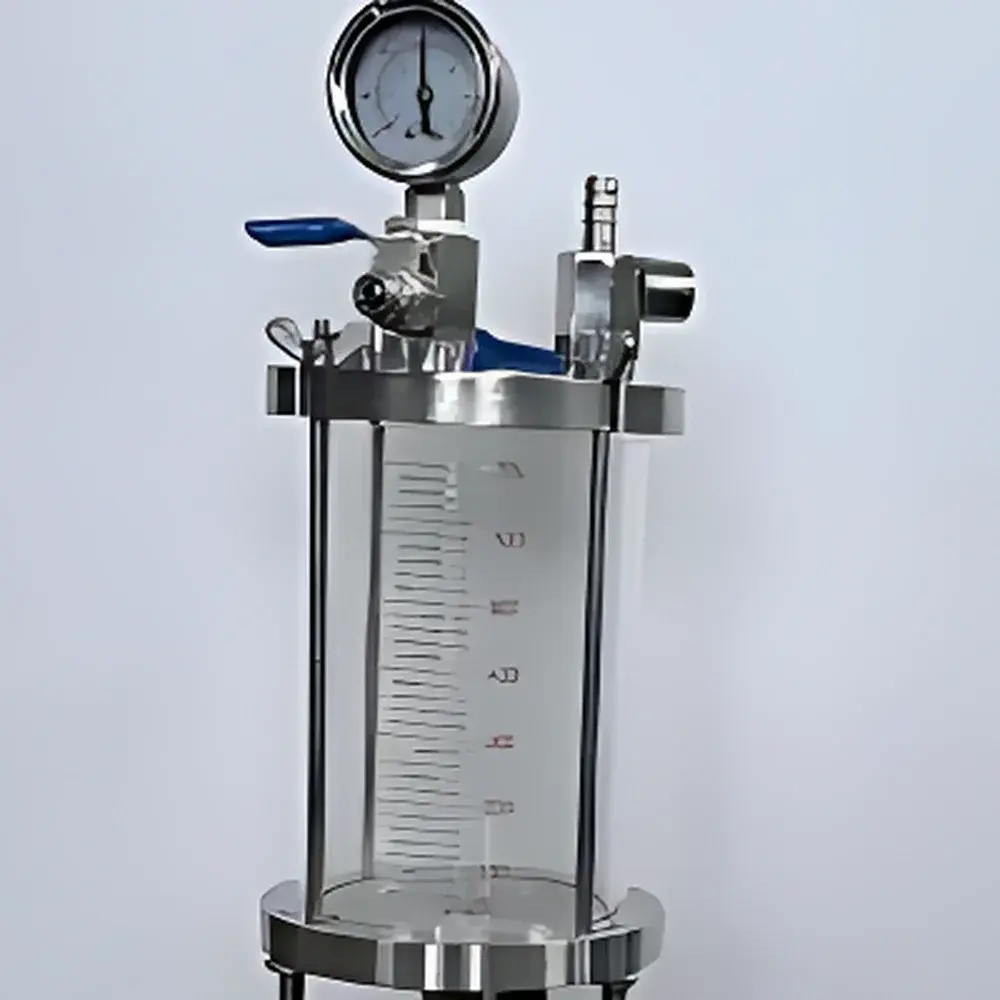
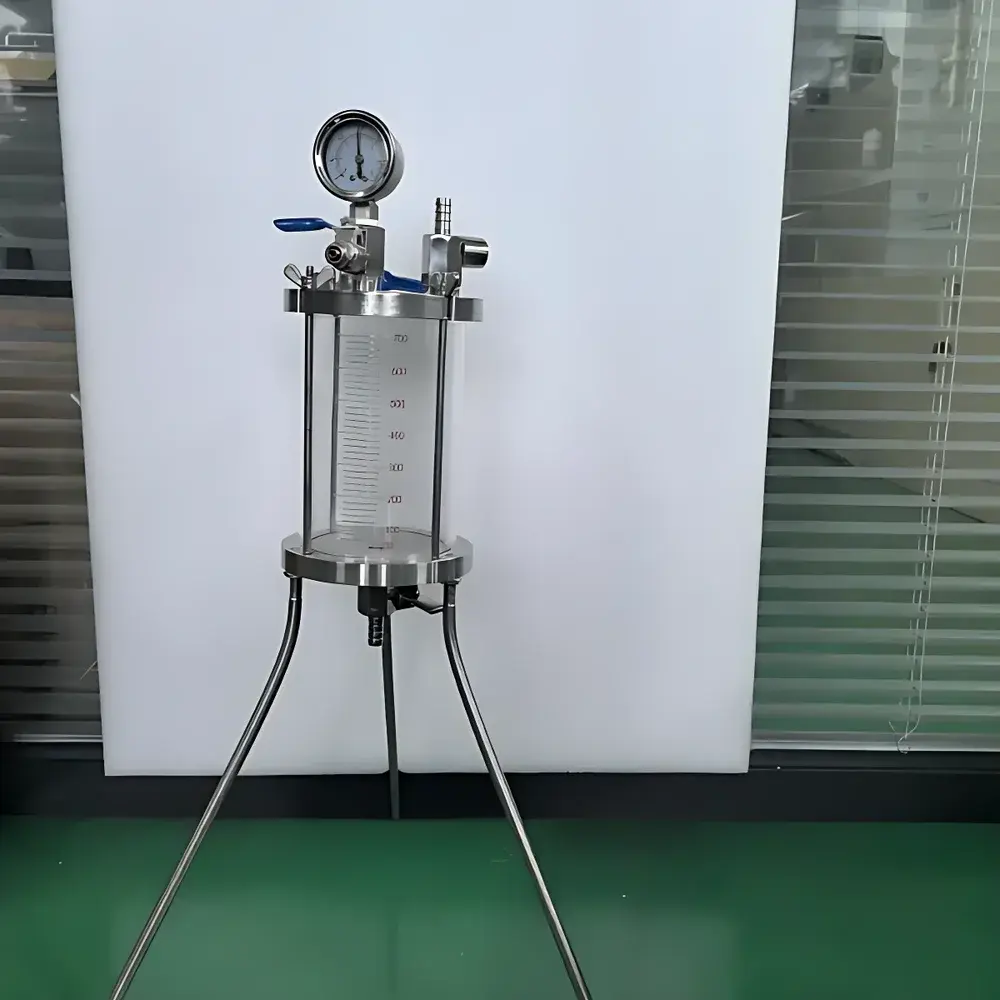
PULUODY PSD-351B Microfiltration Membrane Filtration Tester
| Brand | PULUODY |
|---|---|
| Origin | Shaanxi, China |
| Manufacturer Type | Direct Manufacturer |
| Product Category | Domestic Instrument |
| Model | PSD-351B Microfiltration Membrane Filtration Tester |
| Price | USD 1,600 (approx.) |
| Applicable Standards | SY/T 5329–2012, GB 11901–1989, GB/T 606–2003, GB/T 11133–2015, GB 7600–2008 |
| Gas Source | Nitrogen (user-supplied or optional integrated regulator) |
| Filter Diameter | φ43 mm |
| Sample Volume Capacity | 3500 mL |
| Dimensions (W×D×H) | ≤500 × 500 × 800 mm |
| Construction Materials | Borosilicate organic glass, 316 stainless steel, and corrosion-resistant polymer components |
| Temperature Monitoring | Digital electronic thermometer (±0.5 °C accuracy) |
| Timing Method | Precision digital stopwatch (0.01 s resolution) |
| Pressure Control | Adjustable inlet pressure regulator with dual-stage precision gauge (0–1.0 MPa range) |
| Filtration System | Integrated bubble-venting filter housing with standardized membrane support and sealing mechanism |
| Drain/Exhaust Valves | Stainless steel needle valves with calibrated flow restriction |
| Compliance | Designed for GLP-compliant suspended solids quantification in environmental and petroleum water quality labs |
Overview
The PULUODY PSD-351B Microfiltration Membrane Filtration Tester is a precision-engineered laboratory instrument designed to quantify suspended solids (SS) in aqueous samples via gravimetric membrane filtration—fully aligned with ISO/IEC 17025 traceability principles and standardized methodologies including SY/T 5329–2012 (Recommended Water Quality Indicators for Clastic Reservoir Water Injection), GB 11901–1989 (Water Quality — Determination of Suspended Solids by Gravimetric Method), and ASTM D5907–22 (Standard Test Methods for Total Dissolved Solids and Total Suspended Solids in Water). The system operates on the principle of controlled-pressure cross-flow filtration through a defined-area polymeric microfiltration membrane (φ43 mm), enabling reproducible separation of particulate matter ≥0.45 µm (or user-specified pore size). Filtrate volume is collected and measured volumetrically, while retained solids are dried at 103–105 °C per GB 11901–1989, cooled in a desiccator, and weighed on an analytical balance (0.1 mg resolution) to compute SS concentration (mg/L). Its modular architecture integrates pressure regulation, temperature-compensated timing, real-time visual process monitoring, and inert gas compatibility—making it suitable for volatile, corrosive, or oxygen-sensitive matrices common in oilfield injection water, municipal effluent, and industrial wastewater analysis.
Key Features
- Modular pressure-driven filtration platform with nitrogen-compatible inlet regulation (0–1.0 MPa, ±0.02 MPa repeatability)
- Dual-material construction: borosilicate organic glass for optical clarity and 316 stainless steel for wetted parts ensures long-term chemical resistance against H₂S, chlorides, and organic solvents
- Integrated bubble-venting filtration chamber minimizes air entrapment artifacts during membrane wetting—critical for accurate flux calculation and reduced filtration time variability
- Digital electronic thermometer (range: 0–50 °C; resolution: 0.1 °C) and high-precision stopwatch (0.01 s) support temperature-corrected filtration rate reporting per SY/T 5329–2012 Annex B
- Standardized φ43 mm membrane support geometry ensures interchangeability with certified filters from Sartorius, Pall, and Whatman—facilitating method validation across laboratories
- Compact footprint (≤500 × 500 × 800 mm) and tool-free filter housing assembly enable rapid setup, cleaning, and maintenance in regulated QC environments
Sample Compatibility & Compliance
The PSD-351B is validated for use with surface water, groundwater, domestic sewage, industrial wastewater, and produced water from oilfields—particularly where turbidity, iron sulfide precipitates, or polymer-laden injection streams require rigorous SS quantification. It complies with regulatory frameworks governing water reinjection integrity, including China’s SY/T 5329–2012 (mandatory for clastic reservoir operators) and GB 11901–1989 (national standard for environmental monitoring). When operated within documented SOPs—including pre-rinse protocols, blank correction, and desiccation control—it supports data generation acceptable for GLP audits and internal QA/QC programs. All wetted materials meet USP Class VI biocompatibility requirements, and the system can be adapted for EPA Method 160.2 (Total Suspended Solids) with minor procedural adjustments.
Software & Data Management
While the PSD-351B operates as a manual benchtop instrument without embedded software, its design facilitates full digital integration into LIMS and ELN ecosystems. Users may log filtration parameters—including applied pressure, elapsed time, ambient temperature, filtrate volume, and final dry weight—into structured CSV or Excel templates compliant with 21 CFR Part 11 when paired with electronic balances and digital thermometers featuring audit-trail output. PULUODY provides a comprehensive Standard Operating Procedure (SOP) package, calibration verification checklists, and raw data recording forms aligned with ISO/IEC 17025 Clause 7.5 (Technical Records) and CNAS-CL01:2018 requirements. Optional accessories include a certified pressure transducer module (0–1.0 MPa, NIST-traceable) and a USB-connected digital timer with exportable timestamped logs.
Applications
- Quantitative suspended solids assessment in upstream oilfield water injection systems per SY/T 5329–2012 specifications
- Environmental compliance testing for municipal wastewater discharge permits (e.g., COD, BOD, and SS limits under China’s GB 8978–1996)
- Process validation of coagulation-flocculation and media filtration units in drinking water treatment plants
- Quality control of reverse osmosis feedwater and ultrafiltration pre-treatment streams
- Research-grade particulate characterization in sediment transport studies and colloidal stability experiments
- Verification of filter integrity and pore-size distribution in membrane manufacturing R&D
FAQ
What filtration membranes are compatible with the PSD-351B?
The instrument accepts all standard φ43 mm circular microfiltration membranes—including mixed cellulose ester (MCE), polyethersulfone (PES), nylon, and polyvinylidene fluoride (PVDF)—with nominal pore sizes ranging from 0.1 µm to 5.0 µm.
Is nitrogen gas supply mandatory?
Nitrogen is recommended for inert atmosphere filtration of oxidizable samples (e.g., Fe²⁺-rich produced water), but compressed air or zero-air may be used for non-reactive matrices if oil-free and particle-filtered.
Can the system be used for total dissolved solids (TDS) measurement?
No—the PSD-351B is strictly configured for suspended solids quantification via membrane retention; TDS requires evaporation-based gravimetry per GB/T 5750.4–2023 or conductivity correlation methods.
How often should the pressure regulator and gauges be calibrated?
Per ISO/IEC 17025, pressure instrumentation must be calibrated annually against NIST-traceable standards—or before each critical test series if drift exceeds ±0.02 MPa.
Does the unit include membrane drying and weighing accessories?
No—the PSD-351B delivers filtered membranes only; users must provide a Class I analytical balance (0.1 mg resolution), desiccator, and oven capable of stable 103–105 °C operation per GB 11901–1989.






