
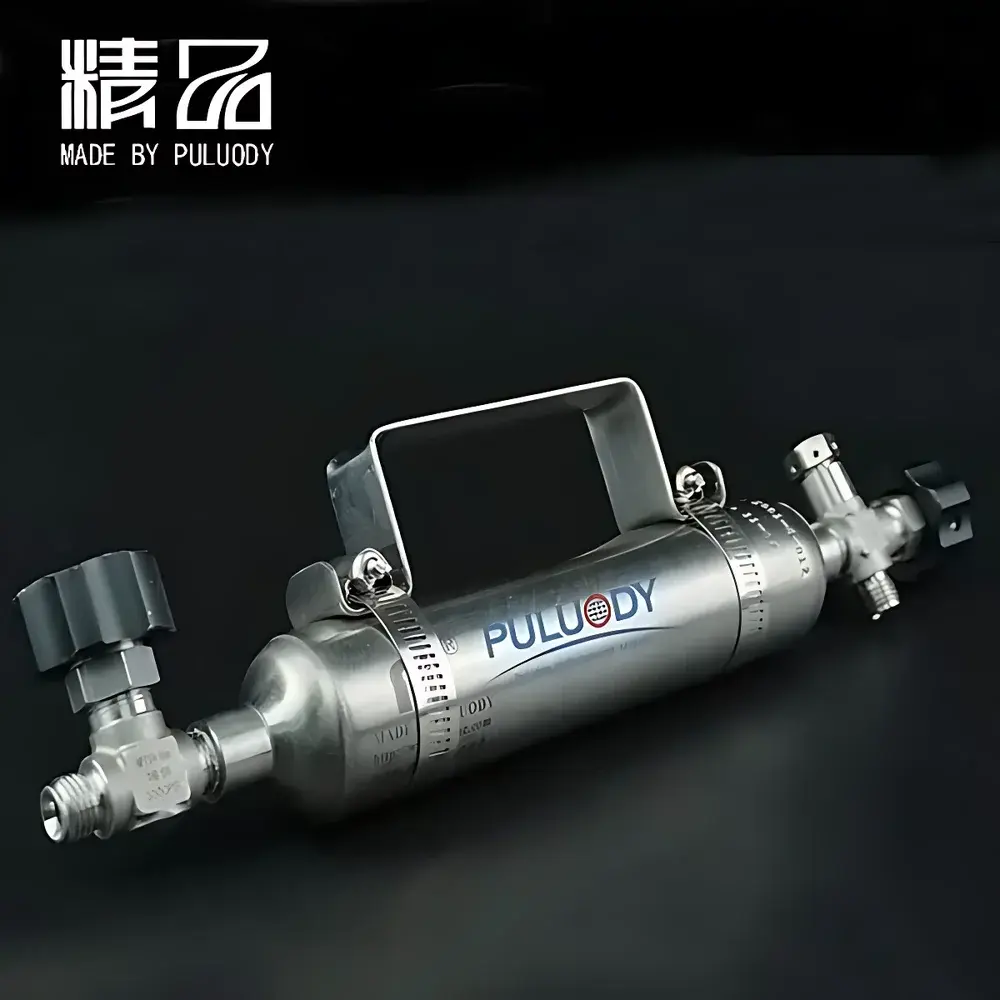
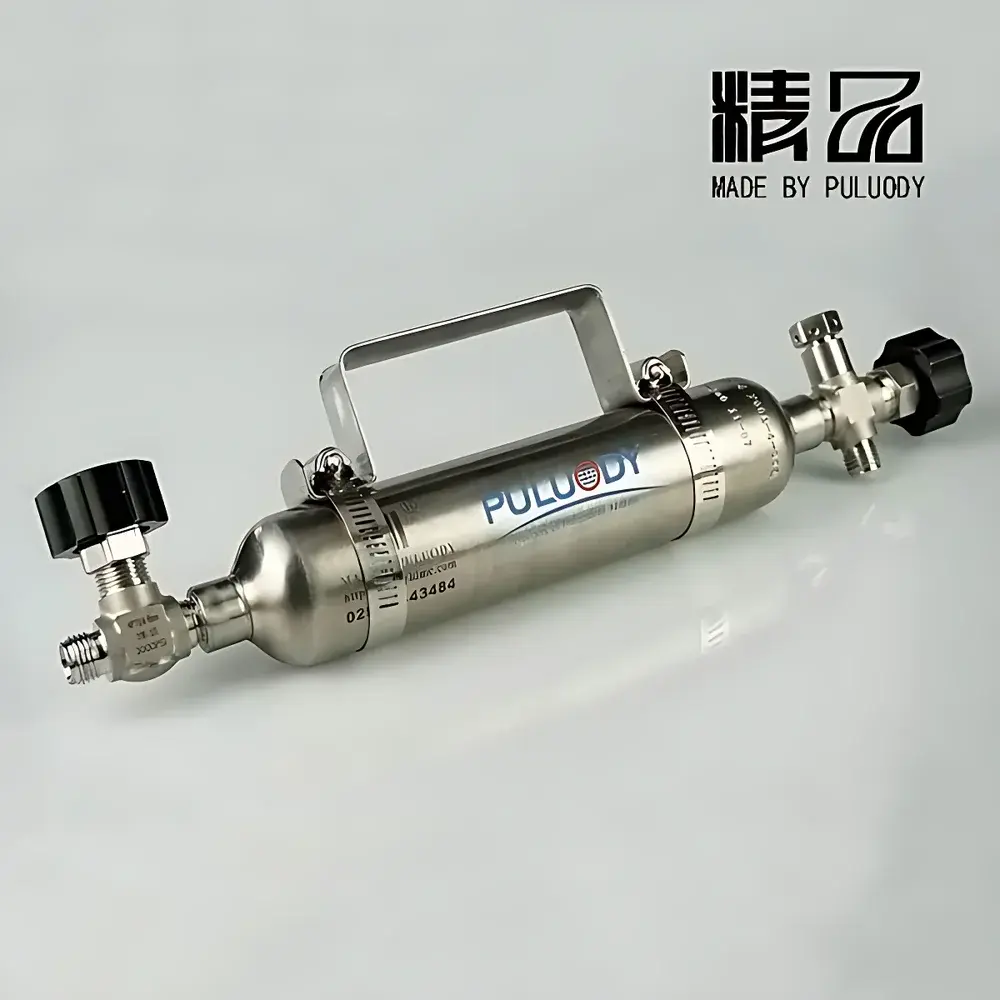
PULUODY PULL-GP20-300 Cryogenic Liquid Oxygen Sampling Cylinder
| Brand | PULUODY |
|---|---|
| Origin | Shaanxi, China |
| Model | PULL-GP20-300 |
| Instrument Type | Single-Channel Cryogenic Gas/Liquid Sampler |
| Flow Range | 0–20 L/min |
| Maximum Operating Pressure | 4–20 MPa |
| Flow Stability | ≤5% over 1 h |
| Flowmeter Accuracy | ≥±2.5% FS |
| Service Life at Max Flow & Backpressure | ≥5000 h |
| Continuous Operation Duration at Max Flow & Backpressure | 8 h |
| Construction Material | ASTM A240 316L Stainless Steel |
| Operating Temperature Range | –190 °C to +80 °C |
| Volumetric Capacity Options | 100 mL to 5000 mL |
| Compliance | SH/T 0233–1992 (Liquefied Petroleum Gas Sampling Method) |
Overview
The PULUODY PULL-GP20-300 Cryogenic Liquid Oxygen Sampling Cylinder is an engineered solution for the safe, precise, and contamination-controlled collection, storage, and transport of cryogenic liquefied gases—including liquid oxygen (LOX), liquid hydrogen (LH₂), liquid argon (LAr), and other low-boiling-point media operating below –150 °C. Designed in accordance with SH/T 0233–1992—a Chinese standard aligned with core principles of ISO 8573-1 (compressed air purity) and ASTM D1265 (sampling of liquefied petroleum gases)—this cylinder employs a monolithic, seamless 316L stainless steel construction formed via cold forward extrusion and deep-draw spin-forming. This manufacturing process eliminates weld seams, minimizes surface grain boundary exposure, and ensures structural integrity under cyclic thermal shock and high-pressure differential conditions. The cylinder integrates a cryo-rated needle valve with metal-to-metal sealing (Inconel 718 seat and stem), a pressure-relief burst disc compliant with ISO 4126-2, and optional calibrated analog pressure gauges traceable to NIST standards. Its operational envelope spans –190 °C to +80 °C, enabling direct sampling from dewars, cryogenic transfer lines, or vapor-phase headers without phase transition-induced adsorption artifacts.
Key Features
- Monolithic 316L stainless steel body manufactured via single-stage cold spin-forming—no longitudinal or circumferential welds, eliminating potential leak paths and micro-crevices that trap reactive species.
- Cryogenically rated needle valve with helium-leak-tested metal seals (≤1×10⁻⁹ mbar·L/s), capable of stable flow control down to 0.1 L/min at –183 °C (LOX boiling point).
- Integrated pressure relief system featuring ASME-certified rupture disc (set point adjustable between 22–25 MPa), mounted upstream of the primary isolation valve for fail-safe overpressure protection.
- Optional internal electropolished passivation (per ASTM A967) or custom silane-based anti-adsorption coating (e.g., SilcoNert® 2000) to minimize trace-level analyte loss (e.g., NOₓ, H₂S, CO) during extended hold times.
- Ergonomic die-cast stainless steel handle with non-slip knurling and integrated strain relief for hose connections—designed for glove-compatible operation in Class 100 cleanrooms or industrial cryo bays.
- Modular interface support: Standard CGA-580 (LOX) and CGA-590 (LAr) inlet/outlet ports; optional push-to-connect fittings (Swagelok SS-400 series) and fluoropolymer-lined PTFE/PFA hoses (–200 °C to +260 °C).
Sample Compatibility & Compliance
The PULL-GP20-300 is validated for use with liquefied gases and vapors chemically compatible with 316L stainless steel—including O₂, H₂, Ar, N₂, CH₄, and CO. It is not intended for halogenated compounds (e.g., Cl₂, F₂), strong oxidizers beyond LOX (e.g., liquid fluorine), or highly corrosive mixtures containing HCl/HF. All units undergo hydrostatic testing at 1.5× maximum allowable working pressure (MAWP) and pneumatic leak testing per ISO 15848-1 (fugitive emission limits). Documentation includes material test reports (MTRs) per EN 10204 3.1, heat treatment records, and calibration certificates for optional pressure instrumentation. The design supports GLP-compliant workflows: traceable serial numbering, permanent laser-engraved lot codes, and compatibility with electronic audit trails when paired with digital flow controllers (e.g., Brooks Instrument SLA Series).
Software & Data Management
While the base PULL-GP20-300 is a passive mechanical sampling device, it is fully interoperable with industry-standard digital acquisition systems. When configured with optional smart pressure transducers (e.g., Keller PA-23Y, 0–25 MPa, ±0.1% FS) or mass flow meters (e.g., Alicat GFC Series), data streams integrate seamlessly into LabArchives ELN, DeltaV DCS, or custom SCADA platforms via Modbus RTU or 4–20 mA analog output. All optional electronic components comply with IEC 61508 SIL2 functional safety requirements and support FDA 21 CFR Part 11-compliant electronic signatures when deployed in regulated QC/QA laboratories. Audit logs capture timestamped valve actuation events, pressure decay profiles, and thermal soak cycles—enabling full chain-of-custody documentation per ISO/IEC 17025:2017 Clause 7.8.
Applications
- Quality assurance sampling of bulk LOX delivered to semiconductor fabrication facilities (SEMI F57 compliance for oxygen purity ≥99.9995%).
- Process validation of cryogenic distillation columns in air separation units (ASUs), supporting ASTM D1946 analysis of hydrocarbon impurities.
- Reference gas preparation for FTIR and GC-MS calibration standards where adsorptive losses must be <0.5% over 72 h at –183 °C.
- Field deployment in LNG terminals for compositional verification prior to regasification—compatible with ISO 8573-6 moisture and hydrocarbon dew point measurement protocols.
- Research-grade sampling in low-temperature physics labs requiring ultra-high-purity H₂ handling (<1 ppb O₂ equivalent) for superconductivity experiments.
FAQ
What is the maximum allowable fill level for liquid oxygen in this cylinder?
Per CGA P-1 and ISO 11119-2, the maximum fill ratio is 0.92 by volume at –183 °C to accommodate thermal expansion; overfilling risks disc activation or valve ejection.
Can the cylinder be used for repeated thermal cycling between ambient and cryogenic temperatures?
Yes—validated for ≥10,000 thermal cycles (–190 °C ↔ +25 °C) with no measurable fatigue or seal degradation, per ASTM E2929 accelerated life testing.
Is third-party certification available for hazardous materials transport?
Each unit carries a UN 2037 marking and is certified to DOT-SP 15519 / ADR 6.2.2.8.1 for road/rail transport of non-pressurized cryogenic liquids when equipped with approved valve caps and thermal insulation sleeves.
How is internal surface cleanliness verified prior to delivery?
All cylinders undergo ultrasonic cleaning in ASTM D4169-compliant solvents, followed by particle count verification (≥99.99% removal of ≥5 µm particles) and residual hydrocarbon assay via GC-FID (limit: <10 ng/cm²).
Does PULUODY provide calibration services for optional pressure instrumentation?
Yes—accredited calibration (ISO/IEC 17025:2017) is offered for all optional gauges and transducers, with certificates traceable to NPL (UK) or NIM (China) national standards.
Related Products







