
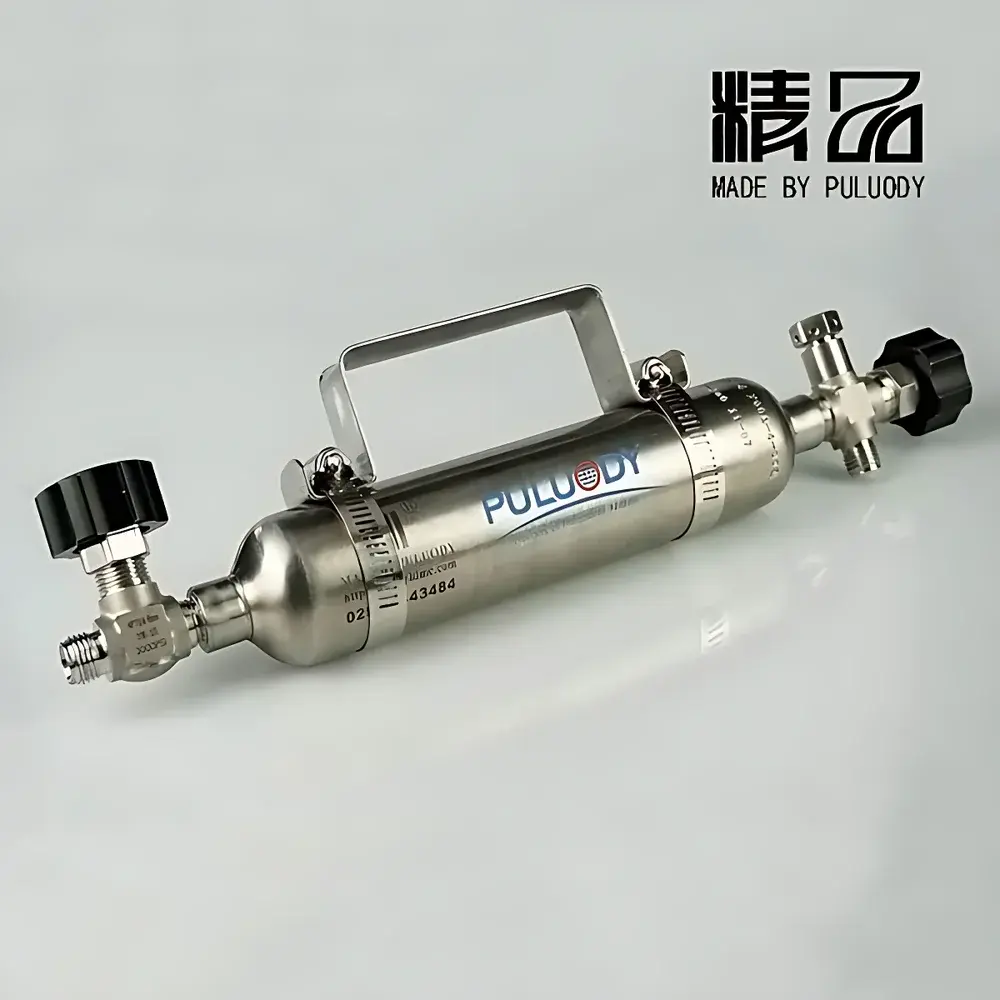
PULUODY PULL-GP20-500 Cryogenic Liquid Nitrogen Sampling Cylinder
| Brand | PULUODY |
|---|---|
| Origin | Shaanxi, China |
| Manufacturer Type | Authorized Distributor |
| Country of Origin | China |
| Model | PULL-GP20-500 |
| Instrument Type | General-Purpose Gas Sampler |
| Configuration | Single-Channel Sampling System |
| Flow Rate Range | 0–0.5 L/min |
| Maximum Suction Pressure | 0–20 MPa |
| Flow Stability | ≤ ±5% |
| Flowmeter Accuracy | ≥ ±2.5% |
| Service Life at Max Flow & Backpressure | ≥ 5000 h |
| Drift Under Rated Load | ≤ ±5% |
| Material | 1Cr18Ni9Ti Stainless Steel (AISI 321 Equivalent) |
| Design Pressure | 20 MPa |
| Hydrostatic Test Pressure | 35 MPa |
| Operating Temperature Range | –60 °C to +80 °C |
| Available Volumes | 25 mL to 10,000 mL |
| Compliance | SH/T 0233, SY/T 1045 |
Overview
The PULUODY PULL-GP20-500 Cryogenic Liquid Nitrogen Sampling Cylinder is a high-integrity, pressure-rated sampling vessel engineered for the safe, representative, and contamination-controlled collection, containment, and transport of cryogenic and pressurized gaseous and liquefied samples—including liquid nitrogen (LN₂), ethylene, propylene, butadiene, LPG, natural gas, and other hydrocarbon or inert gases operating under similar thermodynamic conditions. Constructed from 1Cr18Ni9Ti stainless steel—an austenitic grade equivalent to AISI 321—the cylinder delivers superior resistance to intergranular corrosion, thermal fatigue, and embrittlement at low temperatures. Its design pressure of 20 MPa (2900 psi) and hydrostatic test pressure of 35 MPa ensure structural reliability in demanding field and laboratory environments. Unlike ambient-pressure sampling containers, the PULL-GP20-500 maintains sample phase integrity by preserving both vapor and liquid equilibrium states during transfer—a critical requirement for compositional analysis, calorimetric testing, and purity verification per ASTM D1265, ISO 4257, and ISO 8573-5.
Key Features
- Full-cryogenic compatibility with sustained operation from –60 °C to +80 °C, validated per ASME BPVC Section VIII Div. 1 and EN 13445-3
- Double low-temperature valves (inlet and outlet) fabricated from cryo-grade stainless steel with metal-to-metal sealing surfaces to prevent leakage and frost lock at sub-ambient conditions
- Integrated pressure relief system featuring a certified rupture disc (burst pressure calibrated to 110% of design pressure) compliant with PED 2014/68/EU Annex I, Essential Safety Requirement 2.2
- Optional internal electropolished or fluoropolymer-lined surface finish (e.g., PFA or ETFE) to minimize adsorption of trace analytes—critical for ultra-low sulfur, oxygen, or moisture speciation in LN₂ or semiconductor-grade gases
- Ergonomic, stainless-steel die-cast handle conforming to ISO 11612 for operator safety during handling under cold or pressurized conditions
- Modular interface support: Standard CGA 346 (for N₂/LN₂) and optional CGA 330, CGA 532, or DIN 477-1 connections; compatible with push-to-connect fittings (e.g., Swagelok® SS-400 series) and reinforced PTFE/PFA-lined hoses
Sample Compatibility & Compliance
The PULL-GP20-500 meets the procedural and material requirements of SH/T 0233 (“Standard Test Method for Sampling Liquefied Petroleum Gases”) and SY/T 1045 (“Specification for Sampling Equipment Used in Offshore Oil & Gas Operations”). It is routinely deployed in upstream, midstream, and refining applications where adherence to API RP 14B, ISO 10423, and ISO 20823 is mandated. For regulated laboratories, the cylinder supports GLP-compliant workflows when used with traceable calibration records (NIST-traceable pressure transducers, certified flowmeters), audit-ready documentation, and full chain-of-custody logging. Optional configuration with dual-port valving and a calibrated volume tube (±0.5% tolerance) enables gravimetric and volumetric sampling per USP and ISO 10723:2022 Annex C.
Software & Data Management
While the PULL-GP20-500 is a passive mechanical sampling device, its integration into digital QA/QC systems is facilitated via standardized mounting interfaces and compatibility with third-party instrumentation. When paired with PULUODY’s optional digital pressure logger (model PL-DPL2000), real-time pressure, temperature, and time-stamped event data are recorded in CSV or XML format, supporting 21 CFR Part 11–compliant electronic signatures and audit trails. All accessories—including calibrated flow controllers, dew-point sensors, and residual gas analyzers—are supplied with CoA (Certificate of Analysis) and CoC (Certificate of Conformance) aligned with ISO/IEC 17025:2017 accreditation criteria.
Applications
- Cryogenic fluid sampling in air separation units (ASUs) and LNG terminals
- Compositional analysis of ethylene cracker off-gas and polymer-grade feedstocks
- Trace impurity monitoring (H₂O, O₂, CO, CO₂, hydrocarbons) in electronic-grade nitrogen per SEMI F57
- Calibration gas preparation for FTIR, GC-TCD, and laser absorption analyzers
- Field sampling of sour gas (H₂S-containing streams) with optional H₂S-resistant valve seals
- Transport and storage of reference standards for environmental emissions monitoring (EPA Method 18, ISO 12039)
FAQ
What is the maximum allowable working pressure (MAWP) for the PULL-GP20-500?
The MAWP is 20 MPa at 20 °C, with full derating applied per ASME B31.4 and ISO 13623 for elevated or cryogenic service temperatures.
Can this cylinder be used for liquid oxygen (LOX) sampling?
Yes—provided it undergoes dedicated oxygen cleaning per CGA G-4.1 and is equipped with LOX-compatible valve internals (e.g., Monel seats and PTFE-free stem packing).
Is the 1Cr18Ni9Ti material suitable for hydrogen service?
It is conditionally acceptable for low-pressure, low-cycle hydrogen service (<10 MPa, 15 MPa), consultation with a materials engineer regarding susceptibility to hydrogen embrittlement is recommended.
Does the cylinder include a pressure gauge as standard equipment?
No—a pressure gauge is an optional accessory; the base configuration includes only dual cryo-valves and handle. Analog or digital gauges (0–25 MPa range, Class 1.0 accuracy) may be added upon request.
How often does the rupture disc require replacement?
Rupture discs are single-use, non-reusable components. They must be replaced after actuation or at intervals not exceeding five years, whichever occurs first, in accordance with PED 2014/68/EU Article 13 and manufacturer’s service bulletin SB-PULL-GP20-01.







