
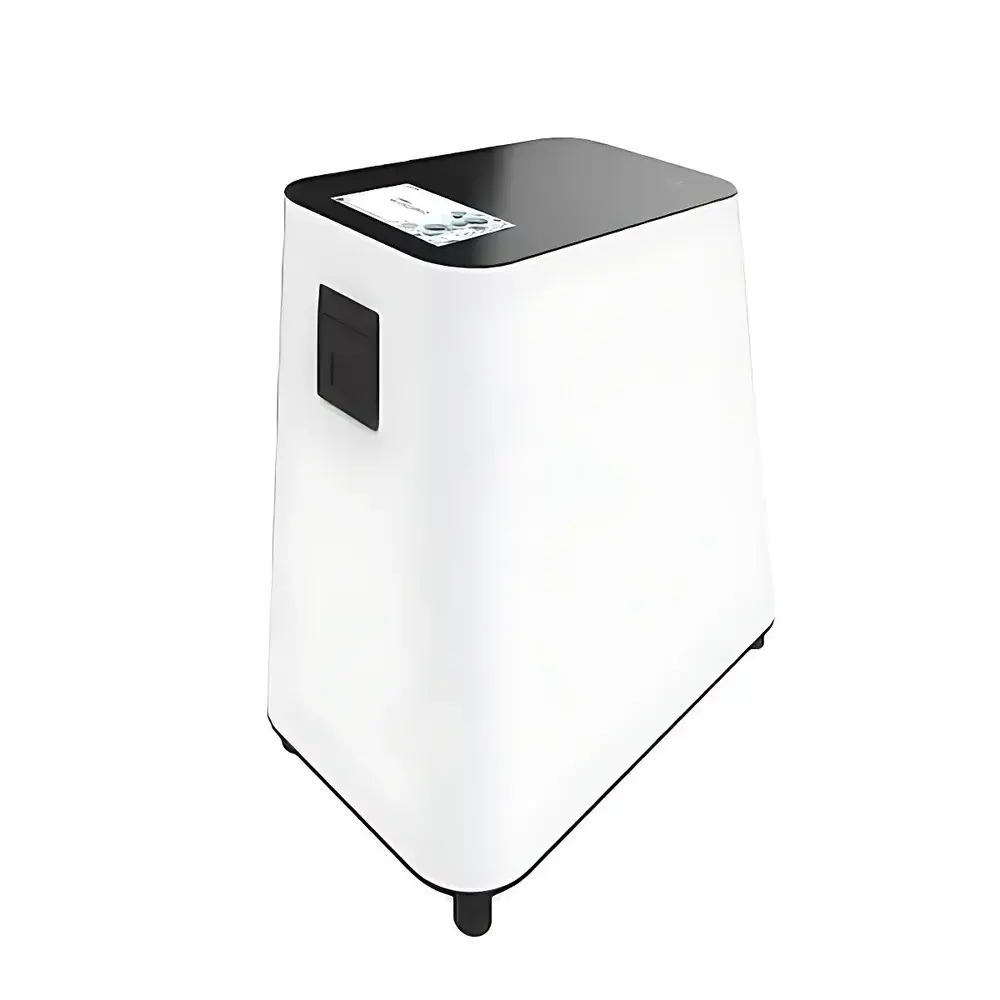
PULUODY TQ-01A Membrane-Based Deaeration System for Purified Water
| Brand | PULUODY |
|---|---|
| Model | TQ-01A |
| Application | Pharmaceutical Dissolution Media Deaeration |
| Display | High-Resolution Touchscreen LCD |
| Heating Range | 35–42 °C (adjustable to non-heating mode) |
| Volume Accuracy | ±1% (for set volumes ≥2 L) |
| Dispensing Resolution | 0.1 L |
| Flow Rate | 1.6 L/min |
| Dimensions (L×H×W) | 500 mm × 340 mm × 295 mm |
| Rated Power | 1700 W |
| Temperature Control Accuracy | ±2 °C |
| Residual Dissolved Oxygen | 3.0–5.0 mg/L (upgradable to <2.8 mg/L) |
| Minimum Inlet Medium Temperature | ≥18 °C |
| Pre-Filter Options | 40 µm / 25 µm / 20 µm Stainless Steel Mesh |
| Compatible Media | Purified water, distilled water (pH 1–14, surfactant-free) |
Overview
The PULUODY TQ-01A Membrane-Based Deaeration System is an engineered solution designed specifically for the pharmaceutical dissolution testing environment. It employs hydrophobic microporous membrane technology to selectively remove dissolved oxygen and other non-condensable gases from purified and distilled water—critical solvents used in USP Apparatus 1 (basket) and Apparatus 2 (paddle) dissolution studies. Unlike vacuum or sonication-based methods, membrane deaeration operates under ambient pressure and avoids cavitation-induced degradation of sensitive media or risk of volatile compound loss. The system integrates inline pre-heating prior to membrane contact, enabling thermodynamically favorable gas desorption while minimizing thermal lag during subsequent transfer to dissolution vessels. This architecture ensures consistent media conditioning—meeting compendial expectations for dissolved oxygen control as referenced in USP <711>, EP 2.9.43, and JP 17 General Test for Dissolution.
Key Features
- Integrated touchscreen interface with intuitive workflow navigation—designed for single-operator operation without auxiliary training.
- Pre-heating module (35–42 °C, field-selectable or disabled) enhances gas solubility differential across the membrane surface, improving deaeration kinetics and reducing total processing time per batch.
- Volumetric dispensing accuracy of ±1% (validated for volumes ≥2 L), with 0.1 L resolution—enabling precise replication of dissolution medium preparation protocols across multiple test runs.
- Modular stainless steel mesh pre-filtration (20/25/40 µm options) protects the hydrophobic membrane from particulate fouling, extending service life and maintaining flow stability over extended operational cycles.
- Compact footprint (500 × 340 × 295 mm) allows benchtop integration adjacent to dissolution apparatuses or automated sampling stations—minimizing tubing length and associated dead volume.
- All wetted components are constructed from USP Class VI-compliant materials; no leachable elastomers or adhesives contact the medium stream.
Sample Compatibility & Compliance
The TQ-01A is validated for use with purified water and distilled water meeting USP <1231> and EP 2.2.45 specifications. It accommodates pH 1–14 aqueous media provided they contain no surfactants, chelators, or organic co-solvents—substances that may compromise membrane wettability or induce irreversible fouling. The system supports GLP and GMP-aligned workflows: all temperature setpoints, dispensed volumes, and run timestamps are logged internally (non-volatile memory) and exportable via USB for audit trail reconstruction. While not inherently 21 CFR Part 11 compliant, the device can be deployed within a validated software-controlled ecosystem where electronic records and signature controls are managed at the supervisory LIMS or MES layer.
Software & Data Management
The embedded firmware provides real-time monitoring of inlet temperature, outlet temperature, cumulative dispensed volume, and active heating status. No proprietary software installation is required—configuration and calibration are performed entirely via the front-panel interface. All operational logs—including date/time stamps, user-defined batch IDs, and error codes—are stored for ≥12 months (circular buffer). Exported data files follow CSV format with ISO 8601 timestamping, facilitating direct import into statistical process control (SPC) platforms or regulatory submission packages. Optional RS-485 Modbus RTU output enables integration with PLC-based dissolution suite orchestration systems.
Applications
- Preparation of deaerated dissolution media for routine QC release testing of immediate-release and modified-release solid oral dosage forms.
- Supporting method development studies requiring strict control over dissolved oxygen concentration to assess oxidative degradation pathways.
- Facilitating comparative dissolution profiling under controlled gas saturation conditions per ICH Q5C guidelines.
- Enabling reproducible media conditioning in laboratories conducting biorelevant dissolution testing (e.g., FaSSIF/FeSSIF formulations where residual O2 may influence surfactant micelle stability).
- Integration into automated dissolution lines where timed, metered media delivery must align precisely with vessel filling sequences.
FAQ
What is the minimum inlet water temperature required for optimal deaeration performance?
The system requires inlet medium temperature ≥18 °C to ensure sufficient vapor pressure differential across the membrane. Lower temperatures significantly reduce gas permeation rate and may result in elevated residual O2 levels above specification.
Can the TQ-01A handle media containing low-concentration surfactants such as SDS or polysorbate 80?
No. Surfactants lower surface tension and promote membrane wetting, leading to gas breakthrough and compromised deaeration efficiency. The unit is strictly intended for surfactant-free purified or distilled water.
How often should the pre-filter and membrane cartridge be replaced?
Under typical pharmaceutical lab usage (≤20 L/day), stainless steel pre-filters require cleaning every 7–10 days; membrane cartridges are rated for ≥6 months or 1,500 L throughput—whichever occurs first—and are field-replaceable without tools.
Is calibration traceable to national standards?
Volume accuracy is verified using NIST-traceable gravimetric methods per ASTM E2879-21; temperature sensors are calibrated against PT100 reference probes certified to ISO/IEC 17025-accredited laboratories.
Does the system support continuous operation mode?
Yes—the TQ-01A operates in either batch-dispense or continuous-flow mode. In continuous mode, it maintains stable outlet temperature and flow rate for up to 8 hours without interruption, suitable for high-throughput dissolution labs.





