Puntino Pro Shack-Hartmann Wavefront Sensor for Astronomical Telescopes
| Brand | ProOpto |
|---|---|
| Origin | Germany |
| Distributor Type | Authorized Distributor |
| Import Status | Imported |
| Model | Astronomical Telescope Dedicated |
| Pricing | Upon Request |
Overview
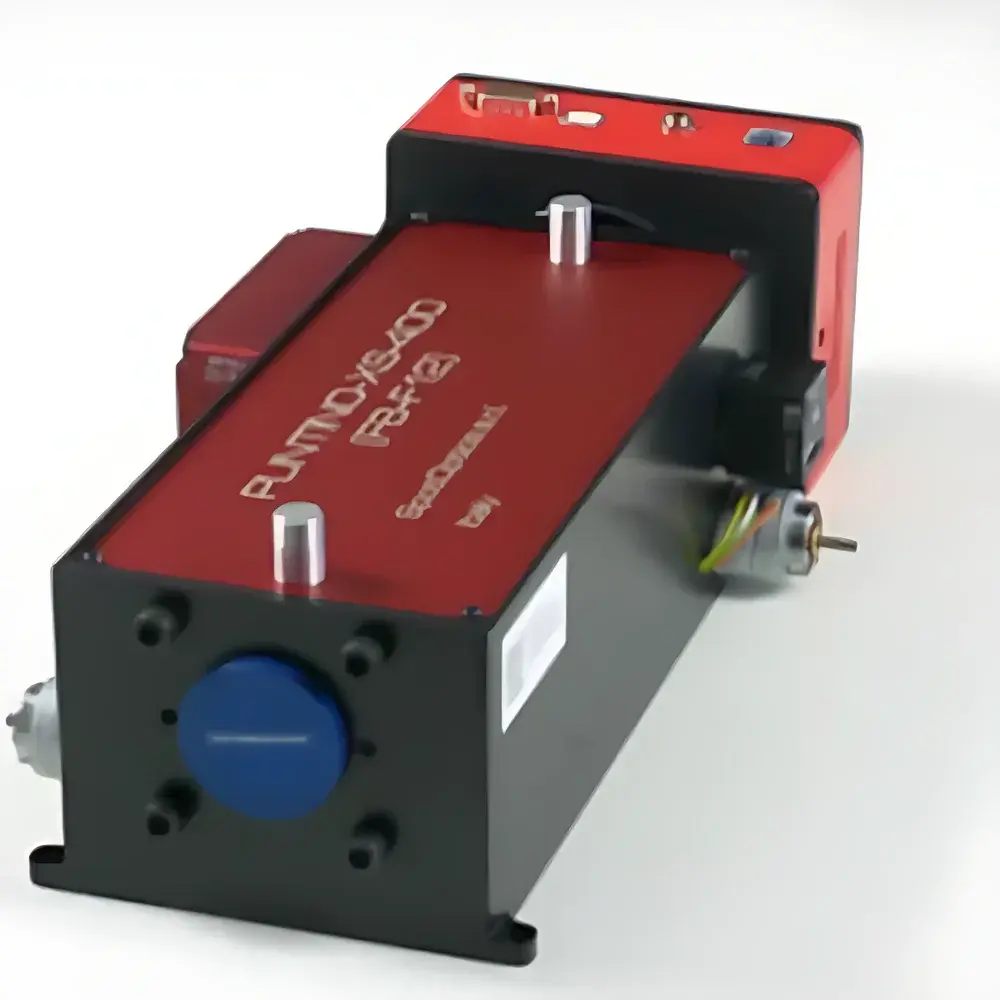
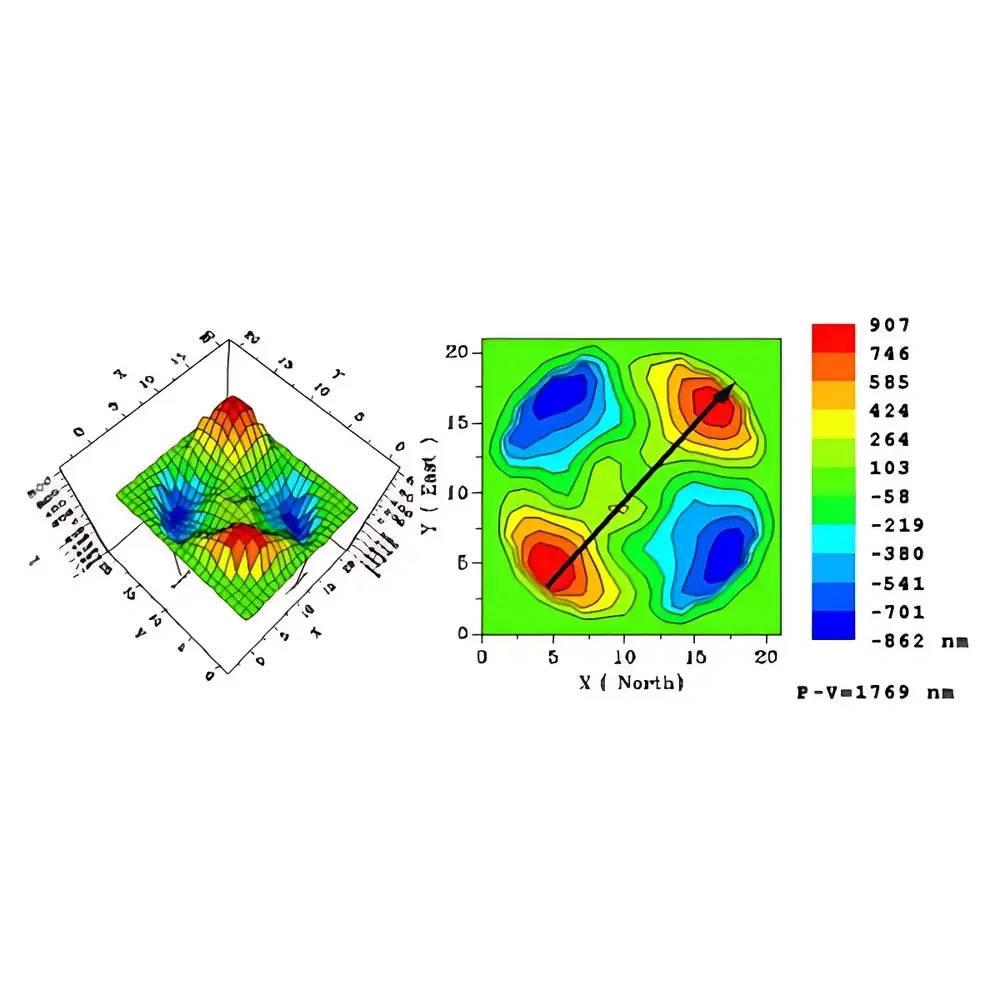
The Puntino Pro Shack-Hartmann Wavefront Sensor (SHWFS) is a high-precision, field-deployable metrology instrument engineered specifically for real-time wavefront characterization in large-aperture astronomical telescopes. Based on the fundamental principle of sub-aperture beam sampling, the system employs a precisely aligned micro-lens array to partition the incident optical wavefront into an orthogonal grid of sub-beams. Each sub-beam is focused onto a high-resolution, thermoelectrically cooled CCD sensor, forming a spot pattern whose centroid displacements—relative to a calibrated reference—are linearly proportional to local wavefront slopes. This geometric-optics foundation enables quantitative reconstruction of both low-order aberrations (e.g., defocus, astigmatism, coma) and high-spatial-frequency distortions (e.g., support-induced mirror deformations, dome seeing turbulence). As a core component of adaptive optics (AO) and telescope alignment systems, the Puntino Pro delivers sub-λ/150 RMS wavefront measurement accuracy across f/1.8–f/300 optical trains, supporting closed-loop correction and long-term optical health monitoring under operational observing conditions.
Key Features
- Ring-Zernike polynomial decomposition—mathematically rigorous treatment of central obscuration (secondary mirror shadow and spider vanes), eliminating artifacts inherent in standard Zernike or Fried-based algorithms
- Up to 34-term Zernike coefficient analysis with laboratory-calibrated precision of λ/300 and on-sky repeatability better than 0.01 arcsecond
- Dual-channel imaging architecture: thermally stabilized SH camera (16-bit, 3326 × 2504 px, 5.4 µm pixel pitch, <10 fps, read noise ≤10 e⁻) + uncooled direct-imaging CMOS camera (10-bit, 1280 × 1024 px) for simultaneous wavefront sensing and pupil-plane diagnostics
- Integrated mechanical global shutter (non-rolling) enabling precise exposure control down to 0.01 ms for bright-star observations
- Onboard auto-calibration unit with embedded LED reference source, compensating for thermal drift of internal optics and maintaining Zernike fidelity across ambient temperature fluctuations
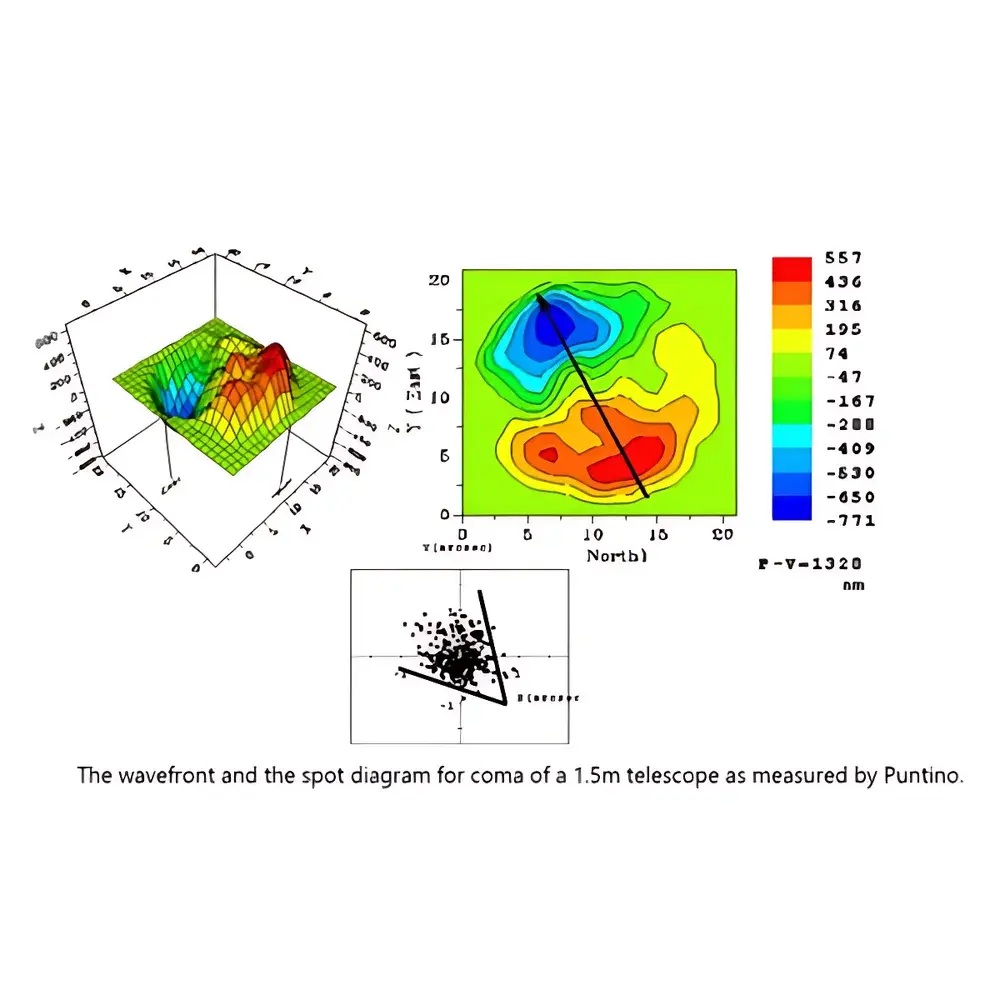
- Real-time diagnostic outputs: FWHM, image motion (2D differential shift), coherence length (r₀), Strehl ratio, residual RMS histogram, and Zernike mode decomposition
- Automated focus plane determination via spherical aberration minimization; guided optical alignment with directional correction vectors for primary/secondary misalignment
- Support for full optical train assessment—including mirror cell stress patterns, spider diffraction effects, dome boundary-layer turbulence, and atmospheric seeing residuals—without physical masks or apodization
Sample Compatibility & Compliance
The Puntino Pro is validated for use with Ritchey-Chrétien, Cassegrain, Nasmyth, and Gregorian telescope configurations operating within the 400–1100 nm spectral band. It accommodates entrance pupils from 41 mm (standard sampling) up to 65 × 65 spot arrays depending on detector selection and focal ratio. The system complies with ISO 10110-5 (optical element surface form tolerances), adheres to GLP-aligned data integrity practices, and supports audit-ready metadata logging (timestamp, ambient T/P/RH, exposure parameters, calibration state) required for observatory QA/QC documentation. While not FDA-regulated, its software architecture incorporates traceable versioning, user-access controls, and immutable raw-data archiving—principles aligned with ISO/IEC 17025 and IAU Observatory Data Management Guidelines.
Software & Data Management
The proprietary Puntino Analysis Suite provides a modular GUI for acquisition, reconstruction, visualization, and reporting. Core modules include: modal wavefront reconstruction (ring-Zernike basis), centroid detection with adaptive thresholding (80%/50% encircled energy), PSF/MTF computation, residual error mapping, and temporal averaging across multi-frame sequences. The software generates exportable reports in PDF and HDF5 formats, including 3D wavefront topography, Zernike coefficient tables, pupil-plane intensity maps, and diagnostic recommendations (e.g., “Primary mirror support point A requires 12 µm upward adjustment”). All processing steps are scriptable via Python API, enabling integration into observatory control systems (TCS) and automated nightly QA pipelines. Data provenance is preserved through embedded EXIF-like headers containing hardware serials, calibration timestamps, and environmental sensor readings.
Applications
- On-sky commissioning and periodic optical alignment of 2–10 m class telescopes
- Real-time AO loop feedback for deformable mirror control
- Dome seeing diagnostics and ventilation optimization via time-resolved residual analysis
- Mirror support system validation and finite-element model correlation
- Secondary mirror decenter/tilt quantification and correction guidance
- Pointing model refinement using zenith-distance-dependent aberration trends
- Long-term optical degradation tracking (e.g., coating aging, thermal hysteresis)
- Education and training in observational astrophysics and optical engineering laboratories
FAQ
What focal ratios does the Puntino Pro support?
It is optimized for f/1.8 to f/300 optical systems, with standard sampling calibrated at f/5–f/35 and extended-range configurations available upon request.
Does the system require custom masks for secondary mirror or spider vane obscuration?
No. The ring-Zernike algorithm inherently accounts for central and radial obscuration without physical masking or post-processing interpolation artifacts.
How is thermal stability ensured during long-duration observations?
The SH camera features thermoelectric cooling to −20 °C ± 0.1 °C, while the optical head includes an internal auto-calibration module with temperature-compensated reference illumination.
Can the software interface with existing telescope control systems?
Yes. The Analysis Suite offers a documented Python API and TCP/IP command protocol compatible with common TCS platforms (e.g., INDI, RTS2, ESO’s TCS framework).
What is the minimum measurable wavefront error (RMS)?
Laboratory-measured sensitivity is λ/300 RMS; on-sky performance typically achieves λ/150 RMS under typical seeing conditions (r₀ ≥ 10 cm), limited primarily by atmospheric turbulence rather than sensor noise.