
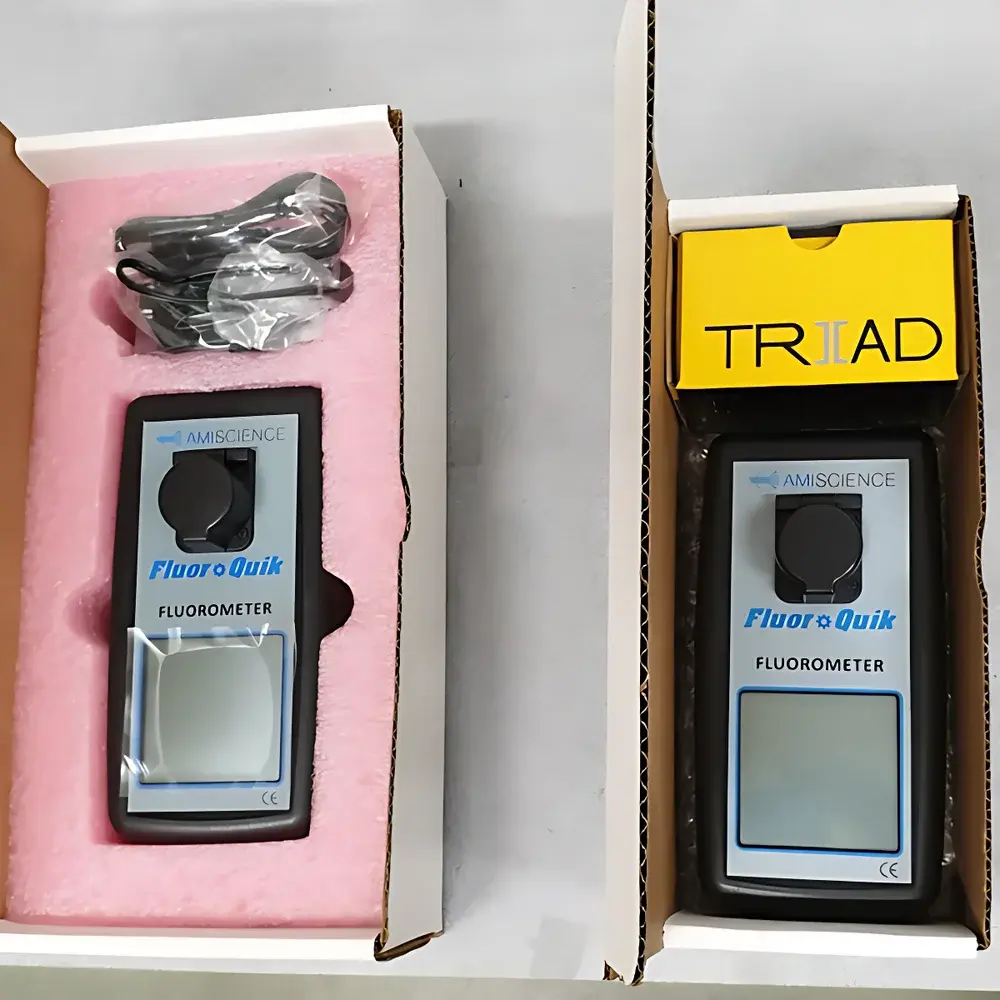
Purity Fluoroquik-O Portable Oil-in-Water Fluorometer
| Brand | Purity |
|---|---|
| Origin | USA |
| Model | Fluoroquik-O |
| Instrument Type | Portable |
| Measurement Principle | Ultraviolet Fluorescence (UV-FL) |
| Measurement Range | 0–5000 mg/L (oil in water) |
| Detection Limit | 0.1 mg/L (for Mobil DTE 220 oil) |
| CDOM Range | 0–1000 ng/L |
| Sensitivity Modes | High- and Low-Fluorescence RFU |
| Calibration | 2-point |
| Compliance | EPA Method 1664, GB 17378.4–2007 |
| Sample Vessel | 200 µL quartz or borosilicate glass cuvette |
| Optical Configuration | Single- or dual-channel |
| Dynamic Range | > 6 decades |
| Data Storage | 3 × 80 measurements |
| Interface | Touchscreen LCD with optional Chinese menu |
| Power | 4 × AA batteries or 5 V DC adapter |
| Dimensions | 185 × 90 × 35 mm |
| Connectivity | USB |
Overview
The Purity Fluoroquik-O Portable Oil-in-Water Fluorometer is an engineered field-deployable analytical instrument designed for rapid, on-site quantification of petroleum hydrocarbons—including crude oil, gasoline, diesel, lubricating oils, kerosene, and jet fuel—in aqueous matrices. It operates on the principle of ultraviolet-induced fluorescence (UV-FL), leveraging the intrinsic optical properties of polycyclic aromatic hydrocarbons (PAHs) and unsaturated aliphatic compounds present in petroleum products. When excited by UV light at a fixed wavelength (typically 254 nm or 365 nm depending on configuration), these compounds emit characteristic fluorescence signals proportional to their concentration. This linear relationship between emitted fluorescence intensity (expressed in Relative Fluorescence Units, RFU) and oil mass concentration (mg/L) enables direct calibration and quantitative analysis without chromatographic separation. The Fluoroquik-O is purpose-built for environmental monitoring workflows where speed, reproducibility, and regulatory traceability are critical—particularly in emergency response, routine compliance sampling, and industrial effluent verification.
Key Features
- Field-rugged, palm-sized design (185 × 90 × 35 mm) optimized for handheld operation in diverse environmental conditions—from coastal monitoring stations to remote wellheads and wastewater treatment plants.
- Dual-sensitivity fluorescence detection architecture supporting both high-dynamic-range (0–5000 mg/L) and ultra-low-level (0.1 mg/L LOD) measurement modes, selectable via touchscreen interface.
- Optimized optical path using quartz or high-transmission borosilicate microcuvettes (200 µL volume), minimizing solvent consumption and cross-contamination risk during hexane-based liquid-liquid extraction.
- Integrated 2-point calibration protocol compliant with EPA Method 1664 and GB 17378.4–2007, ensuring method-defensible data generation for regulatory reporting.
- Onboard data management with non-volatile memory capable of storing three independent datasets of up to 80 readings each, timestamped and indexed for audit readiness.
- Flexible power architecture: operates continuously for >12 hours on four standard AA alkaline batteries or via regulated 5 V DC input—enabling uninterrupted use during extended field campaigns.
Sample Compatibility & Compliance
The Fluoroquik-O delivers reliable performance across a broad spectrum of aqueous and semi-aqueous samples, including surface water, groundwater, seawater, municipal wastewater, cooling tower recirculation water, industrial process streams, and soil leachates. Its fluorescence-based detection is selective for aromatic and olefinic hydrocarbon fractions; it does not respond to saturated alkanes unless co-extracted PAH markers are present. As such, results correlate strongly with gravimetric and GC-FID reference methods when calibrated against certified oil standards (e.g., Mobil DTE 220). The instrument meets key regulatory benchmarks: full alignment with U.S. EPA Method 1664 for oil and grease determination, and formal equivalence to China’s national marine monitoring standard GB 17378.4–2007. While not a replacement for laboratory-grade GC-MS in forensic identification, it satisfies Tier-1 screening requirements under ISO 17025-accredited QA/QC programs and supports GLP-compliant documentation when paired with validated extraction protocols.
Software & Data Management
Data acquisition and configuration are managed through an intuitive capacitive touchscreen LCD interface with optional bilingual (English/Chinese) firmware. All measurements are automatically tagged with date, time, operator ID (if enabled), and calibration status. Raw RFU values and converted concentration outputs (mg/L or ng/L) are stored in CSV-compatible format. USB 2.0 connectivity allows direct export to Windows-based PCs for integration into LIMS environments or statistical analysis platforms (e.g., Excel, R, Python pandas). No proprietary drivers are required—device appears as a standard CDC ACM serial device. Firmware updates and configuration backups are performed via drag-and-drop file transfer. Audit trail functionality includes immutable logging of calibration events, sensor diagnostics, and battery voltage history—supporting FDA 21 CFR Part 11–aligned electronic record integrity where configured per organizational SOPs.
Applications
- Rapid spill response assessment: Quantify oil sheen concentrations within minutes post-collection, informing containment and remediation decisions.
- Wastewater discharge compliance: Verify effluent oil levels against NPDES permit limits prior to release.
- Cooling water system health monitoring: Detect hydrocarbon ingress from heat exchanger leaks before corrosion or fouling escalates.
- Marine environmental baseline studies: Map spatial distribution of petroleum hydrocarbons and CDOM in estuarine and offshore zones.
- Soil leachate screening: Assess potential groundwater contamination risk from hydrocarbon-impacted sites using standardized extraction protocols.
- Educational and training use: Demonstrate fundamental principles of molecular fluorescence, solvent extraction, and environmental analytical chemistry in undergraduate and technical curricula.
FAQ
Does the Fluoroquik-O require solvent extraction for every sample?
Yes—quantitative accuracy depends on consistent hexane (or equivalent non-polar solvent) extraction to isolate hydrophobic oil fractions from the aqueous phase prior to fluorometric analysis.
Can it distinguish between different oil types (e.g., diesel vs. crude)?
No—it provides total extractable petroleum hydrocarbon (TPH) concentration based on collective fluorescence response; speciation requires complementary techniques such as GC-MS or FTIR.
Is the instrument suitable for drinking water analysis?
It is not intended for potable water compliance testing under EPA Method 524 or ISO 20028; its detection range and selectivity are optimized for higher-concentration environmental matrices.
What maintenance is required for long-term reliability?
Routine cleaning of the optical window and cuvette holder with lint-free wipes and isopropanol; annual verification of LED excitation intensity and photodiode linearity using NIST-traceable fluorescence standards.
Does it support external GPS tagging of field measurements?
No built-in GPS—geotagging must be performed externally and correlated during post-processing using timestamps.
Related Products







