
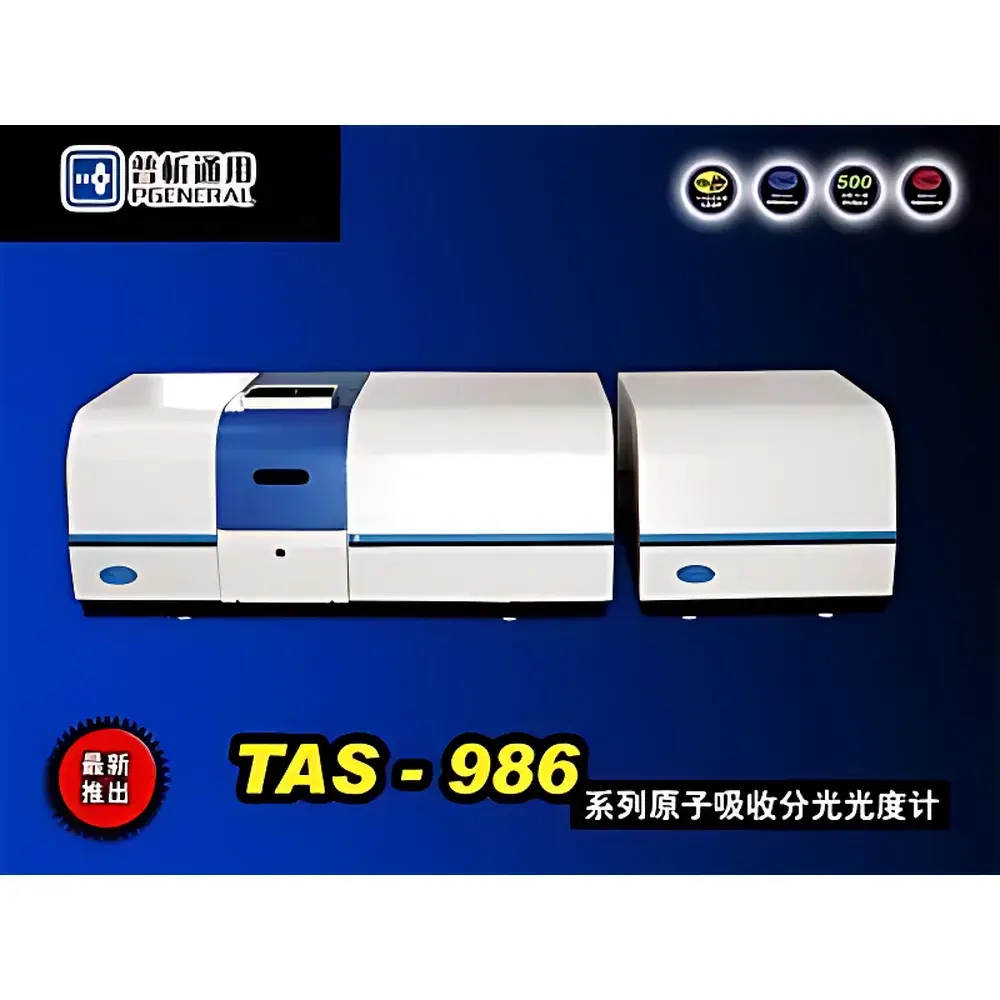
Purkinje TAS-986 Atomic Absorption Spectrometer
| Origin | Beijing, China |
|---|---|
| Manufacturer Type | Authorized Distributor |
| Model | TAS-986 |
| Pricing | Upon Request |
Overview
The Purkinje TAS-986 Atomic Absorption Spectrometer is a dual-mode analytical instrument engineered for quantitative determination of trace metal elements in liquid samples via flame atomic absorption spectroscopy (FAAS) and graphite furnace atomic absorption spectroscopy (GFAAS). Based on the fundamental principle of atomic absorption—where ground-state free atoms in the gaseous phase absorb characteristic wavelengths of electromagnetic radiation—the TAS-986 enables highly selective elemental detection with sub-part-per-trillion (ppt) sensitivity in GFAAS mode and sub-part-per-trillion to part-per-trillion (ppb) detection limits in FAAS mode. Designed for routine laboratory environments in environmental monitoring, metallurgical QC, pharmaceutical impurity testing, geological surveying, and clinical research, the system integrates optical, thermal, and electronic subsystems within a robust, single-chassis architecture optimized for long-term stability and operational reproducibility.
Key Features
- Integrated dual-atomization platform: Flame and graphite furnace atomizers are co-located within a single optical bench, enabling fully automated switching between modes without manual realignment or recalibration.
- Transverse-heated graphite tube furnace: Engineered for uniform axial temperature distribution across the entire graphite surface, minimizing analyte volatilization gradients, chemical interference, and memory effects—critical for high-precision quantitation of refractory elements (e.g., V, Mo, W, Al).
- Motorized 8-position hollow cathode lamp turret: Supports simultaneous pre-alignment of up to eight element-specific lamps; software-controlled lamp selection ensures optimal spectral line intensity and signal-to-noise ratio.
- Intelligent parameter optimization: Automatic peak search, slit width selection (0.1–2.0 nm), burner head height adjustment, and acetylene/air flow regulation ensure consistent atomization efficiency and adherence to method-defined conditions per ASTM E1753 and ISO 8288.
- Dedicated flame safety system: Integrated flame monitor continuously detects ignition status and flame geometry; automatic gas shutoff and audible/visual alarm activate upon flame-out or abnormal combustion dynamics, complying with EN 61010-1 safety requirements.
Sample Compatibility & Compliance
The TAS-986 accepts aqueous and acid-digested samples (HNO₃, HCl, HF-compatible up to 10% v/v) with matrix concentrations ≤5% total dissolved solids. Flame mode accommodates direct aspiration of solutions at flow rates of 5–8 mL/min; graphite furnace mode supports 5–50 µL sample volumes with integrated platform-assisted drying, pyrolysis, and atomization temperature programming. Instrument design conforms to GLP-compliant workflows: audit trail logging (user actions, method parameters, calibration history), electronic signature support, and data integrity safeguards aligned with FDA 21 CFR Part 11 principles. All optical and thermal calibrations are traceable to NIST SRMs (e.g., Cu, Cd, Pb standard solutions), and wavelength accuracy verification follows ISO/IEC 17025 validation protocols.
Software & Data Management
The TAS-986 operates under a native Windows-based control suite with bilingual (English/Chinese) GUI—designed for intuitive navigation without domain-specific programming knowledge. The software provides full instrument control, method development, calibration curve generation (linear, quadratic, weighted least-squares), QC charting (Levey-Jennings, Westgard rules), and raw absorbance/time-profile visualization. Data export formats include CSV, TXT, and XML for LIMS integration. Audit logs record timestamped operator ID, method version, calibration standards used, and instrument status flags—enabling full traceability required for ISO/IEC 17025 accreditation and pharmaceutical QA/QC reporting.
Applications
- Environmental analysis: Quantification of Pb, Cd, Cr, As, and Hg in drinking water, wastewater, soil extracts, and airborne particulate filters per EPA Method 200.7 and 7000B.
- Pharmaceutical quality control: Detection of catalyst residues (Pd, Pt, Ni) in active pharmaceutical ingredients (APIs) per ICH Q2(R2) and USP .
- Geochemical prospecting: Multi-element screening of rock digests and ore concentrates for exploration-grade assays.
- Clinical toxicology: Blood and urine metal profiling (e.g., Zn, Cu, Fe, Se) supporting nutritional assessment and heavy metal exposure evaluation.
- Materials science: Impurity mapping in high-purity metals, ceramics, and battery electrode slurries prior to sintering or electrochemical testing.
FAQ
Does the TAS-986 support hydride generation or cold vapor techniques?
No—the TAS-986 is configured exclusively for flame and graphite furnace AAS. Hydride generation (HG-AAS) and cold vapor (CV-AAS) require dedicated accessory modules not included in the base configuration.
Is firmware upgrade capability available remotely?
Yes—firmware updates are distributed via encrypted USB key or secure FTP; all updates undergo functional verification and version-locking to preserve method integrity.
What maintenance intervals are recommended for the graphite furnace?
Graphite tubes should be replaced after 200–300 firings depending on matrix aggressiveness; furnace alignment verification is advised every 500 analyses or quarterly, whichever occurs first.
Can the software generate 21 CFR Part 11-compliant electronic records?
Yes—the audit trail module captures user identity, action timestamp, parameter values, and digital signature metadata, satisfying predicate rule requirements for regulated laboratories.
Is third-party LIMS connectivity supported?
Yes—via ODBC-compliant database export and configurable ASCII-delimited file output compatible with major LIMS platforms including LabWare, Thermo Fisher SampleManager, and STARLIMS.





