
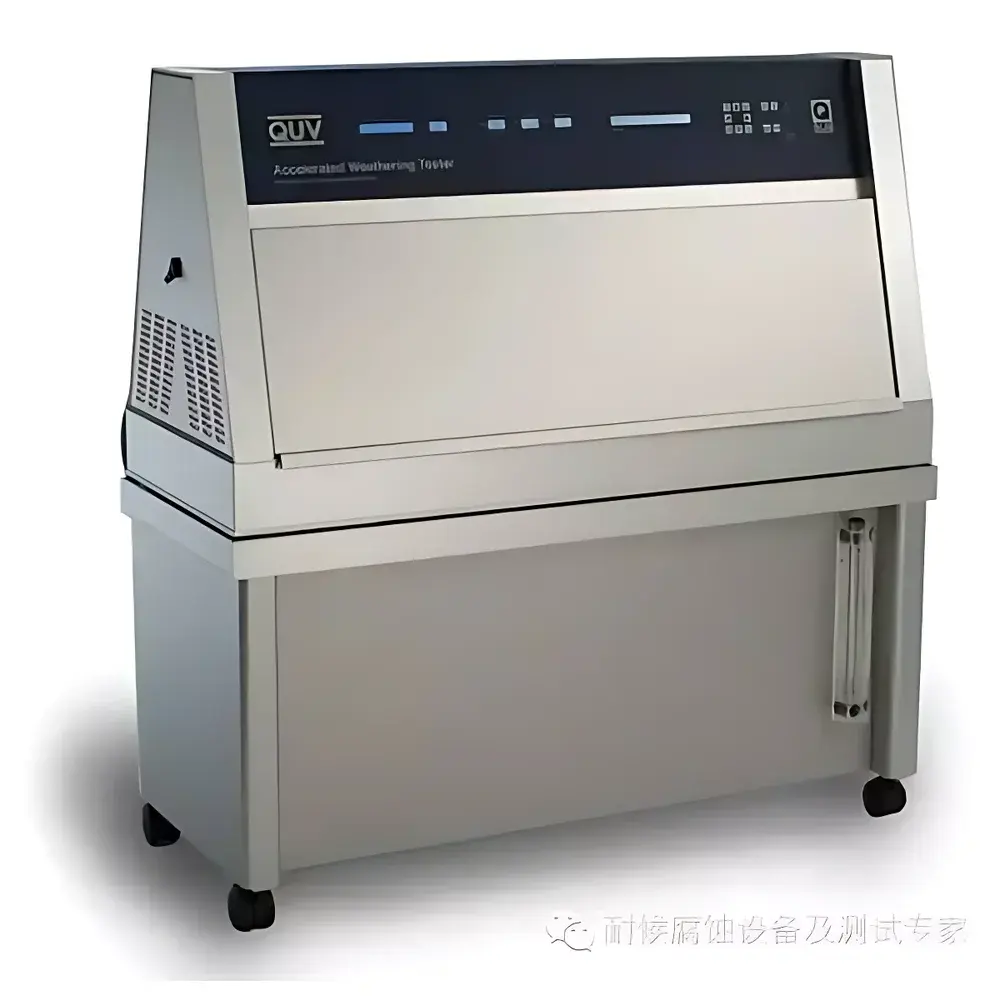
Q-Lab QUV/SE UV Accelerated Weathering Tester
| Brand | Q-LAB |
|---|---|
| Origin | USA |
| Model | QUV/SE |
| Chamber Dimensions (L×W×H) | 114 × 50 × 40 cm |
| Light Source Options | UVA-340 or UVB-313 fluorescent lamps |
| Irradiance Control | Solar Eye® closed-loop feedback system |
| Black Panel Temperature Range | 35–80 °C |
| Condensation Temperature Range | 40–60 °C |
| Illumination Temperature Range | 45–80 °C |
| Sample Capacity | 48 specimens (75 × 150 mm) |
| Power Supply | 120 V / 60 Hz, 16 A or 230 V / 50–60 Hz, 8 A |
| Water Consumption | 8 L/day (condensation mode) |
| Lamp Life (avg.) | 5000 h |
Overview
The Q-Lab QUV/SE UV Accelerated Weathering Tester is an industry-standard benchtop instrument engineered for precision simulation of solar ultraviolet radiation and associated environmental stressors—primarily UV exposure, condensation, and controlled temperature cycling—to evaluate material degradation mechanisms under accelerated conditions. Based on the fundamental principles of photochemical aging, the QUV/SE employs fluorescent UV lamps to replicate the most damaging short-wavelength spectral region of terrestrial sunlight (295–365 nm), where photon energy exceeds bond dissociation thresholds in many organic polymers, coatings, and composites. Unlike broad-spectrum xenon arc testers, the QUV/SE focuses specifically on UV-driven degradation pathways—such as chain scission, crosslinking, and chromophore formation—making it especially suitable for comparative ranking, quality assurance, and formulation screening where correlation with real-world outdoor exposure is required per ASTM G154, ISO 4892-3, and SAE J2020.
Key Features
- Integrated Solar Eye® irradiance control system: A calibrated UV sensor continuously monitors spectral output and dynamically adjusts lamp power to maintain setpoint irradiance (e.g., 0.68 W/m² @ 340 nm), ensuring test repeatability across lamp batches and instrument lifetimes.
- Dual UV lamp compatibility: Supports both UVA-340 lamps (spectrally matched to solar cutoff at 295 nm) for high-fidelity outdoor correlation, and UVB-313 lamps (extended output down to 270 nm) for aggressive, high-acceleration testing in R&D and QC applications.
- Independent black panel thermometer (BPT) and chamber air temperature control: Enables precise thermal management during irradiation cycles, critical for reproducing surface heating effects observed in field exposure.
- Automated condensation cycle: Uses ambient or deionized water to generate uniform moisture exposure via saturated vapor condensation on specimen surfaces—mimicking nocturnal dew formation without mechanical spray nozzles or complex plumbing.
- Rugged stainless-steel chamber construction with quartz-filtered UV optics and interlocked safety door: Designed for continuous unattended operation in regulated laboratory environments compliant with IEC 61000-4 EMC standards.
Sample Compatibility & Compliance
The QUV/SE accommodates flat-panel specimens up to 75 × 150 mm (standard frame size), with support for custom racks and multi-layer mounting configurations. It is widely used for evaluating paints & coatings (ASTM D4587), plastics (ISO 4892-3), automotive interior trim (SAE J2020), roofing membranes (ASTM D6277), and photovoltaic encapsulants (IEC 61215). All operational parameters—including irradiance setpoints, temperature profiles, and cycle timing—are programmable and auditable, supporting GLP and GMP documentation requirements. The system meets essential electrical safety standards (UL 61010-1, CSA C22.2 No. 61010-1) and is compatible with FDA 21 CFR Part 11-compliant data acquisition software when integrated with Q-Lab’s QUVMaster™ platform.
Software & Data Management
While the QUV/SE operates via intuitive front-panel controls, full traceability and long-term data integrity are achieved through optional integration with QUVMaster™ software. This Windows-based application provides real-time monitoring, automated report generation (PDF/CSV), electronic signature capability, and secure audit trails—including user login history, parameter change logs, and calibration event records. Data export supports third-party LIMS and ELN systems via ODBC and REST API interfaces. All irradiance calibrations are traceable to NIST-certified reference sensors, and routine verification follows Q-Lab’s recommended maintenance schedule (lamp replacement every 5000 h, sensor recalibration annually).
Applications
Typical use cases include comparative durability ranking of pigment systems in architectural coatings; validation of UV stabilizer efficacy in polyolefin films; evaluation of yellowing resistance in polycarbonate lenses; qualification of adhesive bondlines in outdoor signage substrates; and accelerated screening of anti-fouling marine coatings. In regulatory contexts, QUV/SE data contributes to ISO 11341 (paints and varnishes), ASTM D4329 (plastics), and MIL-STD-810H Method 506.6 (solar radiation) compliance packages. Its reproducibility enables statistical process control (SPC) analysis of batch-to-batch variation in production lots.
FAQ
What is the difference between UVA-340 and UVB-313 lamps?
UVA-340 lamps emit UV radiation closely matching the solar spectrum from 295 nm to 365 nm and are recommended for tests requiring high outdoor correlation. UVB-313 lamps extend output below 295 nm and produce higher irradiance, enabling faster degradation—but may induce non-representative failure modes in some materials.
Does the QUV/SE require chilled water or external cooling?
No. The system uses passive air-cooling and internal thermal mass management; only standard tap or deionized water is required for condensation cycles.
Can the QUV/SE perform cyclic testing with spray?
The QUV/SE model does not include a spray function. For combined UV/condensation/spray protocols, the QUV/Spray model is specified per ASTM G154 Cycle 4 and ISO 4892-3 Annex B.
How often must the UV sensor be recalibrated?
Q-Lab recommends annual recalibration using a NIST-traceable reference sensor, or after any lamp replacement if irradiance drift exceeds ±5% of setpoint.
Is remote monitoring supported?
Yes—via Ethernet-connected QUVMaster™ software with configurable email/SNMP alerts for alarm conditions (e.g., lamp failure, temperature deviation, water shortage).



