
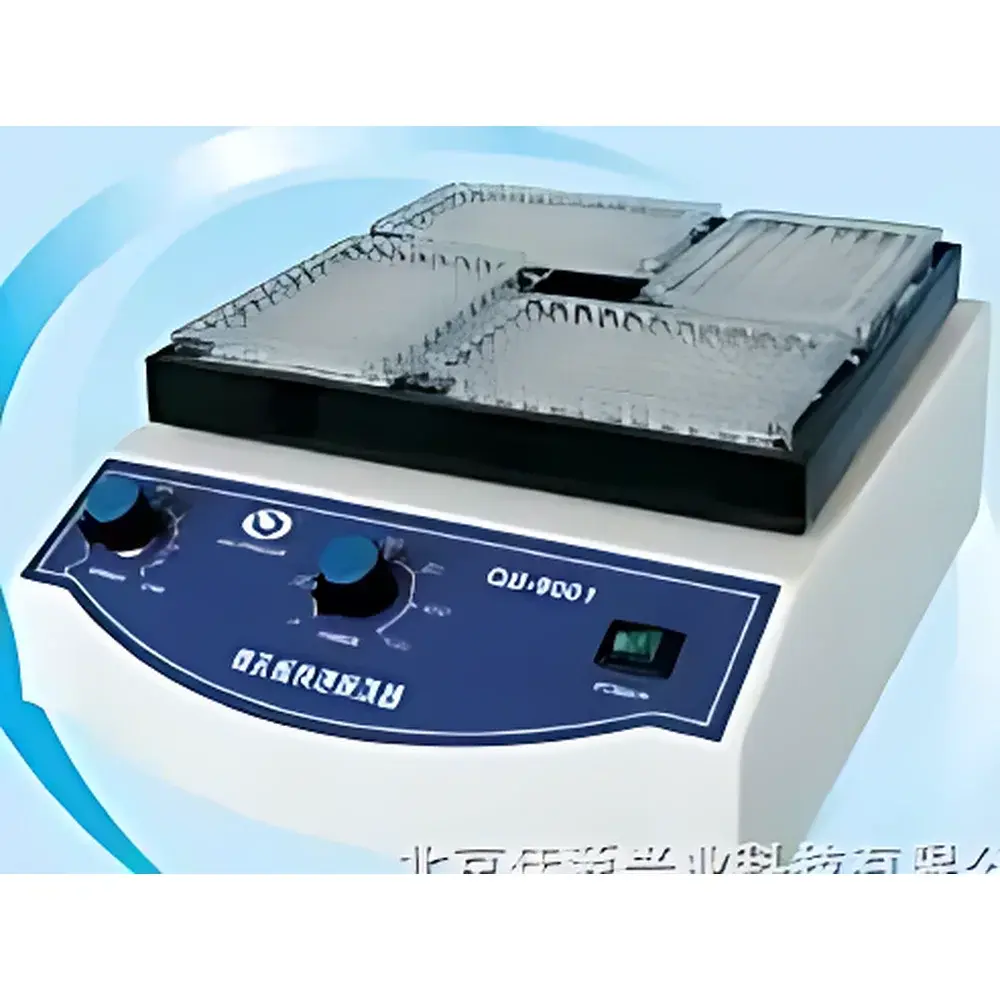
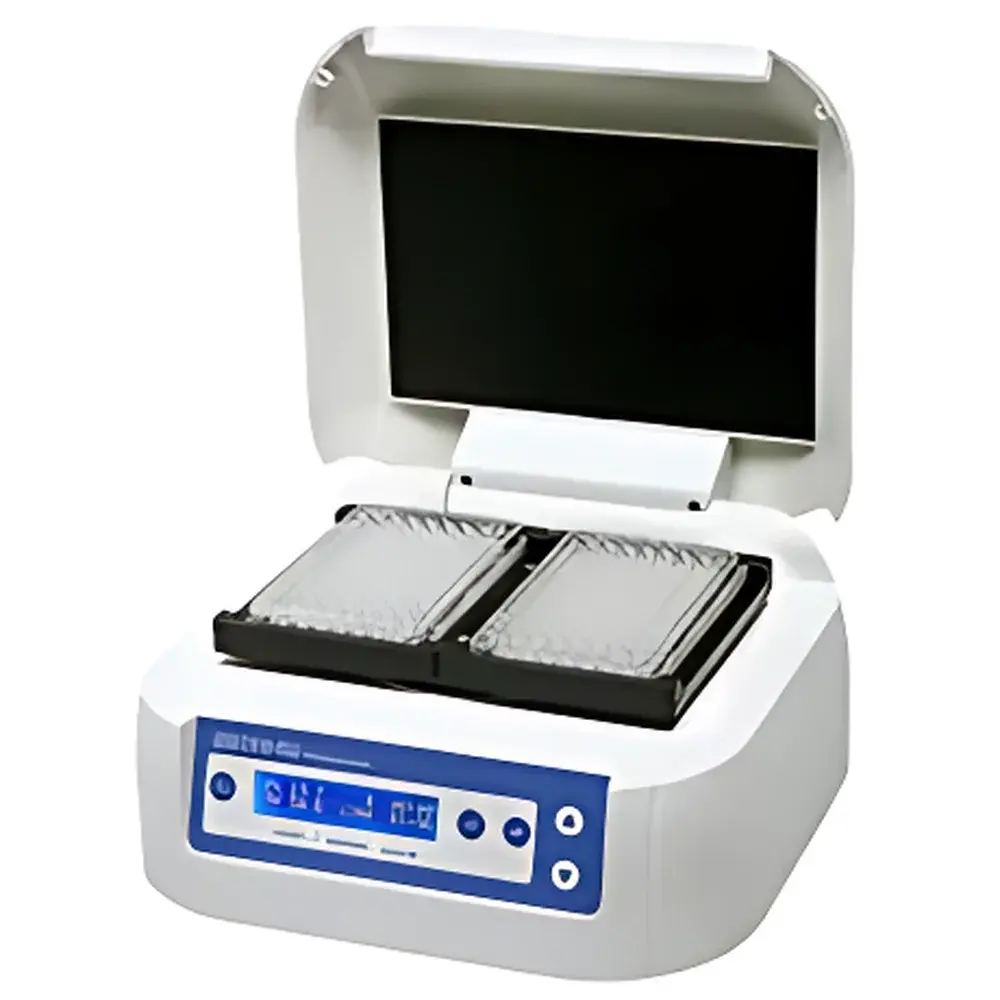
QB9001 Microplate Orbital Shaker
| Origin | Jiangsu, China |
|---|---|
| Manufacturer Type | Authorized Distributor |
| Origin Category | Domestic (PRC) |
| Model | QB9001 |
| Power | 30 W |
| Input Voltage | 220 V AC |
| Speed Range | 0–1350 rpm |
| Speed Control | Continuous (Infinitely Variable) |
| Timer | 0–120 min or Continuous Mode |
| Capacity | Up to 4 × 96-well microplates |
| Dimensions (L×W×H) | 350 × 225 × 150 mm |
| Platform Material | Natural Rubber with Anti-slip Texture |
| Housing Material | Reinforced Engineering Thermoplastic |
Overview
The QB9001 Microplate Orbital Shaker is an engineered solution for consistent, low-noise orbital agitation of standard microtiter plates in life science and clinical laboratory workflows. Utilizing a precisely balanced eccentric drive mechanism, it generates uniform circular motion (orbital shaking) at controlled amplitudes and frequencies—ideal for applications requiring gentle yet effective suspension of cells, reagents, or immunoassay components without foaming or splashing. Designed for routine use in molecular biology, virology, immunology, and diagnostic assay development, the QB9001 delivers high reproducibility across repeated runs and supports adherence to standardized protocols such as those outlined in CLSI EP15-A3 and ISO 15197 for assay repeatability.
Key Features
- Infinitely variable speed control (0–1350 rpm) enables precise optimization for diverse sample viscosities and plate formats—from low-volume PCR plates to full 96-well ELISA plates.
- Dual operation modes: programmable timer (0–120 minutes) with auto-shutoff, plus continuous run mode for extended incubation-assisted mixing.
- Robust platform constructed from natural rubber with micro-textured anti-slip surface—prevents plate displacement during high-speed agitation while minimizing vibration transmission to adjacent equipment.
- Compact footprint (350 × 225 × 150 mm) and lightweight thermoplastic housing facilitate placement inside biosafety cabinets, cold rooms, or stacked benchtop configurations.
- Low acoustic emission (<52 dB at 1000 rpm), achieved via precision-machined motor mount and dynamically balanced drive assembly—critical for shared lab environments and noise-sensitive facilities.
- Thermally stable motor design with integrated thermal cutoff ensures safe, uninterrupted operation during overnight or unattended protocols.
Sample Compatibility & Compliance
The QB9001 accommodates up to four standard 96-well microplates simultaneously (SBS-compliant footprint), including flat-bottom, U-bottom, and V-bottom configurations. It is compatible with common plate materials: polystyrene, polypropylene, and cyclic olefin copolymer (COC). While not certified for sterile or Class II biosafety applications, its smooth, non-porous housing surface supports routine decontamination using 70% ethanol or 0.5% sodium hypochlorite solutions. The device meets general electrical safety requirements per GB 4793.1–2018 (equivalent to IEC 61010-1:2010) and complies with electromagnetic compatibility standards GB/T 18268.1–2010 (IEC 61326-1:2012). For GLP/GMP-regulated environments, users may implement instrument-specific SOPs including daily performance verification using calibrated digital tachometers and documented log entries.
Software & Data Management
The QB9001 operates as a standalone analog-controlled shaker with no embedded firmware or connectivity options. All operational parameters—including speed setpoint and timer duration—are adjusted manually via front-panel dials. This architecture eliminates software validation burdens and aligns with laboratories maintaining legacy instrumentation under FDA 21 CFR Part 11-compliant systems where electronic records are not generated. For traceability, users are advised to record operating conditions in paper-based or LIMS-integrated logbooks referencing batch numbers, operator IDs, and protocol identifiers. Optional external data loggers (e.g., USB-connected RPM/temperature monitors) may be deployed for audit-ready performance trending.
Applications
- ELISA and multiplex immunoassay plate washing and incubation-phase mixing.
- Suspension of adherent cell lines prior to harvesting or passaging in 96-well culture plates.
- Homogenization of PCR master mixes and qPCR reaction setups to ensure reagent uniformity.
- Antibody-antigen binding enhancement during kinetic assays requiring timed agitation.
- Pre-analytical sample preparation for automated liquid handlers—standardizing plate contents prior to robotic aspiration.
- Viral neutralization assay workflows where consistent antigen-antibody interaction kinetics depend on uniform mixing dynamics.
FAQ
What microplate formats does the QB9001 support?
It accepts all SBS-standard 96-well plates (ANSI/SBS 1–2004), including skirted, semi-skirted, and unskirted variants, as well as 384-well plates when used with optional adapter inserts.
Is the QB9001 suitable for use inside a CO₂ incubator?
No—the unit is rated for ambient temperature operation only (10–35°C, <80% RH) and lacks environmental sealing; incubator-compatible shakers require specialized IP-rated enclosures and heater-compatible motors.
Can the QB9001 be validated for GxP environments?
Yes—though it contains no digital controls, it supports IQ/OQ execution through mechanical verification (speed accuracy ±3 rpm, timer deviation ≤±15 sec/hour) and documented maintenance logs per manufacturer-recommended intervals.
Does the shaker include over-speed or overload protection?
Yes—a dual-stage thermal fuse and current-limiting circuitry prevent motor damage during prolonged high-rpm operation or accidental overloading with excessive plate mass.
How often should the rubber platform be replaced?
Under normal use (≤8 hrs/day, 5 days/week), replacement is recommended every 18–24 months or upon visible cracking, permanent deformation, or loss of grip texture.



