
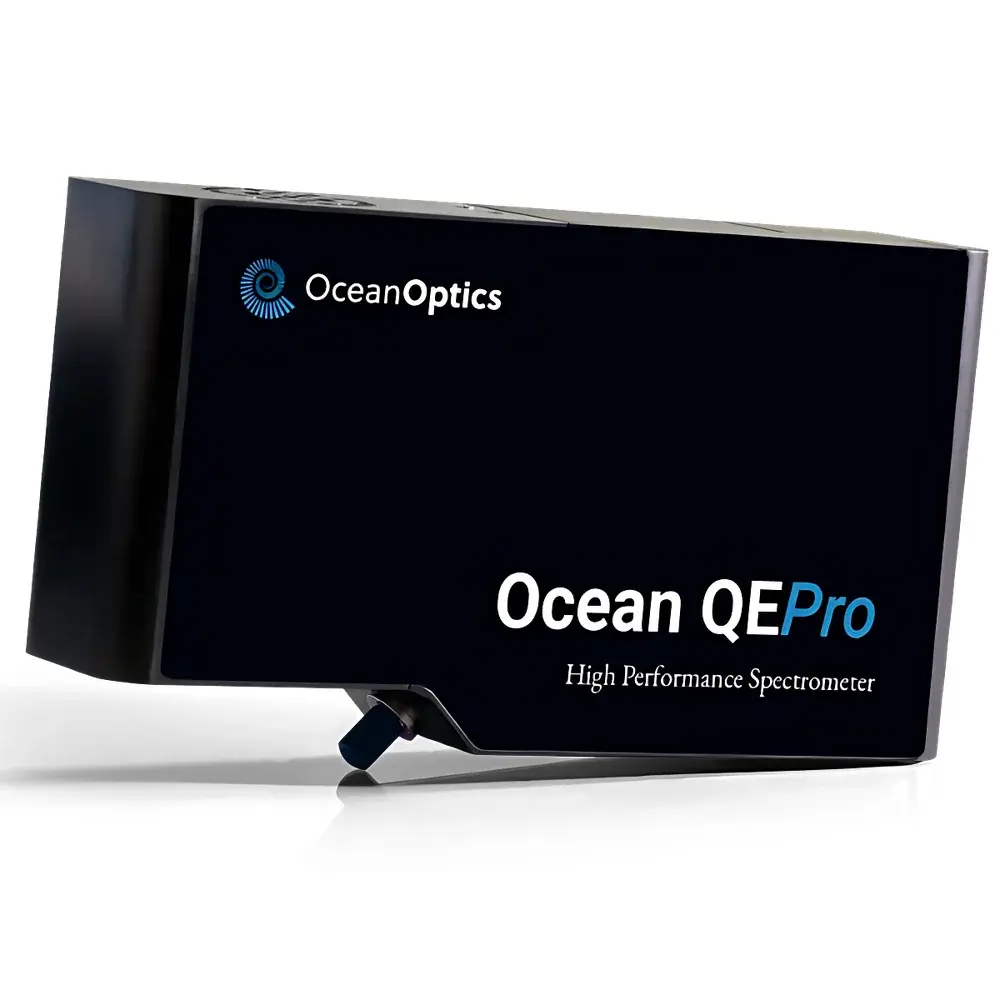
QE Pro High-Performance Back-Illuminated CCD Fiber Optic Spectrometer by Ocean Insight
| Brand | Ocean Insight |
|---|---|
| Origin | USA (Manufactured in Orlando, FL) |
| Detector Type | Back-Illuminated CCD |
| Spectral Range | Configurable from 185–1100 nm |
| Resolution | 18-bit digitization |
| Peak Quantum Efficiency | 90% |
| Signal-to-Noise Ratio | 1000:1 (full well, single acquisition) |
| Dynamic Range | 85,000:1 (typical, with on-board averaging) |
| Stray Light | <0.08% at 600 nm |
| Onboard Memory Buffer | 15 MB |
Overview
The QE Pro is a high-performance, back-illuminated CCD-based fiber optic spectrometer engineered for demanding low-light spectroscopic applications—including fluorescence, Raman scattering, and UV-Vis-NIR absorbance measurements. Its optical architecture leverages a Czerny-Turner design with optimized holographic gratings and precision-aligned optics to deliver exceptional throughput and wavelength fidelity across the full 185–1100 nm spectral range. Unlike front-illuminated detectors, the back-illuminated CCD achieves >90% peak quantum efficiency through enhanced photon collection depth and reduced gate structure obstruction—critical for maximizing signal capture in photon-limited experiments. The spectrometer integrates a 15 MB onboard memory buffer to sustain high-speed, continuous spectral acquisition without host PC latency, supporting frame rates up to 10 Hz at full resolution (dependent on integration time and communication interface).
Key Features
- Back-illuminated CCD detector with peak QE of 90%—optimized for UV sensitivity down to 185 nm and extended NIR response up to 1100 nm
- 18-bit analog-to-digital conversion enabling high-resolution intensity discrimination and improved dynamic linearity
- Low read noise (<3 e⁻ RMS) and dark current stabilization via thermoelectric cooling (standard ±0.1 °C regulation)
- Integrated mechanical shutter (optional) for precise dark reference acquisition and thermal drift compensation
- Modular slit system—interchangeable slits (10, 25, 50, 100, or 200 µm) allow optimization of resolution vs. throughput per application
- USB 3.0 and Ethernet interfaces for deterministic data transfer; compatible with USB 2.0 fallback
- Rugged aluminum housing with EMI-shielded electronics and MIL-STD-810G compliant mechanical design
Sample Compatibility & Compliance
The QE Pro interfaces seamlessly with standard SMA 905 optical fibers (e.g., 200 µm, 400 µm, or 600 µm core) and supports common fiber-coupled accessories—including cuvette holders, integrating spheres, collimating lenses, and Raman probes. It is routinely deployed in regulated environments requiring traceable calibration and audit-ready operation. While the spectrometer itself does not carry FDA 510(k) clearance, its firmware and OEM SDK support GLP/GMP-aligned workflows: spectral data export includes embedded metadata (timestamp, integration time, lamp status, calibration file ID), and optional software configurations enable 21 CFR Part 11–compliant electronic signatures and audit trails when paired with Ocean Insight’s OceanView v3.x or Ocean HDX platform. Calibration certificates are NIST-traceable and provided with each unit.
Software & Data Management
Ocean Insight provides comprehensive cross-platform software support: OceanView (Windows/macOS/Linux) delivers real-time visualization, multi-spectrum overlay, kinetic acquisition, and built-in chemometric tools (PCA, PLS regression). For integration into automated test systems, the OceanHDx SDK offers C/C++, Python, MATLAB, and LabVIEW APIs with thread-safe callbacks and memory-mapped I/O. All spectral data is saved in vendor-neutral formats (.csv, .jdx, .spc) alongside proprietary .obf files containing full instrument configuration and calibration history. Firmware updates are performed via signed binaries with SHA-256 verification, ensuring integrity during field deployment.
Applications
- Fluorescence spectroscopy: Quantification of low-concentration fluorophores in life science assays, environmental monitoring (e.g., dissolved organic matter), and LED phosphor characterization
- Raman spectroscopy: Preconfigured models optimized for 532 nm, 638 nm, 785 nm, and 1064 nm excitation—supporting pharmaceutical polymorph identification, carbon nanotube analysis, and forensic pigment differentiation
- UV-Vis absorption: High-precision kinetics studies in catalysis, enzyme activity assays, and thin-film thickness measurement via interference fringe analysis
- Plasma emission monitoring: Real-time spectral fingerprinting of industrial plasma processes (PECVD, sputtering) with ppm-level elemental line detection capability
- Astronomical instrumentation: Used in small-telescope spectrographs and exoplanet transit light curve analysis due to low dark current and thermal stability
FAQ
Is the QE Pro suitable for time-resolved fluorescence measurements?
Yes—when operated with external TTL triggering and sub-millisecond integration times, the QE Pro supports gated acquisition protocols. Its low-latency USB 3.0 interface enables synchronization with pulsed lasers and delay generators within ±100 ns jitter.
Can I perform absolute irradiance measurements with the QE Pro?
Yes—using NIST-traceable radiometric calibration kits (e.g., HL-3-CAL or PX-2 pulsed source calibrations), users can convert raw counts to µW/cm²/nm. OceanView includes irradiance correction modules that apply grating efficiency, slit function, and detector QE curves.
What is the typical warm-up time to achieve thermal equilibrium?
The TE cooler stabilizes detector temperature within 5 minutes of power-on under ambient conditions (23 °C); full spectral calibration stability is achieved after 15 minutes.
Are custom grating options available for specialized wavelength coverage?
Yes—Ocean Insight offers over 30 standard gratings and accepts custom groove density/ruled coatings for OEM integrators, subject to minimum order quantities and lead time validation.
Does the QE Pro support remote operation in unattended field deployments?
Yes—Ethernet-enabled units support DHCP, static IP, and mDNS discovery. Power-over-Ethernet (PoE+) compatibility is available via optional adapter, enabling operation in harsh or space-constrained enclosures.





