
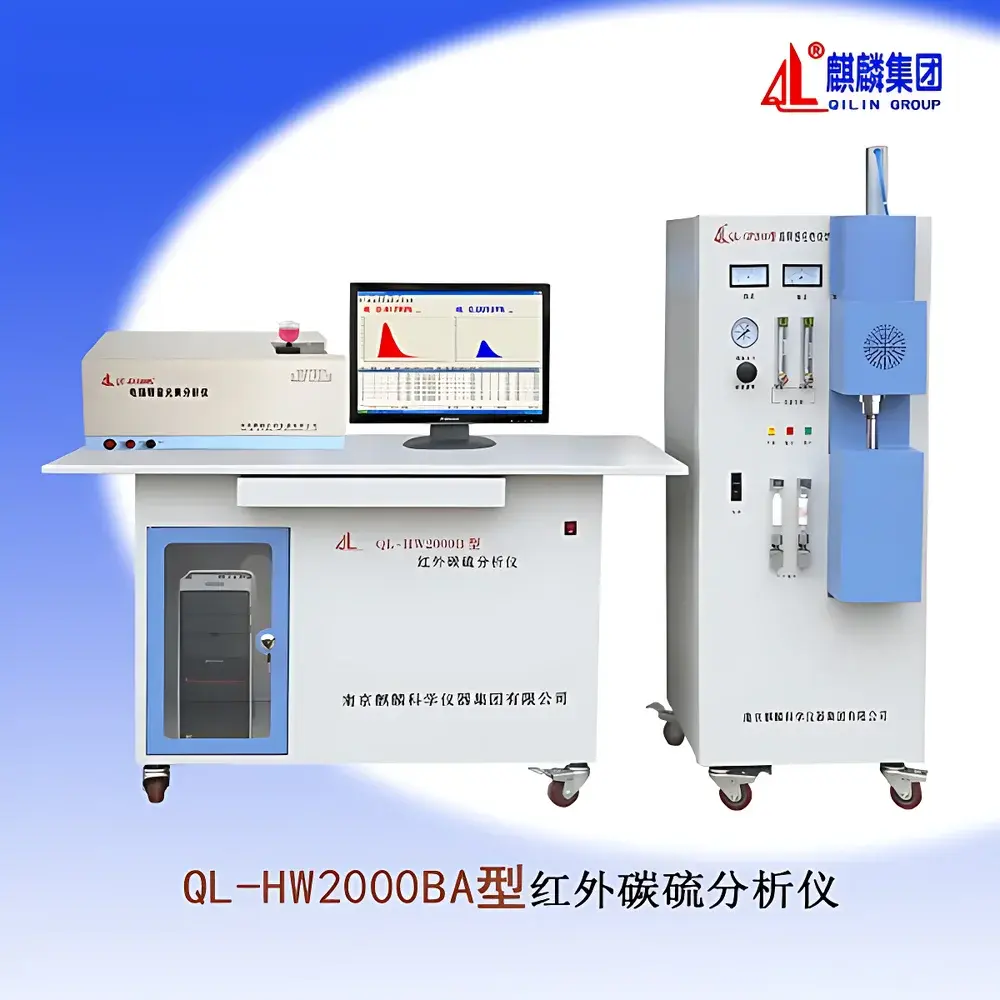
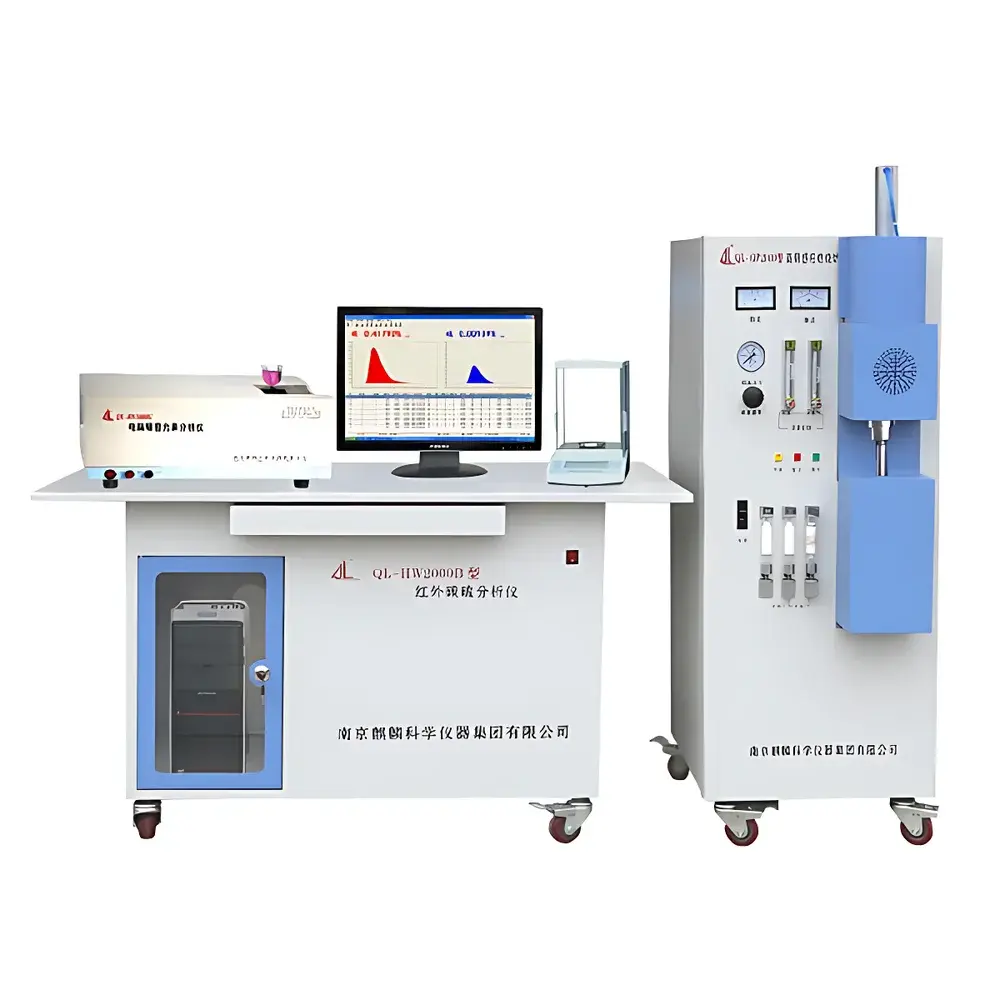
Qilin HW2000BA High-Frequency Infrared Multi-Element Analyzer
| Brand | Qilin (QL) |
|---|---|
| Origin | Jiangsu, China |
| Model | HW2000BA |
| Measurement Principle | Infrared Absorption (C/S), Photometric Colorimetry (Mn, P, Si, Cr, Ni, etc.) |
| Heating System | High-Frequency Induction Furnace |
| Rated Output Power | 2.5 kVA |
| Carbon Range | 0.0001–99.999 wt% |
| Sulfur Range | 0.0001–99.999 wt% |
| Manganese | 0.10–65.00 wt% |
| Silicon | 0.10–75.00 wt% |
| Phosphorus | 0.005–1.80 wt% |
| Chromium | 0.01–65.0 wt% |
| Nickel | 0.010–30.0 wt% |
| Molybdenum | 0.101–6.00 wt% |
| Magnesium | 0.010–0.100 wt% |
| Rare Earth Elements | 0.01–0.100 wt% |
| Wavelength Range (Colorimetric Module) | 400–800 nm (motorized grating, step resolution <1 nm) |
| Calibration Curves | Up to 99 user-storable regression curves |
| Compliance | GB/T 223.3–5:1988, GB/T 223.68–69:1997 |
| Operating Environment | 0–40 °C |
Overview
The Qilin HW2000BA High-Frequency Infrared Multi-Element Analyzer is a dual-module analytical platform engineered for simultaneous quantitative determination of carbon and sulfur by high-frequency combustion-infrared absorption, and up to ten additional metallic and non-metallic elements—including Mn, P, Si, Cr, Ni, Mo, Mg, and rare earths—via post-combustion solution-phase photometric colorimetry. The system integrates two functionally distinct but operationally synchronized modules: the QL-HW2000B infrared carbon-sulfur analyzer and the QL-BS1000G multi-element photometer. This architecture enables laboratories to perform full compositional profiling of ferrous alloys, cast irons, stainless steels, non-ferrous metals (e.g., Cu-, Al-, and Zn-based alloys), and metallurgical raw materials in a single workflow—without requiring separate instrumentation or method revalidation.
Key Features
- High-frequency induction furnace (2.5 kVA output) with rapid thermal ramping and stable temperature control for complete sample oxidation under controlled oxygen flow;
- Dual-CPU architecture in the infrared module ensures real-time signal processing at 4 Hz sampling rate, minimizing drift and enhancing reproducibility;
- Pt-based infrared source with gold-coated optical cavity and aviation-grade motorized chopper for stable, low-noise modulation of IR radiation;
- Gold-plated gas cell design reduces surface adsorption and improves CO2/SO2 detection sensitivity and baseline stability;
- Optional dual-carbon cell configuration with automatic switching for extended dynamic range across ultra-trace to bulk-level carbon quantification;
- Photometric module features a motor-driven holographic grating spectrometer with continuous wavelength tuning from 400 to 800 nm and positioning accuracy better than ±1 nm;
- Onboard calibration curve management supporting up to 99 user-defined linear or polynomial regression equations per element;
- Integrated electronic balance interface (compatible with 0.0001 g precision balances) enabling gravimetric sample introduction with auto-recall of mass data into analysis records.
Sample Compatibility & Compliance
The HW2000BA is validated for solid metallic samples in chip, drillings, or powder form, with typical mass ranging from 0.2 to 1.0 g depending on matrix and target analyte concentration. It supports standardized digestion protocols for non-ferrous matrices prior to colorimetric measurement. All analytical procedures conform to Chinese national standards GB/T 223.3–5:1988 (for carbon and sulfur) and GB/T 223.68–69:1997 (for Mn, P, Si, Cr, Ni), ensuring traceability and inter-laboratory comparability. While not certified to ISO/IEC 17025 out-of-the-box, the instrument’s hardware architecture, audit-ready data logging, and configurable reporting support GLP-aligned validation and internal quality assurance programs. Full compliance with FDA 21 CFR Part 11 requires supplementary software validation and electronic signature implementation by the end user.
Software & Data Management
The embedded control software provides fully automated sequence execution—from sample weighing and furnace ignition to spectral acquisition, peak integration, and result calculation. Raw spectral data, infrared absorption waveforms, calibration parameters, and operator logs are stored in structured binary files with timestamped metadata. Export formats include CSV and Excel-compatible XLSX for downstream statistical analysis. The system maintains a local database of all analyses with searchable fields (sample ID, date/time, operator, method version), supporting retrospective trend analysis and QC charting. Audit trail functionality records all critical events—including method edits, calibration updates, and result overrides—with user identification and timestamps, meeting basic requirements for regulated environments.
Applications
- Quality control of incoming raw materials and outgoing finished products in steel mills and foundries;
- Process monitoring during alloy development and heat treatment verification;
- Compliance testing for ASTM A751, ISO 11577 (steel), and ISO 4941 (copper alloys);
- Research applications in metallurgy, materials science, and failure analysis where multi-element stoichiometry informs phase prediction or corrosion modeling;
- Environmental screening of scrap metal feedstocks for restricted elements (e.g., Pb, Sn, As) when adapted with appropriate digestion and dilution protocols.
FAQ
What sample preparation is required for carbon/sulfur analysis?
Solid metallic samples must be cleaned of oil, grease, and oxide scale; chips or drillings are preferred over turnings to ensure homogeneity. Sample mass is determined gravimetrically using an external analytical balance.
Can the instrument analyze non-metallic materials such as ceramics or slag?
Yes—with appropriate flux-assisted fusion and acid dissolution prior to colorimetric measurement. Carbon/sulfur analysis of insulating matrices requires graphite addition and modified combustion conditions.
Is method validation documentation provided with the system?
The instrument includes factory-installed calibration curves and performance verification reports against certified reference materials (CRMs) per GB/T standards. Full method validation kits (including CRM sets and SOP templates) are available as optional accessories.
How is spectral interference managed during multi-element photometry?
Interference correction is implemented via dual-wavelength background subtraction and matrix-matched calibration. Users may define alternate wavelengths or apply correction coefficients within the curve-fitting engine.
What maintenance intervals are recommended for the infrared module?
The platinum IR source and gold-coated gas cell require inspection every 6 months or after 1,000 analyses; desiccant replacement and optical window cleaning are performed quarterly under standard operating conditions.
Related Products




