
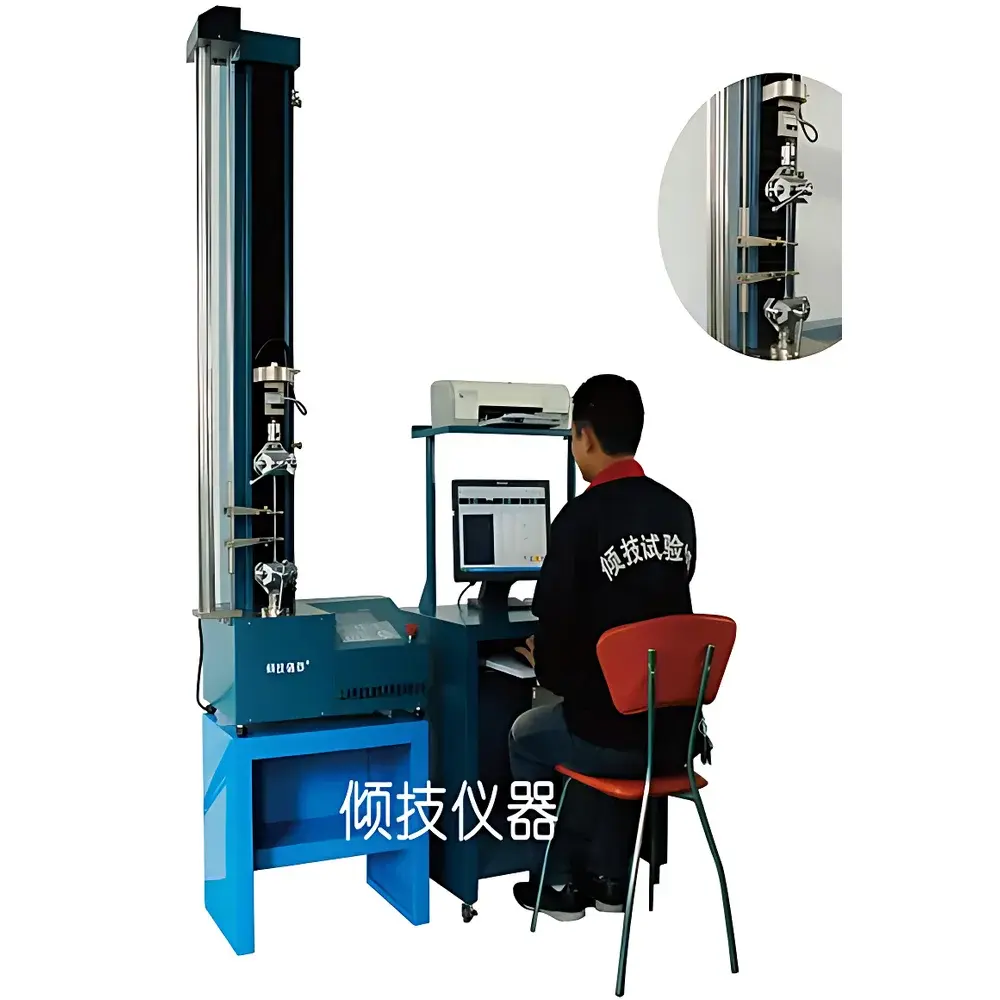
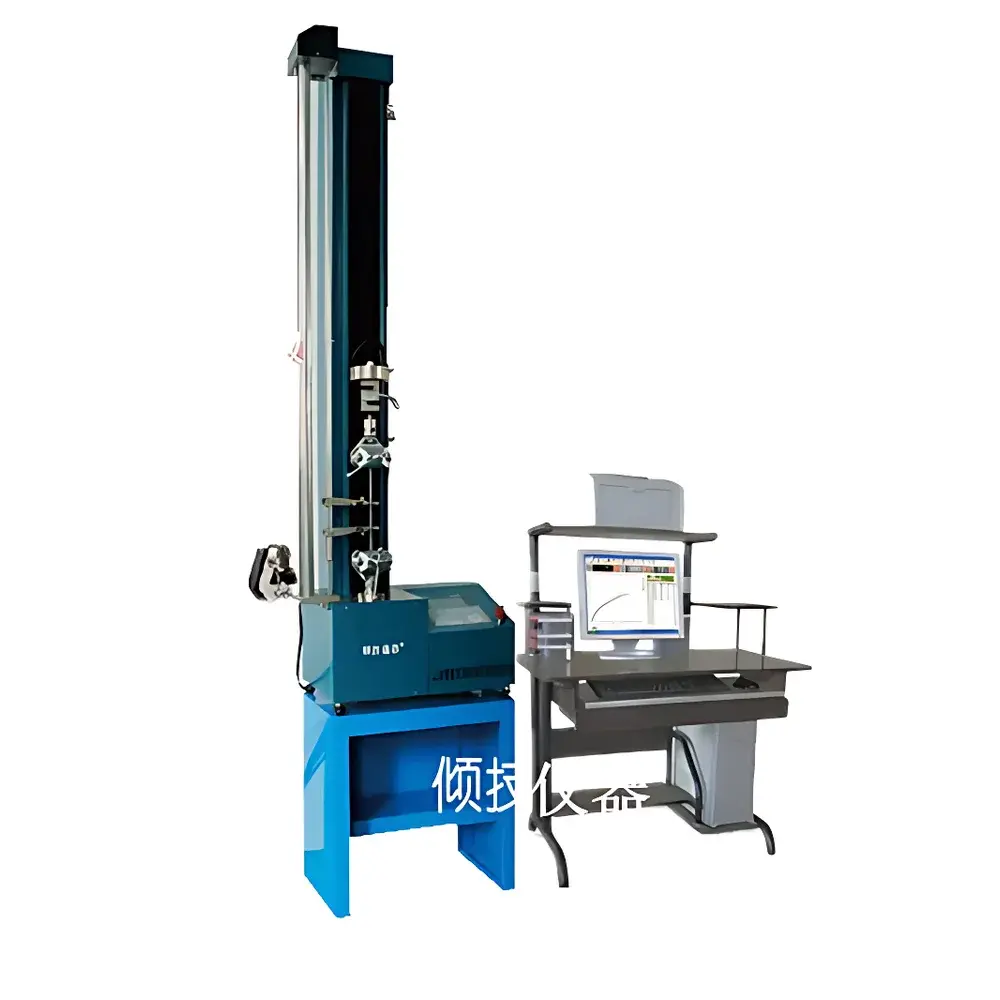
Qingji QJ210A Universal Adhesive Bond Strength Tester
| Origin | Shanghai, China |
|---|---|
| Manufacturer Type | Authorized Distributor |
| Origin Classification | Domestic (China) |
| Model | QJ210A |
| Price | USD 6,050 (FOB Shanghai) |
| Max Load Capacity | 5 kN |
| Load Cell Accuracy | 0.01% FS |
| Force Measurement Accuracy | < ±1% |
| Effective Test Width | 150 mm |
| Effective Stroke | 800 mm (extendable) |
| Test Speed Range | 1–300 mm/min |
| Speed Accuracy | ±1% |
| Displacement Resolution | ±1% |
| Deformation Measurement Accuracy | ±1% |
| Safety Features | Electronic Overtravel Limit, Emergency Stop Button |
| Weight | ~85 kg |
| Control System | Windows-based PC control with integrated data acquisition and reporting |
| Compliance | Designed to support ASTM D1002, ASTM D3163, ISO 4587, ISO 10365, GB/T 7124, GB/T 2790, GB/T 2791, GB/T 2792 |
Overview
The Qingji QJ210A Universal Adhesive Bond Strength Tester is an electromechanical tensile-shear testing system engineered for precision mechanical characterization of adhesive joints in R&D laboratories, quality control environments, and certification testing facilities. It operates on the principle of uniaxial force application under controlled displacement or load rate, conforming to standardized test geometries defined in ASTM, ISO, and Chinese national standards (GB/T). The system applies calibrated tensile, shear, peel, or cleavage forces to bonded substrates—such as metal-to-metal, polymer-to-metal, or composite-to-composite assemblies—to quantify interfacial bond integrity, cohesive strength, and failure mode behavior. Its modular frame architecture supports standardized specimen fixtures (e.g., lap-shear, T-peel, floating roller peel), enabling repeatable execution of method-defined protocols without manual reconfiguration.
Key Features
- High-fidelity 5 kN load frame with dual-range, temperature-compensated load cell (0.01% full-scale accuracy) ensuring traceable force measurement across low- and high-load regimes typical of structural adhesives and pressure-sensitive tapes.
- Full-digital servo motor drive with closed-loop speed regulation, delivering stable crosshead motion from 1 to 300 mm/min (±1% speed accuracy), critical for strain-rate-sensitive viscoelastic adhesives including epoxies, silicones, and acrylics.
- Windows-native control software featuring real-time plotting of force–displacement, stress–strain, and time–load curves; automatic peak detection; and programmable multi-step test sequences (e.g., preload → dwell → ramp → hold).
- Integrated hardware safety suite: programmable electronic travel limits, hardware-triggered emergency stop circuitry, and overload cut-off protection compliant with IEC 61800-5-2 functional safety guidelines.
- Modular fixture interface accommodating standard ASTM/ISO-compliant tooling—including 12.5 mm and 25 mm width shear blocks, 180° peel jigs, and floating roller assemblies—enabling rapid transition between test modes without recalibration.
- Calibration traceability documentation provided per ISO/IEC 17025 requirements, with optional NIST-traceable load cell certification available upon request.
Sample Compatibility & Compliance
The QJ210A accommodates bonded specimens ranging from thin film laminates (<0.1 mm total thickness) to thick-section structural joints (up to 25 mm substrate thickness). Compatible substrate materials include aluminum 2024-T3, stainless steel 304, polycarbonate, FR-4 PCB, and carbon fiber-reinforced polymer (CFRP). The system supports all major adhesive chemistries: thermosetting epoxies (standard and modified), silicone RTVs, polyurethanes, cyanoacrylates, anaerobics, and water-based acrylic dispersions. Test methods executed align with ASTM D1002 (lap shear), ASTM D3163 (small-area lap shear), ISO 4587 (adhesive strength of rigid plastics), ISO 10365 (classification of failure modes), GB/T 7124 (shear strength of adhesives), GB/T 2790 (peel strength), and GB/T 2791 (cleavage resistance). Data audit trails meet GLP and GMP documentation requirements per FDA 21 CFR Part 11 when operated with validated software configuration.
Software & Data Management
Control and analysis are performed via Qingji’s proprietary Windows-based software platform, built on .NET Framework with SQLite backend for local data persistence. The interface supports multi-user role assignment (operator, supervisor, administrator), electronic signature capture, and automated report generation in PDF/XLSX formats compliant with ISO/IEC 17025 clause 7.8. Raw test data—including timestamped force, displacement, and extensometer signals at ≥100 Hz sampling—is stored with metadata (operator ID, calibration date, environmental conditions, fixture ID). Export modules enable direct integration with LIMS platforms via CSV or OPC UA protocol. Software validation documentation (IQ/OQ/PQ templates) and change control logs are supplied for regulated environments.
Applications
- Qualification of aerospace-grade epoxy bonds per Boeing BMS 8-262 and Airbus ABD0031 specifications.
- QC release testing of medical device adhesive assemblies (e.g., sensor housing bonding) per ISO 10993-1 biocompatibility framework.
- Accelerated aging correlation studies—measuring bond strength retention after thermal cycling (−40°C to +125°C), humidity exposure (85% RH/85°C), or UV irradiation per ISO 4892.
- Formulation screening for automotive under-hood adhesives, including shear modulus profiling and failure mode mapping (cohesive vs. interfacial vs. substrate failure).
- Validation of surface pretreatment efficacy (plasma, corona, chemical etching) through comparative lap-shear strength analysis.
- Supporting ISO 11339 fatigue testing when coupled with optional cyclic loading module (not included in base configuration).
FAQ
What standards does the QJ210A support out-of-the-box?
ASTM D1002, ASTM D3163, ISO 4587, ISO 10365, GB/T 7124, GB/T 2790, GB/T 2791, and GB/T 2792 test methods are preconfigured in the software with default parameters and reporting templates.
Is the system compatible with external extensometers or video-based strain measurement?
Yes—the controller provides analog voltage input channels and TTL synchronization triggers for third-party contact or non-contact extensometers (e.g., clip-on LVDTs or digital image correlation systems).
Can test reports be exported in a format suitable for regulatory submission?
All reports generate PDF files with embedded digital signatures, calibration traceability stamps, and audit-ready metadata; XML export is available for ingestion into eDMS or regulatory archives.
What maintenance is required to sustain measurement accuracy?
Annual load cell recalibration and mechanical alignment verification are recommended; Qingji provides certified service technicians and maintains ISO/IEC 17025-accredited calibration labs in Shanghai and Suzhou.
Does the system support multi-specimen sequential testing without operator intervention?
Yes—batch test queues can be programmed with auto-unload/load logic (when used with optional pneumatic grip actuation kit) and pass/fail decision rules based on user-defined strength thresholds.



