
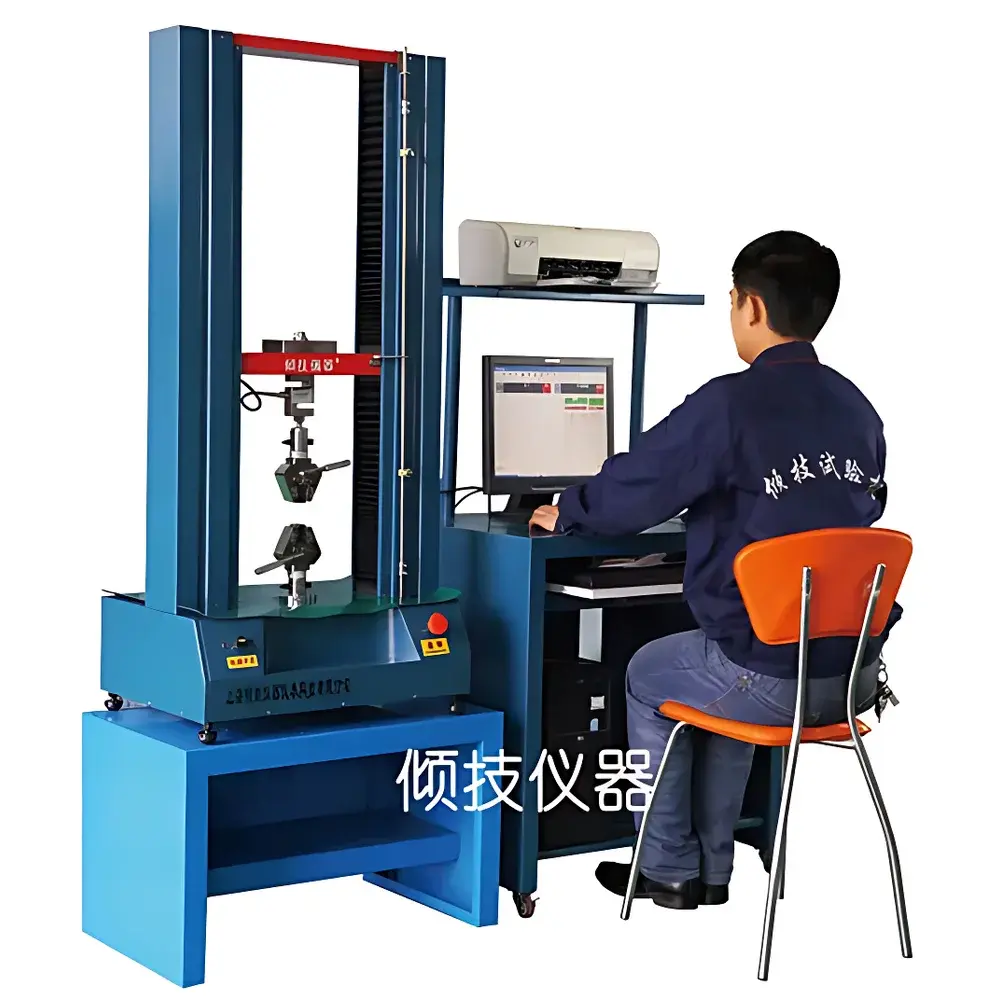
Qingji QJ211S Ceramic Flexural Strength Tester
| Origin | Shanghai, China |
|---|---|
| Manufacturer Type | Authorized Distributor |
| Origin Category | Domestic (China) |
| Model | QJ211S |
| Price | USD 9,500 (FOB Shanghai) |
| Max Load Capacity | 10 kN |
| Accuracy Class | 0.5 |
| Effective Test Width | 320 mm |
| Effective Stroke | 500 mm (extendable to 800 mm) |
| Speed Range | 0.01–300 mm/min |
| Speed Accuracy | ±0.5% of reading |
| Force Resolution | 500,000 counts (full-scale, no range switching) |
| Displacement & Strain Accuracy | ±0.5% of reading |
| Sensor | High-Precision Load Cell (USA-made) |
| Controller | Panasonic Full-Digital AC Servo System |
| Control Mode | Closed-Loop Constant Stress / Strain / Displacement |
| Compliance | ASTM C1161, ISO 14704, ISO 6872, GB/T 6569, JIS R 1601, YY/T 0320 |
Overview
The Qingji QJ211S Ceramic Flexural Strength Tester is a high-precision universal testing machine engineered for static mechanical characterization of advanced brittle and quasi-brittle materials—particularly structural ceramics, dental porcelain, technical alumina, zirconia, silicon carbide, and glass-ceramic composites. Based on the principles of quasi-static uniaxial loading under controlled displacement or force rate, the system implements standardized three-point and four-point bending configurations per ASTM C1161 and ISO 14704, as well as compressive and tensile testing per ISO 6872 (dental ceramics) and GB/T 6569 (engineering ceramics). Its rigid dual-column frame, integrated with a high-stiffness crosshead and precision-ground ball-screw actuation, ensures minimal deflection and high axial alignment fidelity—critical for accurate fracture stress determination in low-ductility materials where microcrack propagation dominates failure behavior.
Key Features
- Full-digital closed-loop control architecture supporting simultaneous real-time regulation of stress, strain, and displacement—enabling precise execution of ISO-compliant ramp-hold cycles and multi-step loading protocols.
- 0.5-class accuracy certified force measurement system, featuring a traceable USA-manufactured load cell with 500,000 internal resolution counts across the full 10 kN range—no auto-ranging or gain-switching required.
- Panasonic digital AC servo motor drive with dynamic speed control from 0.01 to 300 mm/min (±0.5% speed accuracy), optimized for both slow-crack-growth studies and rapid strength screening.
- Dual-mode positioning: motorized fast/slow traverse with programmable acceleration profiles; electronic limit switches and software-based overload protection (>110% FS) ensure operational safety.
- Modular fixture interface compliant with ISO 26203-2 and ASTM E1012, enabling rapid reconfiguration for standard 3-pt/4-pt flexure, compression (ISO 7500-1), and tension (ASTM E8) geometries.
- Integrated LCD console with real-time graphical display of load–displacement, stress–strain, and time-history curves—fully synchronized with PC-based data acquisition.
Sample Compatibility & Compliance
The QJ211S accommodates specimens conforming to ISO 14704 (rectangular bars: 3×4×45 mm), ASTM C1161 (3×4×50 mm), and YY/T 0320 (dental core specimens: Ø10×12 mm cylinders or 3×4×15 mm beams). Fixture sets include hardened steel support rollers (R5 mm radius), loading anvils (R2 mm), and compression platens with self-aligning spherical seats. All test methods are pre-programmed in the software library—including automatic calculation of flexural strength (σf = 3FL/2bd² for 3-pt; σf = FL/bd² for 4-pt), elastic modulus (via initial linear slope), fracture toughness (KIc estimation per ASTM E399 guidelines), and yield offset determination. The system meets GLP documentation requirements with audit-trail-enabled user authentication, electronic signatures, and timestamped raw data export (CSV, XML, PDF).
Software & Data Management
Control and analysis are performed via Qingji’s Windows-native QTest v4.2 software—a 64-bit application compliant with FDA 21 CFR Part 11 for electronic records and signatures. It supports multi-curve overlay, dynamic scaling, derivative analysis (dF/dx for stiffness transition detection), and customizable report templates aligned with ISO/IEC 17025 laboratory accreditation standards. Raw data files retain full metadata: operator ID, calibration certificate ID, environmental conditions (optional hygrometer/thermometer integration), and instrument configuration logs. Export formats include Excel-compatible CSV, vector-based SVG plots, and printer-ready PDFs with embedded digital signatures and revision-controlled headers.
Applications
- Quality control of sintered ceramic substrates (Al2O3, Si3N4) in electronics packaging manufacturing.
- R&D validation of veneering porcelain strength for CAD/CAM dental restorations (ISO 6872 compliance reporting).
- Mechanical screening of additive-manufactured ceramic green bodies pre- and post-sintering.
- Interlaboratory round-robin testing for ASTM WK72851 (standardization of flexural test methodology for ultrafine-grained ceramics).
- Evaluation of thermal shock resistance via sequential bending tests at elevated temperatures (with optional furnace integration kit).
FAQ
What international standards does the QJ211S directly support out-of-the-box?
ASTM C1161, ISO 14704, ISO 6872, GB/T 6569, JIS R 1601, YY/T 0320, and DIN 51105—all with pre-loaded test method definitions, pass/fail criteria, and report formatting.
Can the system perform cyclic fatigue testing on ceramics?
No—the QJ211S is designed exclusively for static monotonic loading. For fatigue evaluation (e.g., ISO 14704 Annex B), a dedicated servo-hydraulic fatigue tester with ≥10 Hz frequency response is recommended.
Is third-party calibration certification included?
Yes—each unit ships with a NIST-traceable calibration certificate valid for 12 months, covering force, displacement, and speed channels per ISO 7500-1 and ISO 9513.
What maintenance intervals are specified for long-term accuracy retention?
Biannual verification of load cell linearity and crosshead alignment is advised; annual recalibration is required for ISO/IEC 17025-accredited labs. Consumables include roller fixtures (recomm. replacement every 5,000 cycles) and grip inserts (every 2,000 tests).
Does the software support automated batch testing with barcode-triggered specimen identification?
Yes—via optional USB barcode scanner integration, QTest v4.2 enables auto-population of specimen IDs, material codes, and lot numbers into test records, reducing manual entry errors in high-throughput QC environments.



