
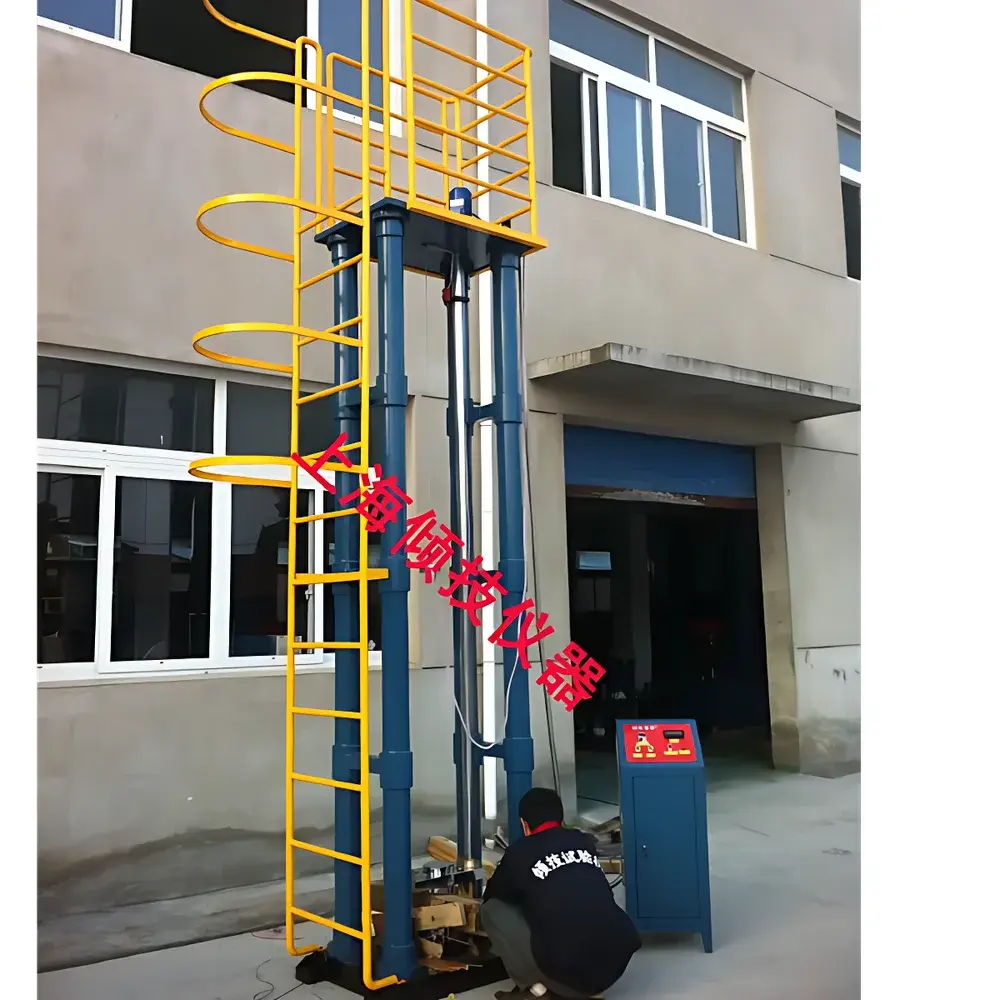
Qingji QJLC-3 High-Speed Impact Strength Tester
| Brand | Qingji |
|---|---|
| Origin | Shanghai, China |
| Model | QJLC-3 |
| Maximum Load Capacity | 500 kN |
| Test Range | 20–500 kN (Accuracy: ±1%) |
| Drop Height Adjustment Range | 0–10,000 mm (Resolution: 0.1 mm) |
| Standard Weights | 2, 3, 4, 5, 10, 20, 50, and 100 kg (AISI 1045 steel |
| Mass Tolerance | ±1%) |
| Accuracy Class | Class 1 (per ISO 7500-1) |
| Control & Data Acquisition | Integrated QJLC17.7.Ttest Real-Time Impact Analysis Software |
Overview
The Qingji QJLC-3 High-Speed Impact Strength Tester is a precision-engineered drop-weight impact testing system designed for quantitative evaluation of dynamic mechanical response in rigid and quasi-brittle materials. It operates on the principle of gravitational free-fall impact, where a calibrated mass is elevated to a precisely controlled height and released to strike a standardized specimen at defined velocity and kinetic energy. The system captures transient force-time, displacement-time, and energy-time profiles during the entire impact event—enabling derivation of key material performance indicators including peak impact force, total absorbed energy, plastic deformation, elastic recovery, and fracture initiation threshold. Engineered for compliance with fundamental mechanical testing frameworks, the QJLC-3 supports method development aligned with ASTM E23, ISO 148-1, ISO 83, and GB/T 229, while its modular architecture accommodates custom fixture integration for non-standard geometries and industry-specific test configurations.
Key Features
- High-resolution electro-mechanical drop-height actuation with 0.1 mm positional repeatability across a 0–10,000 mm vertical travel range
- Dual-sensor synchronized acquisition: piezoelectric force transducer (up to 500 kN full scale) and high-speed linear variable differential transformer (LVDT) for sub-millisecond displacement resolution
- Class 1 load measurement accuracy per ISO 7500-1, verified via traceable calibration certificates for all standard weights (2–100 kg AISI 1045 steel)
- Real-time data streaming at ≥1 MHz sampling rate, buffered to onboard solid-state memory to prevent loss during high-energy impact events
- Modular weight configuration system enabling rapid reconfiguration between low-energy (20 kN) and high-energy (500 kN) test regimes without hardware modification
- Fail-safe electromagnetic braking and redundant mechanical catch mechanisms compliant with ISO 12100 Category 3 safety architecture
Sample Compatibility & Compliance
The QJLC-3 accommodates specimens up to 300 mm × 300 mm × 150 mm (L×W×H), supporting Charpy V-notch, Izod, tensile impact, and custom geometry fixtures. It is routinely deployed for quality control and R&D validation of cemented carbides, sintered diamond compacts, structural steels (including quenched & tempered grades), engineering thermoplastics (e.g., PEEK, PEI), graphite electrodes, and geological core samples. All mechanical and electrical subsystems meet CE marking requirements under Machinery Directive 2006/42/EC and EMC Directive 2014/30/EU. Software functionality adheres to ALCOA+ principles for data integrity, with audit trail logging, electronic signature support, and export formats compatible with LIMS integration (CSV, XML, PDF/A-2).
Software & Data Management
The proprietary QJLC17.7.Ttest software provides full-cycle test management—from parameter definition and pre-test diagnostics to real-time waveform visualization, post-event curve analysis, and automated report generation. It implements ISO/IEC 17025-compliant uncertainty estimation for each test result, incorporating contributions from load cell hysteresis, height encoder drift, and mass tolerance. Raw time-series datasets are stored in HDF5 format with embedded metadata (operator ID, calibration expiry, environmental conditions). The software supports 21 CFR Part 11-compliant user access control, role-based permissions, and immutable audit trails—including all parameter edits, manual overrides, and calibration interventions. Export modules generate GLP/GMP-ready documentation packages suitable for regulatory submission or internal QA review.
Applications
- Dynamic toughness assessment of tungsten carbide cutting tools subjected to intermittent machining loads
- Fracture energy benchmarking of nuclear-grade graphite moderators under simulated LOCA conditions
- Impact resistance qualification of composite tooling plates used in aerospace autoclave tooling
- Brittle-to-ductile transition temperature mapping in high-strength low-alloy (HSLA) steels
- Energy absorption characterization of polymer matrix composites for ballistic panel development
- Validation of ASTM D7136/D7136M for compression-after-impact (CAI) residual strength prediction
FAQ
What standards does the QJLC-3 support out-of-the-box?
The system includes preconfigured test templates for ASTM E23, ISO 148-1, ISO 83, and GB/T 229, with configurable parameters for notch geometry, striker radius, and support span.
Can the system be integrated into an existing laboratory network?
Yes—Ethernet TCP/IP interface enables remote monitoring, scheduled calibration alerts, and secure data push to centralized servers via TLS 1.2 encrypted channels.
Is third-party calibration certification available?
Qingji provides factory calibration reports traceable to NIM (China National Institute of Metrology); optional UKAS-accredited calibration services are available through authorized regional partners.
What maintenance intervals are recommended?
Preventive maintenance is scheduled every 12 months or after 5,000 impact cycles—whichever occurs first—with documented verification of guide rail alignment, brake response latency, and sensor zero stability.
Does the software support multi-user environments with audit compliance?
Yes—QJLC17.7.Ttest implements role-based access control, electronic signatures, and immutable audit logs meeting FDA 21 CFR Part 11 and EU Annex 11 requirements.



