
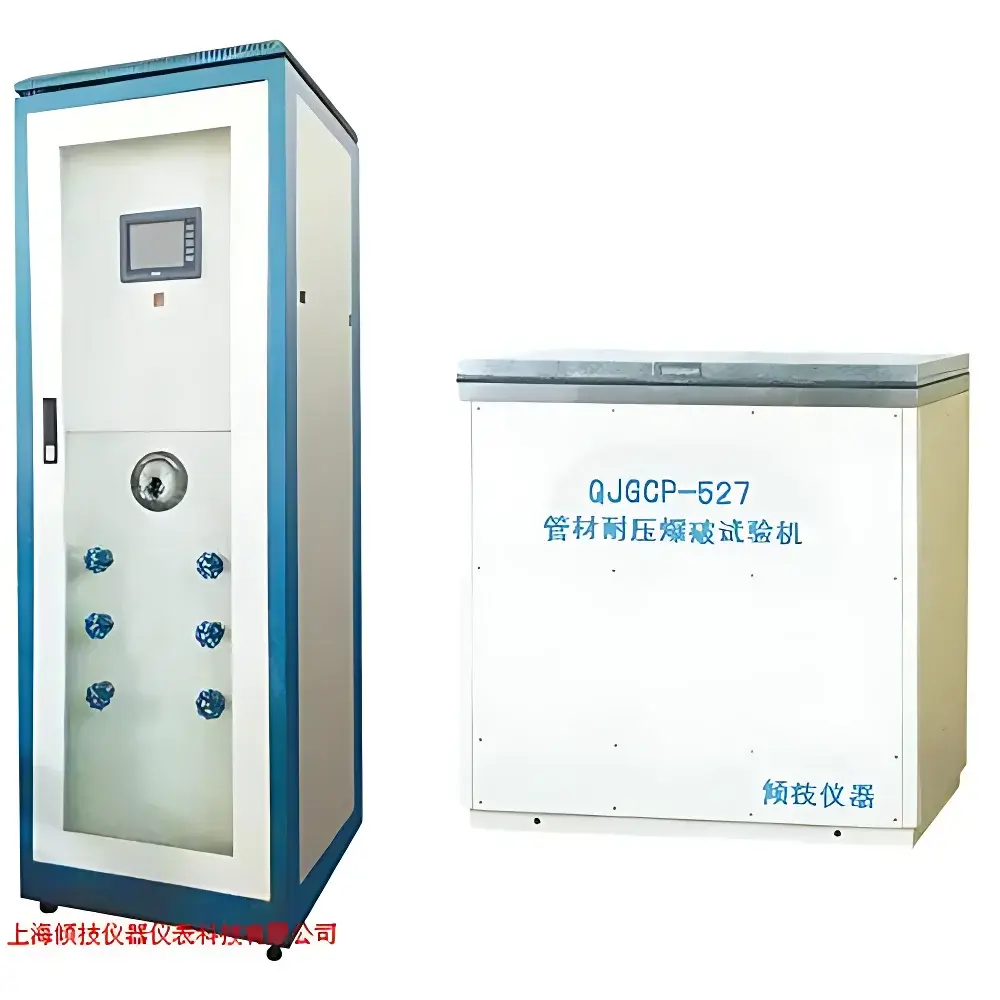
Qinji GCP-527 Tri-Station Hydraulic Pressure Testing Machine for Plastic Pipes
| Brand | Qinji |
|---|---|
| Model | GCP-527 |
| Type | Tri-Station Static Hydrostatic Pressure Tester |
| Compliance | ISO 1167, GB/T 6111 |
| Pressure Range | 0–10 MPa |
| Pressure Resolution | 0.001 MPa |
| Pressure Control Accuracy | ±0.1% of setpoint |
| Temperature Control Range | Ambient to 95 °C |
| Temperature Uniformity | ±1 °C |
| Test Duration Range | 0 min to 9999 h 59 min |
| Time Resolution | 1 s |
| Power Supply (Pressure System) | AC 380 V, 1.5 kW per station |
| Power Supply (Heating System) | AC 380 V, 9 kW total |
| Station Count | 3 independent test stations |
| Sample Diameter | Customizable per user requirement |
| Data Output | Automated calculation and thermal printing |
Overview
The Qinji GCP-527 is a tri-station static hydrostatic pressure testing machine engineered for standardized long-term pressure resistance and instantaneous burst evaluation of thermoplastic and composite piping systems. It operates on the principle of sustained internal hydraulic pressure application under controlled thermal conditions—directly aligned with the fundamental test methodology defined in ISO 1167-1:2014 (Plastics pipes and fittings — Resistance to internal pressure — Part 1: General method) and GB/T 6111–2018 (Methods for determination of resistance to internal pressure of thermoplastic pipes for liquid transport). The system subjects sealed pipe specimens to precisely regulated water-based hydrostatic loads within a thermostatically stabilized bath, enabling quantification of time-to-failure, creep rupture behavior, and structural integrity under service-relevant stress states. Designed for laboratories performing quality assurance, product certification, and R&D validation, the GCP-527 delivers high reproducibility across extended test durations—critical for compliance with international piping standards including ASTM D1598, EN 921, and ISO 13479.
Key Features
- Three independent, synchronized test stations—enabling parallel evaluation of up to three specimens under identical or individually programmed pressure/temperature profiles.
- High-resolution digital pressure control system with 0.001 MPa resolution and tight regulation accuracy of ±0.1% of setpoint—ensuring traceable, repeatable load application per ISO 1167 Annex C requirements.
- Integrated temperature-controlled bath with PID-driven heating (ambient to 95 °C), uniformity maintained within ±1 °C across the immersion volume—validated per ISO 1167-2 calibration protocols.
- Real-time monitoring of pressure, temperature, and elapsed time with 1-second temporal resolution and display range extending to 9999 hours 59 minutes—supporting multi-week creep rupture tests without data interruption.
- Dedicated AC 380 V power architecture: 1.5 kW per pressure station (total 4.5 kW for pressurization), plus centralized 9 kW heating supply—optimized for stable thermal equilibrium during prolonged high-temperature testing.
- Automated pass/fail logic and result computation engine compliant with GB/T 6111 failure criteria, generating timestamped reports with specimen ID, test parameters, and rupture time—export-ready for audit trails.
Sample Compatibility & Compliance
The GCP-527 accommodates standard pipe geometries used in municipal water, gas distribution, and industrial fluid conveyance—including PVC-U, PE80/PE100, PP-R, ABS, and multilayer composite structures. Specimen diameter is configurable via user-selected end caps and sealing fixtures (sold separately), supporting common nominal diameters from DN16 to DN630. All operational parameters adhere to the metrological and procedural constraints specified in ISO 1167-1, ISO 1167-2, and GB/T 6111. The system supports both constant-pressure hold tests (for long-term hydrostatic strength assessment) and stepwise pressure ramping (for burst threshold identification), with full alignment to the statistical analysis frameworks outlined in ISO 9080 for extrapolated minimum required strength (MRS) derivation.
Software & Data Management
The embedded microcontroller firmware provides local real-time data acquisition without dependency on external PCs. Test logs—including pressure vs. time curves, temperature drift records, and event timestamps—are stored internally and output via integrated thermal printer. For laboratories requiring electronic record retention, optional RS485/Modbus RTU interface enables integration into LIMS or SCADA environments. All printed reports include unique test identifiers, operator inputs, environmental verification stamps, and compliance statements referencing applicable clauses of ISO 1167 and GB/T 6111—facilitating GLP-aligned documentation and FDA 21 CFR Part 11–compatible audit readiness when paired with validated electronic signature modules.
Applications
- Quality conformance testing of pipe batches prior to ISO 4427/4437 certification.
- Long-term hydrostatic strength (LTHS) data generation for ISO 9080-based design coefficient derivation.
- Burst pressure validation for pressure-rated piping systems operating at elevated temperatures (e.g., hot water distribution).
- Comparative evaluation of material formulations (e.g., PE resin grades, stabilizer packages) under accelerated stress conditions.
- Third-party verification testing for CE marking, CCC certification, and utility company procurement specifications.
- Research into time-dependent deformation mechanisms (creep, slow crack growth) in polymeric pipe materials.
FAQ
What standards does the GCP-527 directly support?
ISO 1167-1:2014, ISO 1167-2:2014, GB/T 6111–2018, ASTM D1598, EN 921, and ISO 13479.
Can the system perform both constant-pressure and pressure-ramp tests?
Yes—user-defined test profiles include static hold, linear ramp, and multi-step pressure sequences, all programmable per station.
Is temperature uniformity verified across the entire bath volume?
Yes; bath homogeneity is validated using calibrated PT100 sensors at multiple spatial points per ISO 1167-2 Annex B requirements.
Are test reports compliant with regulatory audit requirements?
Thermal printouts contain mandatory metadata (date/time, operator ID, calibration status, standard reference) and support 21 CFR Part 11–compliant digital archiving when interfaced with validated software.
What is the maximum recommended test duration?
The system supports continuous operation up to 9999 hours 59 minutes—sufficient for 16,000-hour extrapolation studies per ISO 9080.



