
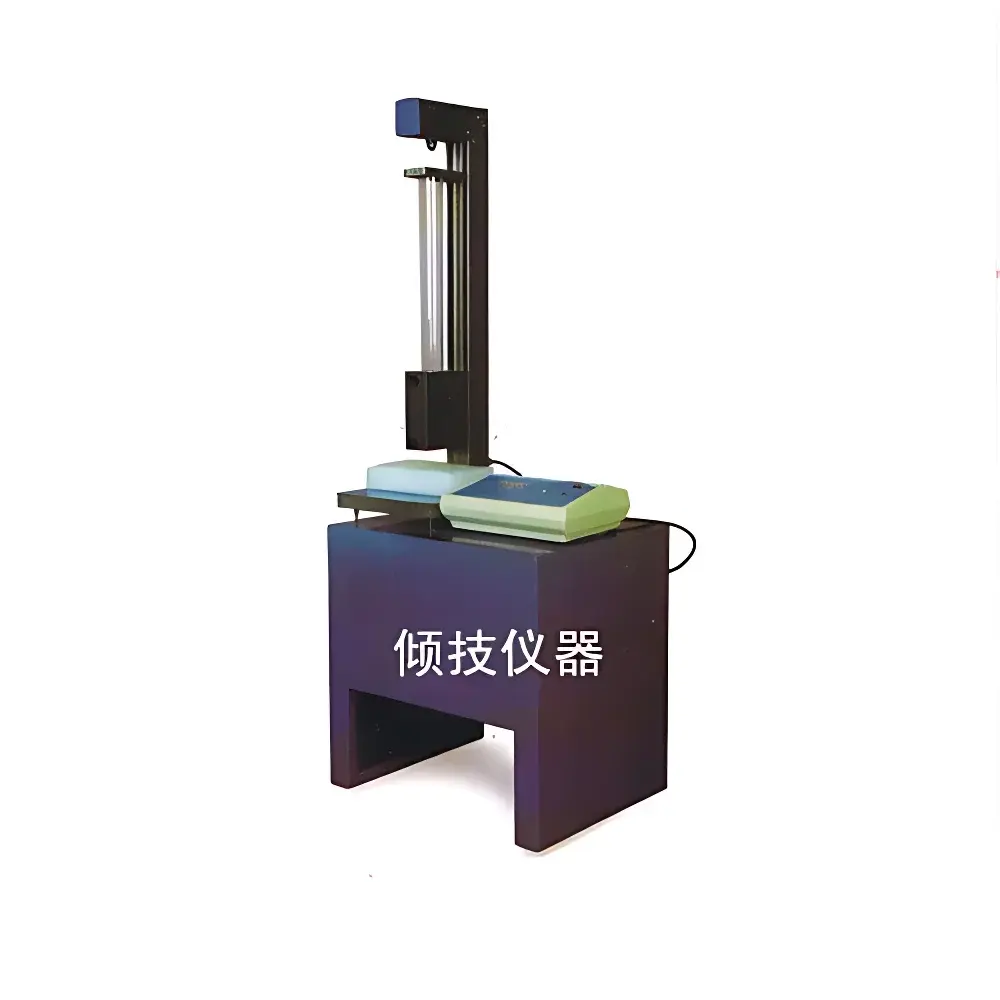
Qinji QJ-REB Elastic Recovery Coefficient Tester for Flexible Foam and Rubber Materials
| Origin | Shanghai, China |
|---|---|
| Manufacturer Type | Authorized Distributor |
| Origin Category | Domestic (PRC) |
| Model | QJ-REB |
| Price | USD 5,900 |
| Power Supply | 220 V, 50 Hz |
| Drop Height | 460 mm |
| Steel Ball Diameter | 16 mm |
| Steel Ball Mass | 16.7 g |
| Time Resolution | 0.0001 s |
| Rebound Coefficient Range | 25%–80% |
Overview
The Qinji QJ-REB Elastic Recovery Coefficient Tester is a precision instrument engineered for the quantitative assessment of dynamic resilience in soft cellular polymeric materials—primarily flexible polyurethane (PU) foams, elastomeric rubbers, and other viscoelastic cushioning media. It operates on the principle of free-fall impact rebound, compliant with ISO 8307:2022 Determination of resilience of flexible cellular polymeric materials — Ball rebound method, and equivalent to ASTM D3574 Method B and GB/T 6670–2008 (replacing GB 6670–1986). In this standardized test, a calibrated steel sphere is released from a fixed vertical height onto a horizontally mounted specimen surface; the rebound height is measured optically with high temporal resolution, and the resilience coefficient is calculated as the ratio of rebound height to drop height, expressed as a percentage. This method provides a reproducible, non-destructive metric directly correlated with energy absorption, hysteresis loss, and long-term fatigue resistance—critical parameters for automotive seating, mattress core evaluation, packaging cushion design, and medical support surfaces.
Key Features
- Electromagnetically actuated release mechanism ensuring zero initial velocity and minimal mechanical perturbation at drop initiation
- High-resolution photogate timing system with 0.0001 s resolution, enabling precise capture of both impact and rebound events
- Dual-mode validation: simultaneous digital measurement via optical sensors and manual visual verification using integrated scale reference grid
- Stainless-steel test chamber with anti-vibration base plate and adjustable leveling feet for stable operation on standard laboratory benches
- LED-digit display module showing real-time rebound height (mm), calculated coefficient (%), and pass/fail status against user-defined thresholds
- Compliance-ready design: all electronic components meet IEC 61000-4 electromagnetic compatibility standards; housing conforms to IP20 ingress protection
Sample Compatibility & Compliance
The QJ-REB accommodates specimens measuring ≥100 mm × 100 mm × 50 mm (L × W × H), with minimum density ≥15 kg/m³ and Shore A hardness ≤80. It supports testing of slabstock foams, molded PU parts, thermoplastic elastomers (TPE), natural rubber compounds, and silicone elastomers—provided surfaces are flat, dry, and free of coatings or adhesives that may interfere with rebound dynamics. The instrument satisfies mandatory requirements for quality control laboratories operating under ISO/IEC 17025:2017 accreditation frameworks. Test reports generated include full traceability metadata: operator ID, calibration date, ambient temperature/humidity (optional external sensor input), and raw time-stamped photogate signals—supporting audit readiness for automotive OEM Tier-1 suppliers and medical device manufacturers subject to IATF 16949 or ISO 13485 quality systems.
Software & Data Management
While the base QJ-REB operates as a standalone unit with embedded firmware, optional USB-to-PC interface enables data export in CSV format for integration into LIMS or statistical process control (SPC) platforms. Firmware version 2.3+ supports GLP-compliant audit trails: each test record logs timestamp, operator code, sample ID, and instrument serial number. No proprietary software installation is required—data files are natively readable in Excel, Minitab, or JMP. For regulated environments, optional 21 CFR Part 11 add-on module provides electronic signature capability, role-based access control, and immutable record archiving—validated per IQ/OQ protocols supplied with documentation package.
Applications
- Quality assurance of flexible foam batches in PU manufacturing plants
- Rubber compound development labs assessing vulcanization effects on resilience
- Automotive interior component testing per GMW15634 and Ford FLTM BU 141-01
- Furniture and bedding certification per BS EN 1334:2012 and ASTM F1957
- Academic research on polymer network structure–resilience correlations
- Third-party testing laboratories performing accredited conformity assessments
FAQ
What standards does the QJ-REB comply with?
ISO 8307:2022, ASTM D3574 Method B, GB/T 6670–2008, and JIS K 6400-4:2015.
Is calibration certification included with shipment?
Yes—a NIST-traceable calibration certificate (valid for 12 months) is provided with each unit, covering drop height accuracy, ball mass verification, and timing system linearity.
Can the instrument be used for non-foam materials such as gel pads or memory foam composites?
Yes, provided the material exhibits sufficient surface elasticity and dimensional stability during impact; users must validate repeatability per ISO 5725 for new material classes.
What maintenance is required to sustain measurement accuracy?
Annual recalibration recommended; routine cleaning of photogate lenses and steel ball with isopropyl alcohol; replacement of electromagnet coil every 50,000 cycles (log available in firmware diagnostic menu).
Is technical support available outside China?
Yes—Qinji maintains authorized service partners in Germany, USA, and Singapore, with remote diagnostics and on-site engineer dispatch options under extended warranty agreements.



