
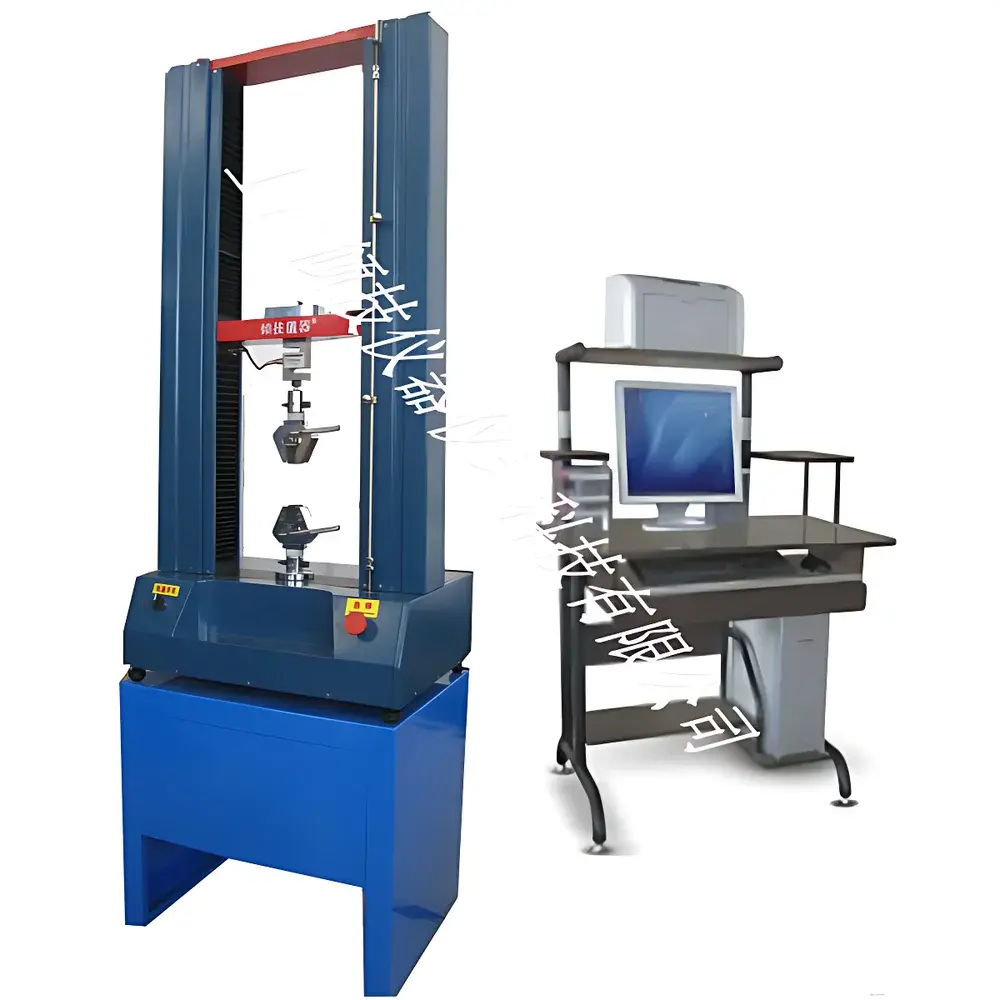
Qinji QJ211S Intelligent Electronic Tensile Testing Machine
| Brand | Qinji |
|---|---|
| Origin | Shanghai, China |
| Manufacturer Type | Authorized Distributor |
| Product Origin | Domestic (China) |
| Model | QJ211S |
| Price | USD 1,700 (FOB Shanghai) |
| Instrument Type | Electromechanical Universal Tensile Tester |
| Maximum Load Capacity | 10 kN |
| Accuracy Class | 0.5 |
| Effective Test Width | 320 mm |
| Effective Stroke | 500 mm |
| Speed Range | 0.01–50,000 mm/min (standard default: 300 mm/min) |
| Speed Accuracy | ±0.5% of indicated value |
| Displacement Measurement Accuracy | ±0.5% of indicated value |
| Strain Measurement Accuracy | ±0.5% of indicated value |
| Load Resolution | 500,000 counts (full-scale, no internal range switching) |
| Motor Power | 400 W |
| Net Weight | 145 kg |
Overview
The Qinji QJ211S Intelligent Electronic Tensile Testing Machine is a precision electromechanical universal testing system engineered for static mechanical property evaluation of flexible and semi-rigid materials—including leather, textiles, films, foams, elastomers, medical tubing, packaging substrates, and polymer composites. It operates on the principle of controlled uniaxial force application via a servo-controlled AC motor-driven crosshead, with real-time acquisition of load, displacement, and strain signals through high-stability load cells and optical encoders. Designed to meet ISO 7500-1 (Class 0.5), ASTM E4, and GB/T 16491 verification standards, the system delivers traceable force measurement across its full 10 kN capacity—enabling accurate determination of tensile strength, yield point, elongation at break, modulus of elasticity, tear resistance, and peel adhesion per standardized test protocols.
Key Features
- High-resolution force measurement: 500,000-count A/D conversion with no internal range switching—ensuring consistent resolution (0.02 N typical at 10 kN) across the entire load spectrum.
- Wide dynamic speed range: Programmable crosshead velocity from 0.01 mm/min (for creep/stress-relaxation studies) to 50,000 mm/min (for high-strain-rate impact simulation), with speed accuracy maintained within ±0.5% of setpoint.
- Dual-mode motion control: Independent fast/slow jog controls for rapid positioning and fine adjustment; programmable return-to-start functionality with selectable speed profiles (manual or automatic post-fracture).
- Integrated safety architecture: Dual-layer overload protection (electronic limit + mechanical stop), programmable software-based force/displacement limits, and emergency stop circuit compliant with IEC 60204-1.
- Modular fixture compatibility: Standardized T-slot base and quick-mount interface support interchangeable grips—including pneumatic vise, wedge-action, pin-and-roller, bend fixtures, puncture probes, and peel test assemblies—for multi-test capability without hardware reconfiguration.
- Real-time Windows-based control: Native 64-bit software with synchronized dual-channel data acquisition (load + displacement), live curve overlay, and configurable sampling rates up to 1 kHz.
Sample Compatibility & Compliance
The QJ211S accommodates specimens up to 320 mm wide and 500 mm gauge length, supporting flat, tubular, and irregular geometries via custom fixturing. Its modular design enables seamless adaptation to international test standards including ASTM D638 (plastics), ASTM D412 (rubber), ISO 1798 (foam), ISO 13934-1 (textiles), GB/T 2792 (peel), QB/T 2710 (leather tensile), YY/T 0681.10 (medical packaging), and JIS K6251 (elastomer). All firmware and calibration routines are documented per ISO/IEC 17025 requirements, and the system supports audit-ready electronic records compliant with FDA 21 CFR Part 11 when configured with user authentication, electronic signatures, and immutable data logging.
Software & Data Management
The included Windows-native software provides full GLP/GMP-aligned data governance: automatic timestamping, operator ID tagging, instrument ID logging, and version-controlled method templates. Test curves are stored in open-format CSV and XML, enabling third-party statistical analysis (e.g., JMP, Minitab). Advanced post-processing includes derivative calculation (dF/dt, dε/dt), modulus segmentation (secant/tangent), yield offset determination (0.2% proof stress), and batch report generation with customizable pass/fail criteria. Data integrity safeguards include write-once archive mode, encrypted backup export, and configurable retention policies aligned with internal quality management systems.
Applications
This system serves QC laboratories in footwear, automotive interiors, medical device manufacturing, flexible packaging R&D, and textile mills—where reproducible quantification of mechanical behavior under tension, flexure, puncture, and peel loading is critical. Typical use cases include validating raw material consistency against supplier specifications, verifying process-induced property changes (e.g., heat aging, UV exposure), supporting regulatory submissions (e.g., ISO 10993 biocompatibility mechanical testing), and generating input parameters for finite element modeling (FEM) of component deformation.
FAQ
Does the QJ211S comply with ISO 17025 calibration traceability requirements?
Yes—the system ships with a factory calibration certificate traceable to NIM (National Institute of Metrology, China) and includes procedures for user-performed verification per ISO/IEC 17025 Annex B.
Can the software generate 21 CFR Part 11-compliant audit trails?
Yes—when deployed on a domain-joined Windows machine with enabled Group Policy settings, the software logs all user actions, parameter changes, and data modifications with timestamps and operator IDs.
What is the recommended maintenance schedule?
We recommend quarterly verification of load cell linearity and encoder resolution, annual recalibration by an accredited lab, and biannual lubrication of lead screws and guide rails per the maintenance manual.
Is remote technical support available for troubleshooting?
Yes—Qinji’s engineering team offers secure remote desktop assistance (via TeamViewer with customer consent) during business hours CET+8, with SLA response times defined in the service agreement.
Are ASTM- or ISO-specified test methods preloaded in the software?
The software includes over 40 validated method templates—including ASTM D882, ISO 527-3, and GB/T 1040.4—with auto-configured test parameters, acceptance criteria, and reporting formats.



