
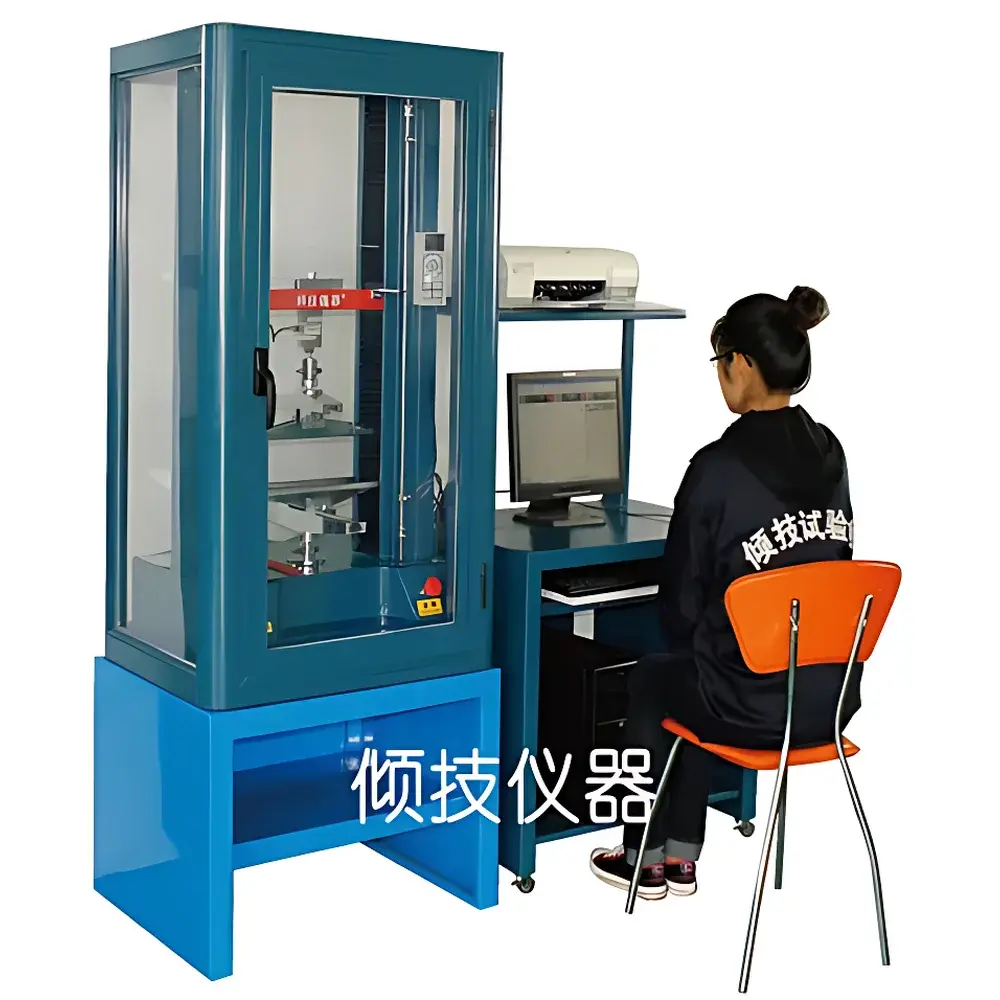
Qinji QJ211S2 Three-Point Bending Tester for Glass – Universal Electromechanical Testing Machine
| Brand | Qinji |
|---|---|
| Origin | Shanghai, China |
| Model | QJ211S2 |
| Type | Electromechanical Universal Testing Machine |
| Max Load Capacity | 10 kN |
| Load Accuracy Class | 0.5 |
| Effective Test Width | 320 mm |
| Stroke (Tensile) | 500/800 mm |
| Speed Range | 0.01–300 mm/min |
| Speed Accuracy | ±0.5% of reading |
| Force Resolution | 500,000 counts (full-scale, no range switching) |
| Displacement & Strain Measurement Accuracy | ±0.5% of reading |
| Sensor | High-Precision U.S.-Sourced Load Cell |
| Controller | Panasonic Full-Digital AC Servo System |
| Control Mode | Closed-Loop Digital Control (Constant Load, Constant Displacement, Constant Strain) |
| Safety Protection | Software Diagnostics, Electronic Limit Switches, Overload Protection (110% FS), Emergency Stop |
| Weight | ~145 kg |
| Compliance | GB, ISO 178, ASTM D790, JIS K7203, DIN 53455, EN 1288-3, YB/T 5349, JT/T 604, QC/T 989 |
Overview
The Qinji QJ211S2 Three-Point Bending Tester for Glass is a high-precision electromechanical universal testing machine engineered specifically for mechanical characterization of brittle and semi-brittle transparent substrates—including chemically strengthened smartphone cover glass, LCD/OLED display panels, tempered architectural glazing, optical lens substrates, and ophthalmic lenses. It operates on the standardized three-point bending (3PB) principle defined in ISO 178 and ASTM D790, where a rectangular specimen rests on two parallel supports while a centrally applied load induces flexural stress until fracture or specified deflection. The system’s rigid C-frame architecture, low-noise servo drive, and real-time closed-loop control ensure high reproducibility in modulus, flexural strength, and fracture toughness evaluation—critical parameters for quality assurance in glass manufacturing, R&D labs, and third-party certification facilities.
Key Features
- Modular test configuration supporting both three-point and four-point bending per EN 1288-3 and ISO 1288-5, with optional fixture kits for tensile, compression, shear, puncture, and peel testing.
- 0.5-class force accuracy certified to ISO 7500-1, validated across the full 10 kN capacity without internal range switching—enabling consistent resolution down to 0.02% of full scale.
- Full-digital closed-loop control system integrating Panasonic AC servo motor, high-resolution encoder, and U.S.-sourced load cell for synchronized force-displacement-strain feedback.
- Real-time dynamic visualization of load vs. displacement, stress vs. strain, and modulus evolution curves via 7-inch industrial LCD interface; all parameters configurable pre-test with password-protected user profiles.
- Dual-speed crosshead actuation (fast positioning + precision testing mode) and programmable return-to-start function improve throughput in high-volume QA environments.
- Comprehensive hardware safety: electronic travel limits, software-based overload cutoff (110% FS), emergency stop circuitry compliant with IEC 60204-1, and automatic fault logging.
Sample Compatibility & Compliance
The QJ211S2 accommodates flat, polished glass specimens up to 320 mm wide and 800 mm long, with standard support span adjustable from 20 mm to 300 mm to meet requirements for thin cover glass (e.g., 0.3–2.0 mm thickness) and thicker architectural laminates. Fixture geometry adheres strictly to ISO 1288-3 (for float glass) and ASTM C158 (for edge-strengthened specimens). Data acquisition and reporting workflows support audit-ready compliance with GLP, GMP, and ISO/IEC 17025 laboratory accreditation standards. Export-capable test reports include raw time-stamped data, statistical summaries (mean, SD, CV%), pass/fail flags against user-defined thresholds, and digital signatures traceable to operator ID and calibration certificate numbers.
Software & Data Management
Control and analysis are executed via Windows-based QinjiTest Pro v4.2 software—a 64-bit application compatible with Windows 10/11 and FDA 21 CFR Part 11–ready when deployed with optional electronic signature modules. The software enables full curve manipulation: overlay multiple tests, apply polynomial smoothing, extract tangent/ secant modulus, calculate fracture energy from area under the curve, and export ASCII, CSV, or PDF formats. All test sessions are logged with immutable timestamps, instrument ID, calibration status, environmental metadata (optional external hygrothermograph integration), and operator credentials. Audit trails record every parameter change, file deletion, or report generation event—retained for ≥15 years per default configuration.
Applications
- Flexural strength validation of alkali-aluminosilicate cover glass (e.g., Gorilla Glass®, Dragon Trail™) during incoming inspection and batch release.
- Comparative evaluation of ion-exchange depth vs. bend resistance in post-processing QA.
- Mechanical screening of anti-reflective, oleophobic, and hard-coated glass substrates under controlled humidity conditions.
- Development testing of laminated safety glass interlayers (PVB, EVA, TPU) using four-point bending per EN 1288-5.
- Research-grade fracture mechanics studies including R-curve analysis and crack initiation energy quantification.
- Support for automotive glazing certification per JT/T 604 and railway window testing per TB/T 3187.
FAQ
What standards does this tester fully support for glass bending tests?
ISO 178, ASTM D790, EN 1288-3, ISO 1288-5, GB/T 9341, JIS K7203, and YB/T 5349 — with preloaded test templates and automatic calculation of flexural modulus, strength at break, and strain at peak load.
Can the system be integrated into an existing LIMS or MES environment?
Yes — via OPC UA or TCP/IP API interfaces; raw data streams and JSON-formatted test summaries can be pushed to enterprise databases or cloud platforms (e.g., AWS IoT Core, Azure IoT Hub) with TLS 1.2 encryption.
Is calibration traceability provided with the instrument?
Each unit ships with a factory calibration certificate traceable to NIM (China National Institute of Metrology) and includes a 12-month recalibration schedule aligned with ISO/IEC 17025 requirements.
What maintenance is required during routine operation?
Daily visual inspection of guide rails and load train; quarterly lubrication of ball screws; annual verification of sensor linearity and encoder resolution using NIST-traceable reference standards.
Does the system support automated testing sequences for unattended operation?
Yes — batch test protocols with auto-load/unload triggers, pass/fail decision logic, and conditional branching (e.g., “if strength < X MPa, run secondary compression test”) are fully scriptable in QinjiTest Pro.



