
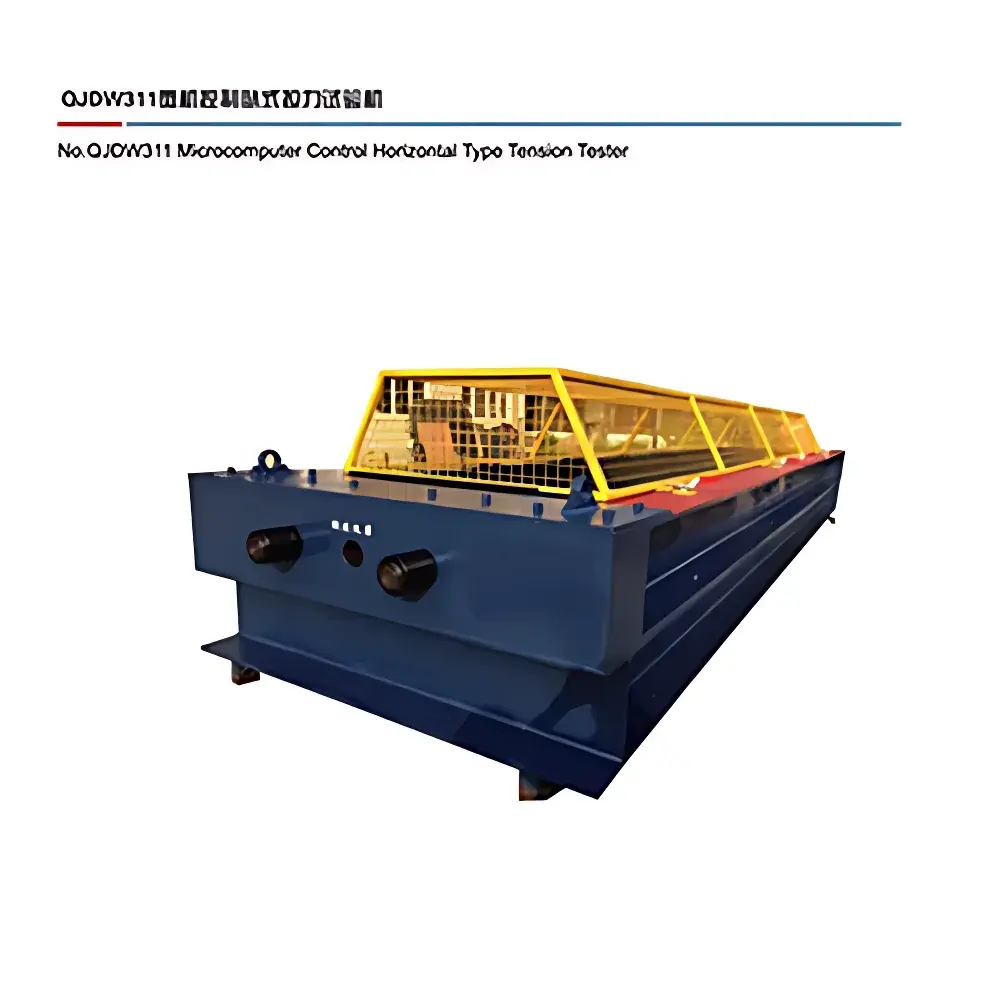
Qinji QJDW311 Horizontal Tensile Testing Machine
| Brand | Qinji |
|---|---|
| Origin | Shanghai, China |
| Manufacturer Type | Authorized Distributor |
| Country of Origin | China |
| Model | QJDW311 |
| Price Range | USD 4,200 – 28,000 |
| Load Capacity | 0–10,000 kN (configurable) |
| Load Cell Accuracy | ±0.01% FS |
| Measurement Accuracy | ±0.5% of reading |
| Test Speed Range | 0.001–300 mm/min (standard), or 5–300 mm/min (high-speed option) |
| Effective Test Length | ≥100 mm to ≥20,000 mm |
| Power Supply | AC 220 V, 50/60 Hz |
| Dimensions (W×D×H) | 600 × 300 × 300 mm |
| Weight | 40–5,000 kg |
Overview
The Qinji QJDW311 Horizontal Tensile Testing Machine is an electromechanical universal testing system engineered for high-force static tensile evaluation of elongatable and terminally anchored components under controlled displacement or load control. Unlike vertical configurations, its horizontal architecture accommodates extended test specimens—such as wire harnesses, steel cables, structural connectors, crimped terminals, automotive plugs and sockets, and mechanical assemblies—without gravitational interference on alignment or load path integrity. The system operates on a precision ball-screw actuation principle coupled with closed-loop servo control, enabling stable force application across ultra-low (0.001 mm/min) to high-speed (300 mm/min) displacement rates. Designed for industrial R&D labs, quality assurance departments, and third-party certification facilities, the QJDW311 complies with fundamental mechanical testing principles defined in ISO 7500-1 (static calibration of force-proving instruments), ASTM E4 (load verification of testing machines), and ISO 5893 (tensile testing apparatus requirements).
Key Features
- Modular high-capacity load frame with rigid welded steel construction and electrostatically applied baked enamel finish for corrosion resistance and long-term dimensional stability.
- High-precision preloaded ball screw transmission system with backlash-free operation and repeatability ≤0.01% FS over full stroke.
- Digitally calibrated load cells traceable to national metrology institutes, offering resolution down to 1/1,000,000 of full scale and linearity error <±0.01% FS.
- Real-time dual-channel data acquisition: simultaneous display and recording of force (kN), displacement (mm), and derived parameters (e.g., elongation %, modulus, yield point) via embedded controller interface.
- Adjustable test length capability—from compact 100 mm short-stroke validation to full-scale 20,000 mm cable pull tests—achieved via extendable crosshead rails and modular anchoring fixtures.
- Integrated safety interlocks including emergency stop circuitry, overload cut-off, and mechanical limit switches compliant with ISO 13857 and EN 60204-1.
Sample Compatibility & Compliance
The QJDW311 supports standardized and custom specimen geometries within ISO 6892-1 (metallic materials), ISO 20795-2 (dental materials), IEC 60512-8 (electrical connectors), and SAE J1708 (heavy-duty vehicle wiring). Its horizontal orientation eliminates bending moments induced by self-weight during high-aspect-ratio testing—critical for validating crimp integrity, solder joint strength, and strain relief performance in automotive and aerospace harness systems. All hardware and firmware configurations adhere to CE marking requirements (EMC Directive 2014/30/EU, Machinery Directive 2006/42/EC), and documentation includes Declaration of Conformity, calibration certificates, and traceable uncertainty budgets per ISO/IEC 17025.
Software & Data Management
The system ships with Qinji TestMaster v4.2—a Windows-based control and analysis suite supporting multi-user access, audit trail logging, and electronic signature workflows aligned with FDA 21 CFR Part 11 requirements. Raw data is stored in encrypted .qtdb binary format with metadata tagging (operator ID, timestamp, environmental conditions, calibration status). Export options include CSV, PDF test reports (with customizable templates), and XML for LIMS integration. Optional GLP/GMP modules provide role-based permissions, change control logs, and automated backup to network drives or cloud repositories.
Applications
- Tensile strength and elongation-at-break assessment of insulated and bare copper/aluminum conductors per ASTM B3, B8, and IEC 60228.
- Withdrawal force measurement of PCB-mounted connectors, USB-C receptacles, and MIL-DTL-38999 series circular connectors.
- Proof loading and fatigue cycling of lifting shackles, anchor chains, and marine rigging components per ISO 1704, DNV-RP-F101.
- Validation of crimp pull-out resistance for automotive FAKRA, HSD, and LVDS terminals per USCAR-21 and ISO/TS 16949.
- Creep and stress-relaxation characterization of polymer-insulated cables under sustained loads at elevated temperatures (when integrated with environmental chamber).
FAQ
What is the maximum test length supported without structural modification?
Standard configuration supports up to 20,000 mm; custom rail extensions beyond this require engineering review and foundation anchoring verification.
Is the load cell factory-calibrated and NIST-traceable?
Yes—each unit includes a certificate of calibration valid for 12 months, with uncertainty values reported per ISO/IEC 17025 and traceability to NIM (China National Institute of Metrology).
Can the system perform cyclic tension-compression tests?
No—the QJDW311 is optimized for uniaxial tensile loading only; bidirectional testing requires the QJDU series universal testing machines.
Does the software support automated pass/fail decision logic based on specification limits?
Yes—TestMaster allows user-defined acceptance criteria per test method, with real-time flagging and report annotation upon deviation.
What maintenance intervals are recommended for long-term accuracy retention?
Load cell verification every 6 months; ball screw lubrication and alignment check annually; full system recalibration required after any impact event or relocation.



