
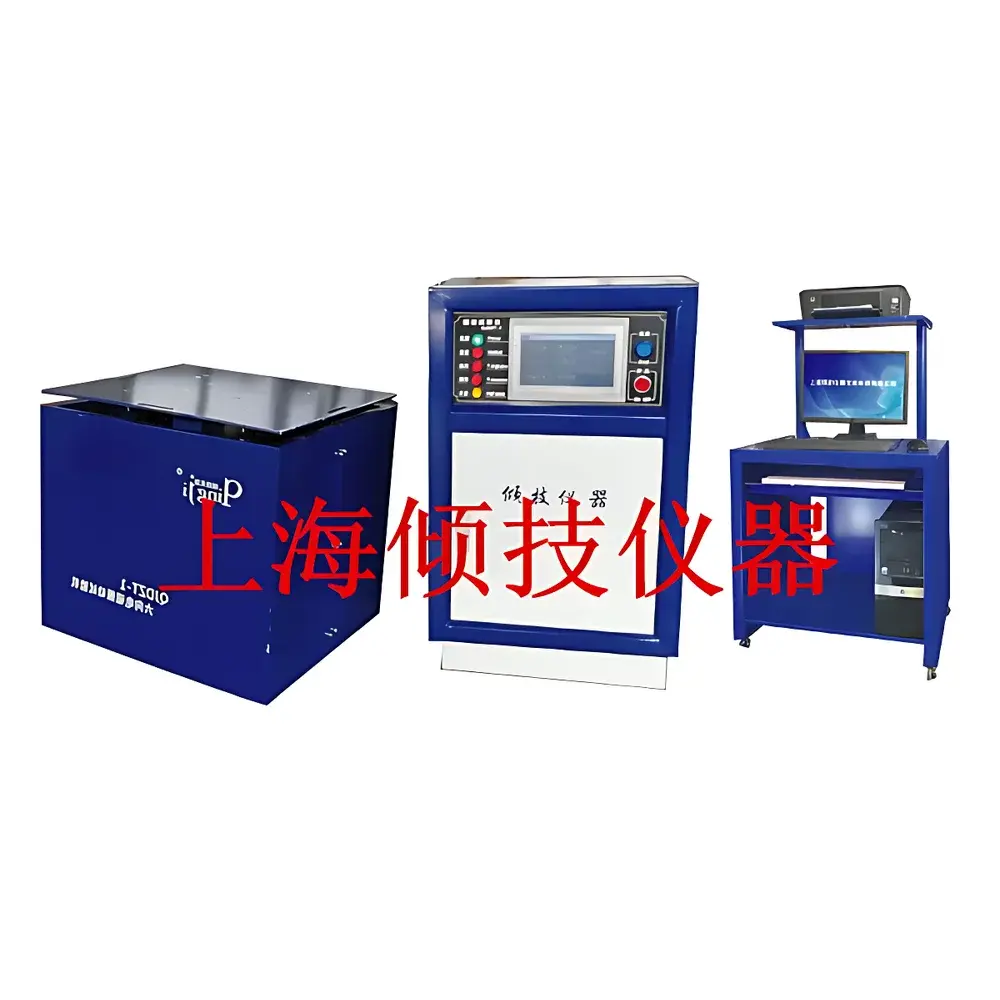
Qinji QJDZT-A Electromagnetic Vibration Test System
| Brand | Qinji |
|---|---|
| Origin | Shanghai, China |
| Manufacturer Type | Authorized Distributor |
| Origin Category | Domestic (China) |
| Model | QJDZT-A |
| Price | USD 4,200 (FOB Shanghai) |
| Sinusoidal Force | 2200 kgf |
| Random Force | 2200 kgf |
| Shock Force | 4400 kgf |
| Frequency Range | 2–3000 Hz |
| Continuous Displacement | ±51 mm |
| Shock Displacement | ±51 mm |
| Maximum Velocity | 2 m/s |
| Maximum Acceleration | 1000 m/s² |
| Moving Coil Diameter | Φ320 mm |
| First-Order Resonant Frequency | 2600 Hz |
| Allowable Eccentric Moment | >500 N·m |
| Moving Mass | 22 kg |
| Mounting Points | 16 threaded inserts |
| Standard Table Thread | M10 |
| Axial Isolation Frequency | <3 Hz |
| Maximum Payload | 300 kg |
| Magnetic Leakage | ≤1 mT |
| Dimensions (L×W×H, unpacked) | 1189 × 780 × 1080 mm |
| Weight | 1650 kg |
Overview
The Qinji QJDZT-A Electromagnetic Vibration Test System is a high-performance, dual-magnetic-circuit electrodynamic shaker engineered for rigorous environmental simulation testing in R&D laboratories, quality assurance departments, and certification facilities. Based on fundamental electromagnetic actuation principles—where Lorentz force drives the moving coil within a controlled magnetic field—the system delivers precise, repeatable acceleration profiles across a broad frequency spectrum (2 Hz to 3000 Hz). Its optimized mechanical architecture features a frameless moving coil design, minimizing inertial mass while elevating the first-order resonant frequency to 2600 Hz—enabling faithful reproduction of high-frequency spectral content without structural amplification artifacts. The dual-magnet configuration ensures high flux density (>1.2 T) and low stray field emission (≤1 mT at table surface), critical for testing magnetically sensitive devices such as MEMS sensors, optical assemblies, and aerospace avionics.
Key Features
- Dual-magnetic-circuit topology with active flux containment, achieving magnetic leakage ≤1 mT at the test table surface—compliant with IEC 60068-2-83 requirements for magnetic field sensitivity control.
- Frameless moving coil assembly reducing moving mass to 22 kg while maintaining structural rigidity; enables extended upper frequency response up to 3000 Hz with minimal phase distortion.
- High-force capability: 2200 kgf sinusoidal and random output, 4400 kgf shock peak force—suitable for MIL-STD-810H, DO-160G, and ISO 16750-3 vibration severity levels.
- 16 standardized M10 threaded mounting points distributed across the 320 mm diameter aluminum table, supporting symmetric load distribution and minimizing bending moments under off-center payloads up to 300 kg.
- Integrated axial passive isolation system with natural frequency <3 Hz, decoupling base vibrations from facility floor motion per ASTM E1876 guidelines.
- Thermally robust voice coil and forced-air cooling architecture ensure continuous operation at maximum velocity (2 m/s) and acceleration (1000 m/s²) without thermal derating.
Sample Compatibility & Compliance
The QJDZT-A accommodates rigidly mounted electronic enclosures, automotive ECUs, PCB subassemblies, and small mechanical subsystems weighing up to 300 kg. Its low magnetic leakage profile permits concurrent testing of Hall-effect sensors, magnetometers, and MRI-compatible components without signal interference. The system meets mechanical interface requirements of ISO 5344 (shaker mounting), ISO 10816-1 (vibration severity assessment), and supports full traceability under GLP and GMP audit frameworks when paired with validated control software. Optional slip-table and thermal chamber integration enable combined environmental stress screening (ESS) per Telcordia GR-63-CORE and JEDEC JESD22-B103.
Software & Data Management
When operated with industry-standard digital vibration controllers (e.g., Vibration Research VR9500 or Data Physics SI-100), the QJDZT-A executes real-time closed-loop control of sine, random, classical shock, shock response spectrum (SRS), sine-on-random, and random-on-random test profiles. All test sequences are fully programmable with user-defined breakpoints, tolerances, and abort criteria. Data acquisition supports 24-bit resolution, ≥51.2 kHz sampling, and IEEE 1588 PTP time synchronization. Audit trails, electronic signatures, and report generation comply with FDA 21 CFR Part 11 requirements when configured with validated software modules and secure user access controls.
Applications
- Aerospace component qualification per DO-160G Section 7 (vibration) and Section 8 (shock).
- Automotive electronics validation against ISO 16750-3 and LV-124 vibration spectra.
- Reliability screening of consumer electronics per IPC-9592 and JEDEC JESD22-B103B.
- Structural dynamic analysis of prototypes using operational modal analysis (OMA) and transfer function measurement.
- Calibration of accelerometers and vibration transducers per ISO 16063-21.
- Electromagnetic compatibility (EMC) pre-compliance testing where mechanical vibration must coexist with RF emissions monitoring.
FAQ
What is the maximum payload capacity for dynamic testing without performance degradation?
The system maintains full specification compliance (including displacement, acceleration, and force linearity) for payloads up to 300 kg, provided center-of-gravity alignment remains within ±15 mm of the table center and moment loading stays below 500 N·m.
Does the QJDZT-A support real-time SRS synthesis and control?
Yes—when integrated with compatible digital controllers supporting MIL-STD-810H Annex G algorithms, the shaker performs closed-loop SRS control with live error correction and convergence monitoring.
Is the system suitable for HALT/HASS applications?
While not a dedicated HALT chamber, its wide frequency range, high g-level capability, and robust thermal management make it appropriate for high-acceleration step-stress vibration profiling when used with external temperature chambers.
What documentation is supplied for regulatory submissions?
Factory calibration certificates (traceable to NIM, China), mechanical interface drawings, magnetic field mapping reports, and installation verification protocols are provided standard. IQ/OQ documentation packages are available upon request.
Can the system be retrofitted with hydraulic assist for ultra-low-frequency (<2 Hz) testing?
No—the QJDZT-A is an electromagnetic shaker optimized for 2–3000 Hz operation. For sub-2 Hz motion, a separate electrohydraulic shaker or slip-table system is required.



