
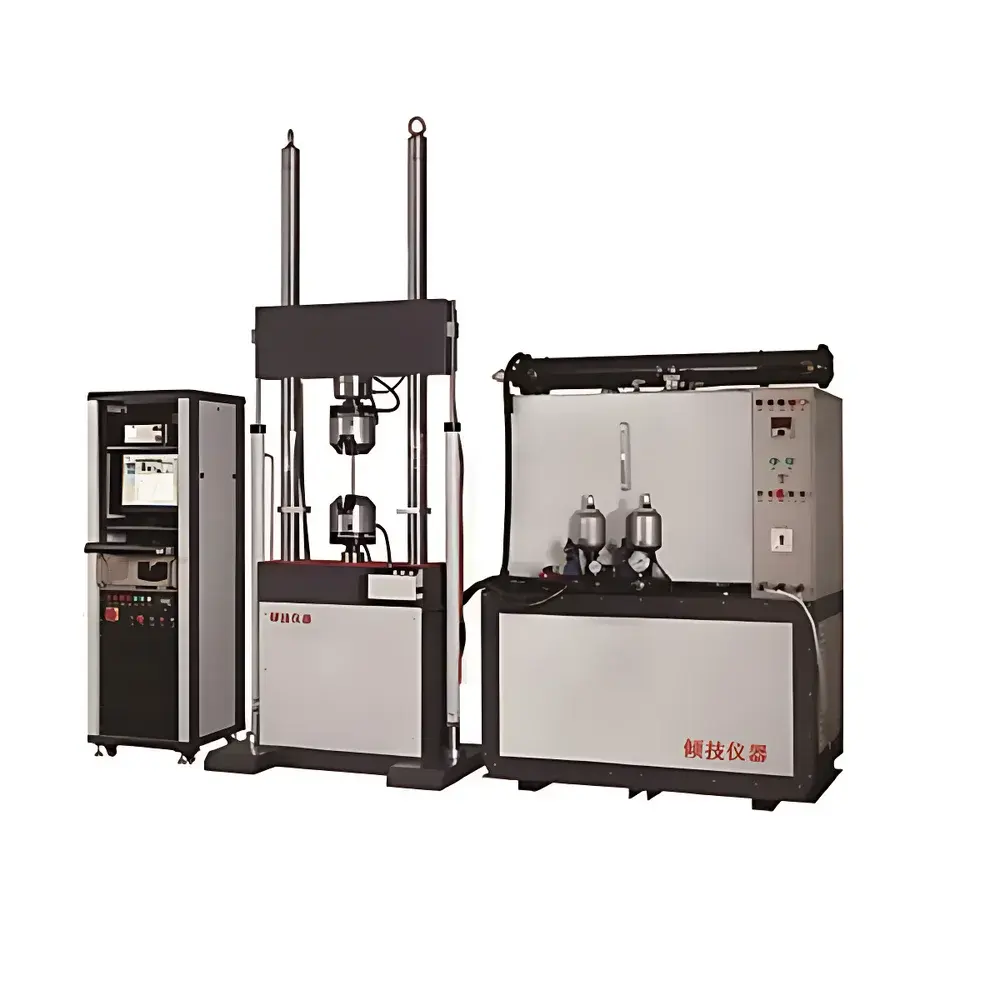
Qinji QJWE Series Electro-Hydraulic Servo Fatigue Testing Machine
| Brand | Qinji |
|---|---|
| Origin | Shanghai, China |
| Model | QJWE— |
| Price Range | USD 4,200 – 28,000 |
| Maximum Test Force Range | 2–100% of Full Scale |
| Frequency Range | 0.001–1000 Hz |
| Force Measurement Accuracy | ±1% within 2–100% FS |
| Dynamic Force Ripple | ≤2% |
| Actuator Stroke | ±50 mm (customizable) |
| Control Bandwidth | 10 kHz |
| Waveform Options | Sine, Triangle, Square, Trapezoidal, Sawtooth, Half-Sine, Half-Triangle, Random, and External Input Waveforms |
| Control Modes | Force, Displacement, and Strain Closed-Loop |
| Mode Switching | Seamless Transition Between Control Loops |
| Frequency Resolution | 0.001 Hz |
Overview
The Qinji QJWE Series Electro-Hydraulic Servo Fatigue Testing Machine is a high-performance, multi-axis dynamic testing system engineered for precision evaluation of mechanical fatigue behavior under controlled cyclic loading. Based on electro-hydraulic servo actuation and real-time digital closed-loop control architecture, the system applies programmable tensile-compressive loads to specimens using sinusoidal, triangular, square, trapezoidal, or user-defined waveforms. It operates across an exceptionally broad frequency spectrum—from ultra-low-frequency quasi-static cycling (0.001 Hz) to high-frequency dynamic excitation (up to 1000 Hz)—enabling rigorous simulation of service conditions encountered in aerospace components, automotive powertrain systems, biomedical implants, and advanced composite structures. The machine complies with fundamental mechanical testing principles defined in ASTM E466, ISO 1099, and GB/T 2611, supporting standardized fatigue life assessment, crack propagation kinetics (da/dN), and fracture toughness characterization (KIc, ΔKth) under both force- and displacement-controlled regimes.
Key Features
- High-bandwidth electro-hydraulic servo actuation with 10 kHz closed-loop control frequency for exceptional waveform fidelity and phase accuracy
- Force measurement accuracy of ±1% over 2–100% of full-scale capacity, traceable to national metrological standards
- Dual-range load cell integration supporting wide dynamic range without manual range switching
- ±50 mm peak-to-peak stroke with optional extended-travel configurations for large-strain or low-frequency long-duration tests
- Multi-mode real-time control architecture enabling seamless transition between force, displacement, and strain feedback loops
- Programmable waveform generator supporting standard and arbitrary time-domain signals—including external analog input synchronization for hardware-in-the-loop (HIL) applications
- Integrated safety interlock system compliant with ISO 13857 and EN 60204-1 for emergency stop, overtravel, and overload protection
Sample Compatibility & Compliance
The QJWE platform accommodates standardized test specimens per ASTM E8/E8M (tensile bars), ASTM E606 (strain-controlled fatigue), ASTM E647 (crack growth), and ISO 12106 (fatigue testing of metallic materials). Custom fixtures—such as wedge-grip, hydraulic tension-compression, and torsional adapters—are available to support metallic alloys, fiber-reinforced polymers, sintered ceramics, and additively manufactured parts. All calibration procedures adhere to ISO/IEC 17025 requirements. System validation documentation supports GLP and GMP environments, including audit trails for test parameter changes, operator logins, and data integrity verification per FDA 21 CFR Part 11 when paired with compliant software modules.
Software & Data Management
The system is operated via Qinji’s proprietary TestMaster™ software suite—a Windows-based application supporting real-time visualization, script-driven test sequencing, and post-test spectral analysis. Data acquisition occurs at up to 100 kHz sampling rate with 24-bit resolution. Raw datasets are stored in HDF5 format for long-term archival stability and third-party interoperability (MATLAB, Python, OriginLab). Software features include automatic cycle counting (ASTM E1037), hysteresis loop analysis, S-N and ε-N curve generation, and Paris law fitting for crack growth rate modeling. Audit trail logs record all user actions, parameter modifications, and calibration events with timestamped digital signatures.
Applications
- High-cycle fatigue (HCF) and low-cycle fatigue (LCF) characterization of turbine blades, landing gear, and structural welds
- Thermo-mechanical fatigue (TMF) coupling studies when integrated with environmental chambers
- Reliability qualification of medical device components—including orthopedic screws and stent platforms—per ISO 14243 and ISO 14242
- Dynamic modulus and damping coefficient determination in viscoelastic polymer composites
- Calibration and validation of finite element models using experimentally derived hysteresis and stiffness degradation data
- Standards-compliant fatigue life prediction for ISO 12107, ASTM D3479 (adhesives), and EN 10002-5 (metallic materials)
FAQ
What standards does the QJWE series comply with for fatigue testing?
The system supports test execution and reporting aligned with ASTM E466, ASTM E606, ISO 1099, ISO 12106, and GB/T 2611. Full compliance documentation—including uncertainty budgets and traceable calibration certificates—is provided upon request.
Can the system perform crack propagation tests under ΔK control?
Yes. When equipped with a clip-on crack mouth opening displacement (CMOD) gauge and compatible software module, the QJWE enables ΔK-controlled fatigue crack growth testing per ASTM E647, with real-time K-calculations and automatic da/dN derivation.
Is remote operation and data monitoring supported?
TestMaster™ includes secure TCP/IP-based remote access functionality, allowing authorized users to monitor live test status, download datasets, and initiate pre-approved test protocols from offsite locations—subject to network security policies.
What maintenance intervals are recommended for hydraulic components?
Hydraulic oil replacement and filter inspection are recommended every 2,000 operational hours or annually, whichever occurs first. A full preventive maintenance checklist—including servo valve diagnostics and accumulator precharge verification—is included in the operator manual.
Does the system support integration with third-party DAQ or control hardware?
Yes. Analog I/O ports (±10 V, 16-bit) and digital trigger lines enable synchronization with external sensors (e.g., DIC systems, thermal cameras) or PLC-based manufacturing cells via TTL or RS-422 interfaces.



