
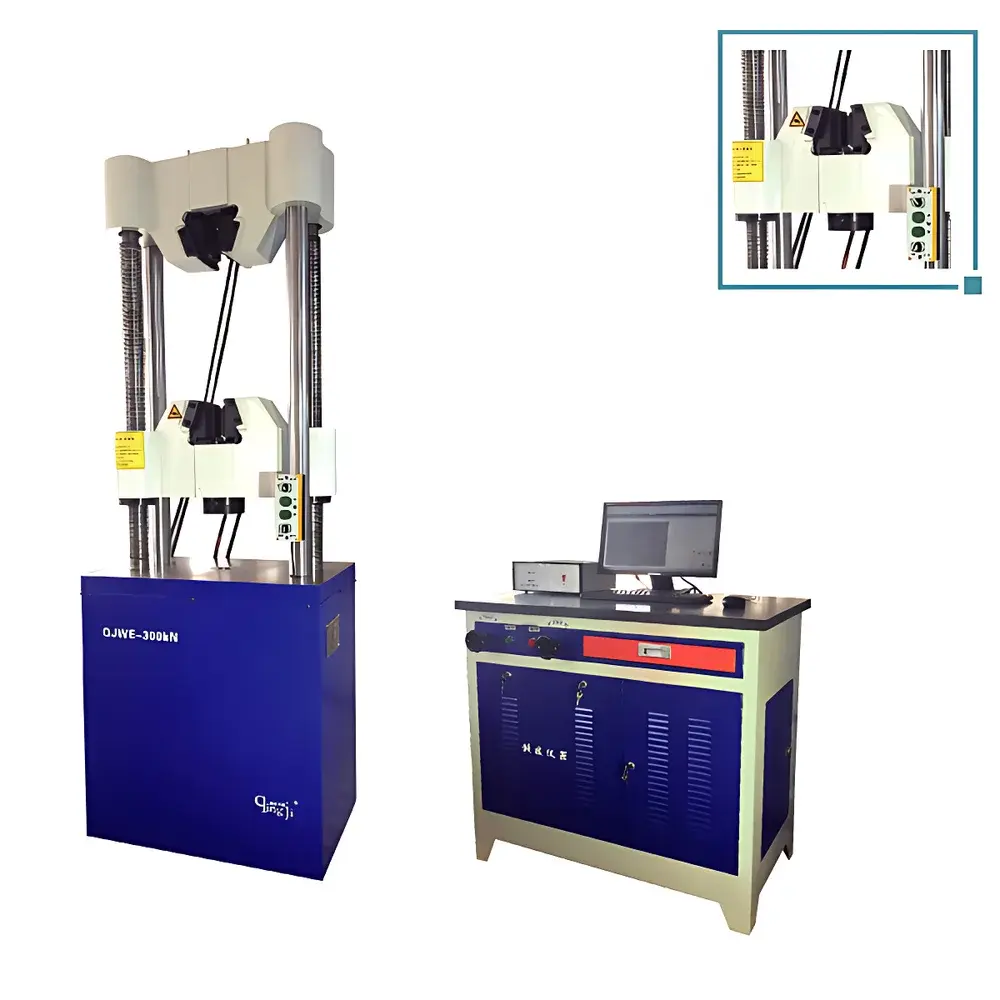
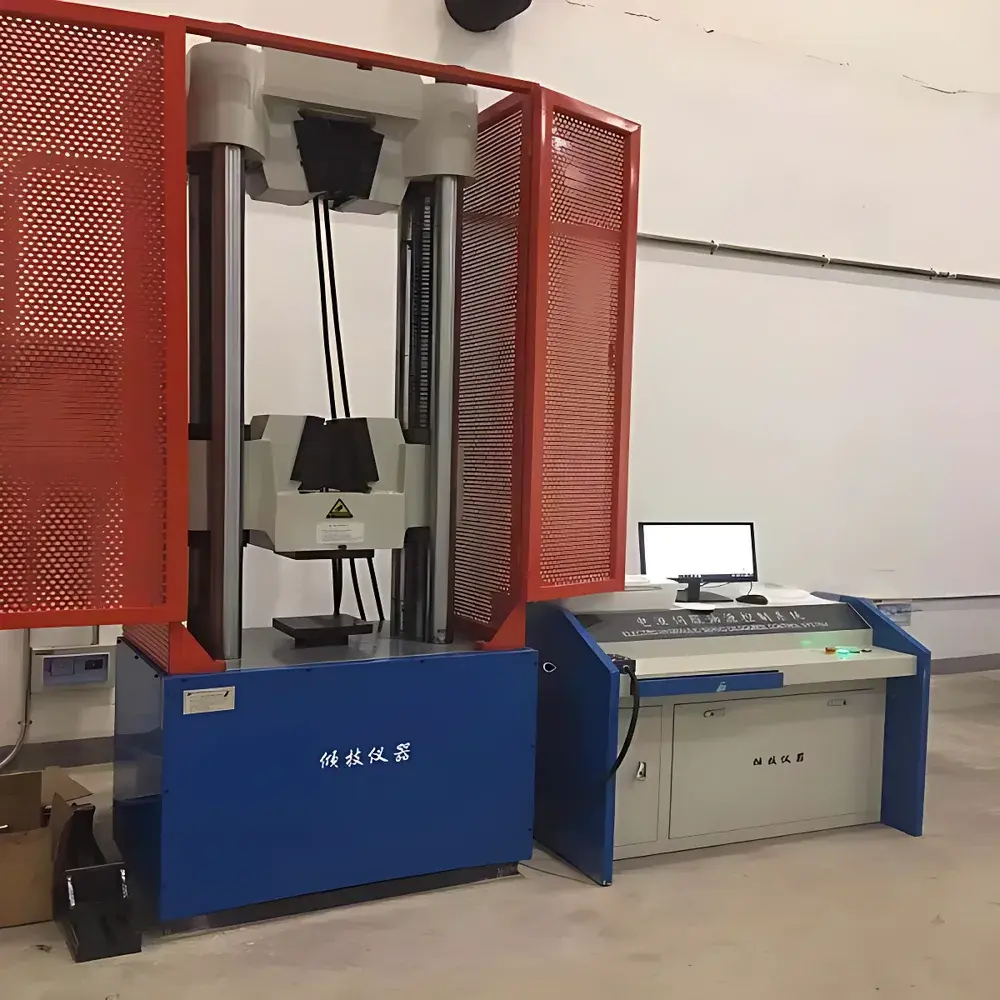
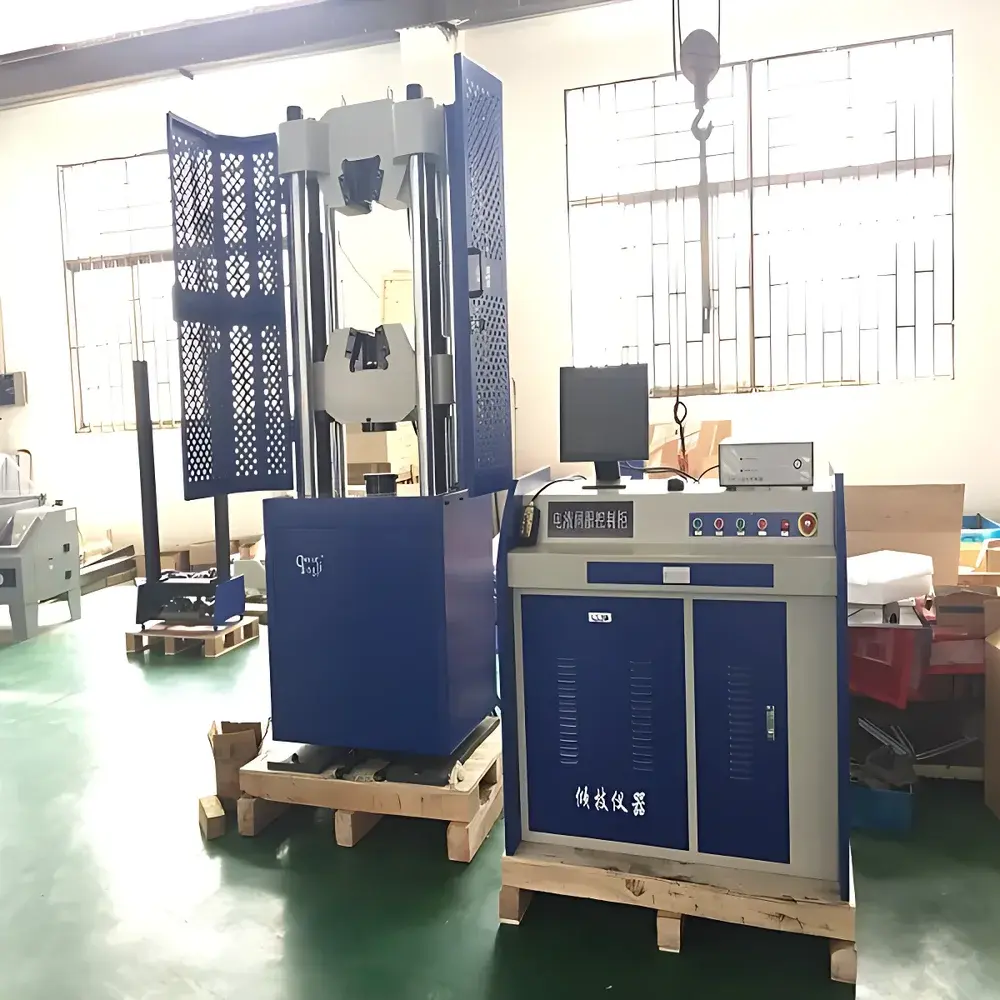
Qinji QJWE Series Electro-Hydraulic Universal Testing Machine
| Brand | Qinji |
|---|---|
| Origin | Shanghai, China |
| Model | QJWE-Series |
| Max. Test Load | 2000 kN |
| Load Application Rate | 1.5 (kN/s, typical default setting) |
| Platen Spacing | Customizable |
| Platen Dimensions | Customizable |
| Accuracy | ±0.5% of full scale |
| Resolution | ≤0.5% of full scale |
| Compression Space | 480–510 mm |
| Tensile Space | 480–610 mm |
| Round Specimen Grip Range | φ10–70 mm (by model) |
| Flat Specimen Grip Range | 0–40 mm (by model) |
| Piston Stroke | 150–170 mm |
| Bend Support Span | 100–500 mm |
| Shear Specimen Diameter | φ10–30 mm |
| Motor Power | 1.5 kW or 2.1 kW, 3-phase |
| Dimensions (L×W×H) | 800×520×1850 to 950×650×2220 mm |
| Weight | 1650–2500 kg |
Overview
The Qinji QJWE Series Electro-Hydraulic Universal Testing Machine is a high-capacity, servo-controlled mechanical testing system engineered for static tensile, compression, bending, and shear evaluation of structural materials under controlled loading conditions. Based on electro-hydraulic actuation with proportional servo-valve control, the system delivers precise force application across a wide dynamic range—up to 2000 kN—while maintaining stable load-rate fidelity and minimal hysteresis. Its oil-cylinder-underneath configuration provides an open-front test zone with vertically adjustable crosshead travel, enabling flexible specimen handling for large-scale metallic components, reinforced concrete specimens, precast cementitious elements, and polymer composites. The machine operates in full digital closed-loop mode, supporting constant-rate-of-load (CRL), constant-rate-of-displacement (CRD), and constant-rate-of-strain (CRS) control profiles per ISO 6892-1, ASTM E8/E21, and EN 10002-1 standards.
Key Features
- Electro-hydraulic actuation with proportional servo-valve for smooth, low-noise force delivery and repeatable load ramping (typical default rate: 1.5 kN/s, user-definable within operational limits)
- Dual-mode hydraulic grip system: wedge-type self-tightening clamps for round specimens (φ10–70 mm) and flat specimens (0–40 mm thickness), with manual or optional motorized adjustment
- High-precision multi-axis load cell (imported, temperature-compensated) with ±0.5% full-scale accuracy and ≤0.5% resolution, traceable to national metrology institutes
- Adjustable platen spacing and customizable platen dimensions accommodate non-standard civil engineering specimens, including full-size concrete cylinders (e.g., Ø150 × 300 mm) and steel-reinforced beams
- Robust cast-iron frame with reinforced column structure ensures minimal deflection (<0.05 mm/kN) during high-load testing, critical for modulus and yield point determination
- Integrated displacement transducers and extensometer interfaces (via LVDT or strain-gauge inputs) support simultaneous measurement of axial deformation, lateral strain, and crack-mouth opening displacement (CMOD)
Sample Compatibility & Compliance
The QJWE platform accommodates diverse specimen geometries and material classes—including carbon steels, stainless alloys, aluminum extrusions, fiber-reinforced polymers, Portland cement mortars, and geopolymer concretes—within defined dimensional envelopes. Compression tests comply with ASTM C39/C109, ISO 7500-1 Class 1, and GB/T 228.1; tensile tests align with ISO 6892-1 Annex A (for metallics) and ASTM D638 (for plastics). Bending configurations meet ASTM C78 and EN 12390-5 requirements for flexural strength assessment. All mechanical safety interlocks, emergency stop circuits, and hydraulic pressure relief valves conform to CE Machinery Directive 2006/42/EC and ISO 13857 clearance specifications.
Software & Data Management
Bundled with Qinji’s proprietary TestMaster Pro v4.x software, the system supports real-time data acquisition at ≥1 kHz sampling rate, synchronized force–displacement–strain plotting, and automated calculation of key mechanical parameters (yield strength Rp0.2, ultimate tensile strength Rm, elastic modulus E, fracture toughness KIc). Data export formats include CSV, XML, and PDF report templates compliant with ISO/IEC 17025 documentation requirements. Audit trail functionality records all operator actions, parameter changes, and calibration events—supporting GLP/GMP environments and FDA 21 CFR Part 11 readiness when deployed with network authentication and electronic signature modules.
Applications
- Mechanical qualification of structural steel plates and welded joints per ASME BPVC Section IX
- Compressive strength validation of ready-mix concrete batches in precast plant QA/QC workflows
- Flexural performance evaluation of fiber-cement roofing panels per EN 12467
- Shear resistance testing of anchor bolts and embedded connectors in seismic retrofitting applications
- R&D-level cyclic loading protocols for fatigue-prone composite laminates (with optional load reversal capability)
- Calibration verification of secondary standard load cells up to 2000 kN via direct comparison method
FAQ
What standards does the QJWE series comply with for calibration and verification?
The system meets ISO 7500-1 Class 1 accuracy requirements for static force measurement and is supplied with factory calibration certificates traceable to NIM (National Institute of Metrology, China) or equivalent national metrology institutes.
Can the machine be integrated into an existing LIMS or MES environment?
Yes—TestMaster Pro supports OPC UA and TCP/IP-based data streaming, enabling bidirectional communication with laboratory information management systems (LIMS) and manufacturing execution systems (MES) for automated result ingestion and audit logging.
Is third-party certification (e.g., UKAS, DAkkS) available for installation qualification (IQ) and operational qualification (OQ)?
Qinji partners with accredited calibration laboratories to provide IQ/OQ documentation packages upon request, including mechanical alignment checks, load-cell linearity verification, and closed-loop controller response characterization.
What maintenance intervals are recommended for hydraulic oil and filter elements?
Hydraulic oil should be replaced every 2,000 operating hours or biannually (whichever occurs first); suction and pressure filters require replacement every 1,000 hours or annually, per DIN 24550 recommendations for industrial servo-hydraulic systems.



