
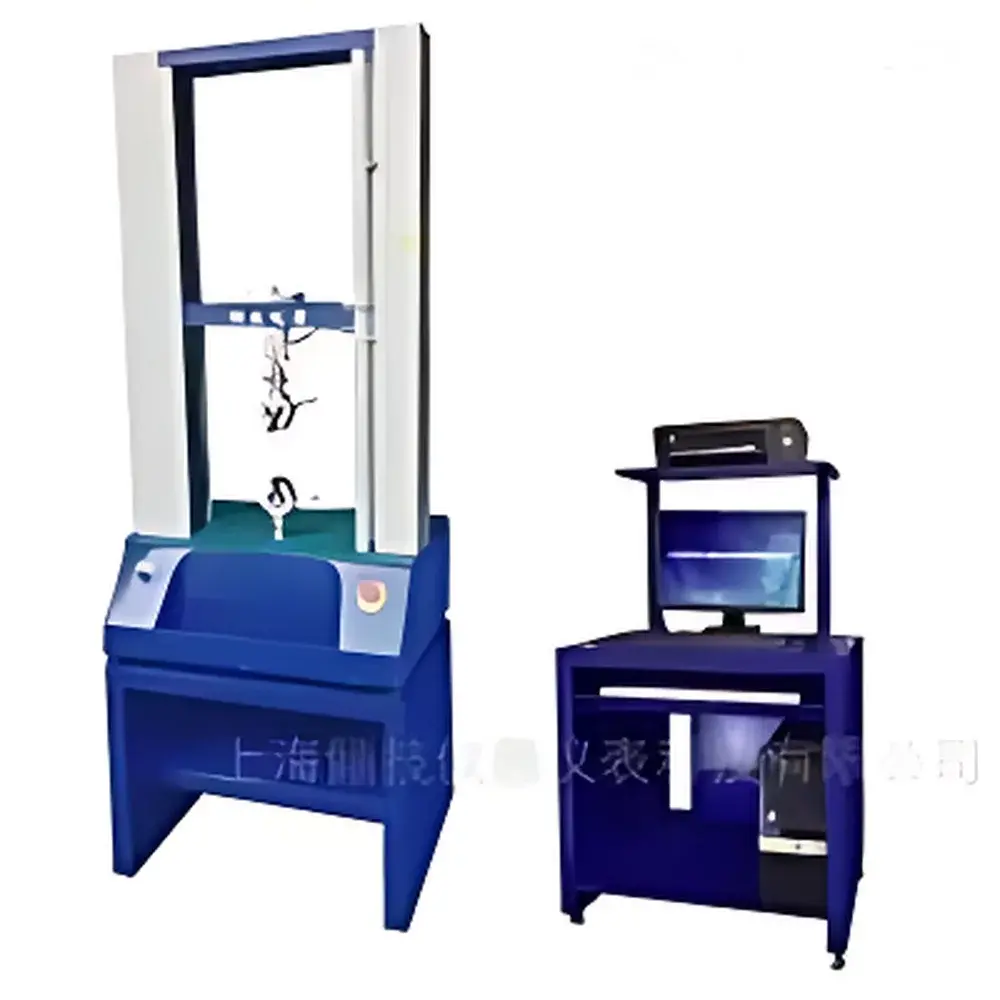
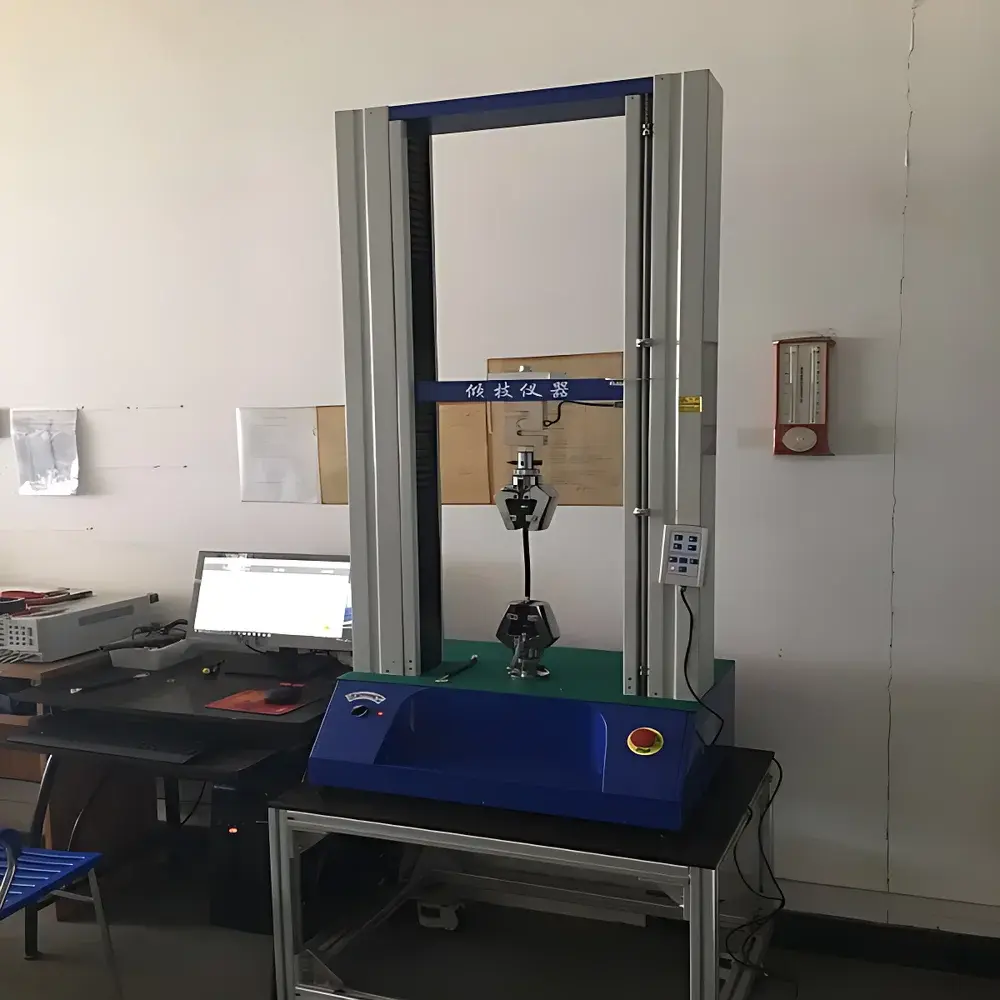
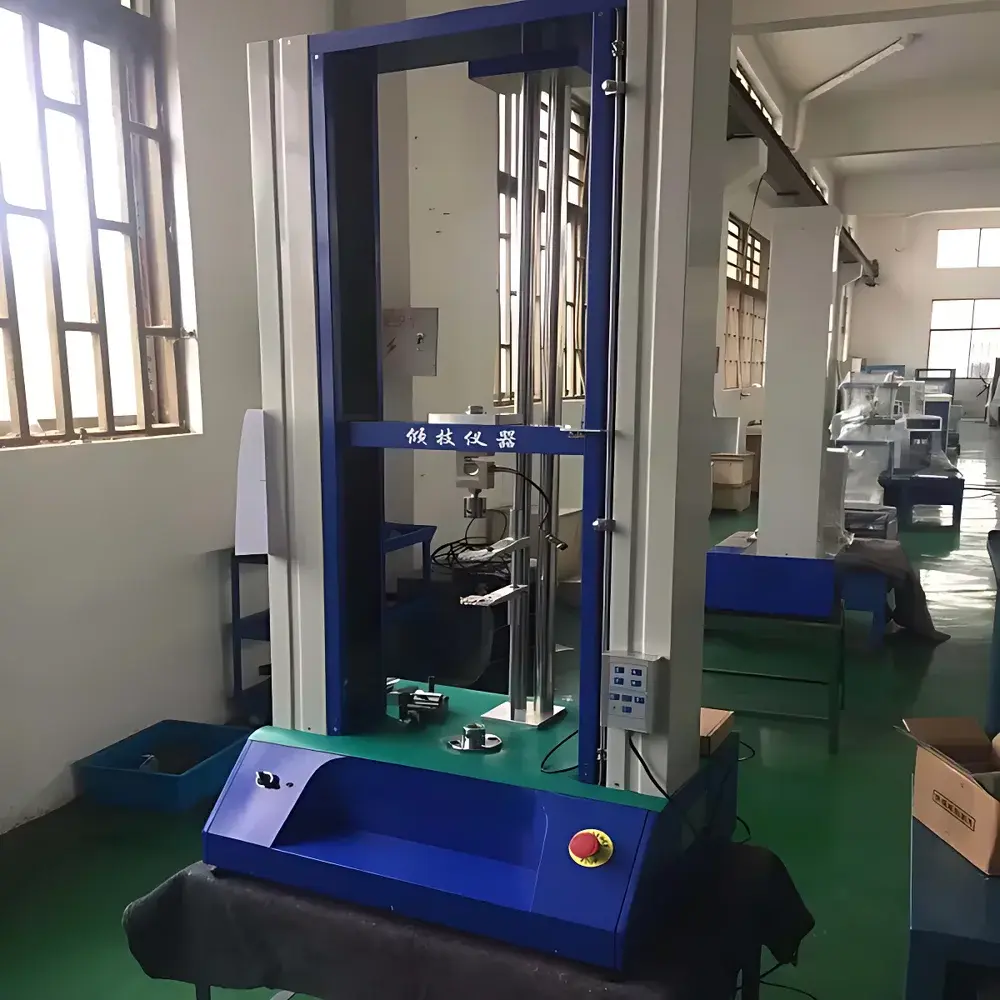
Qinsen QJ211S Electronic Tensile Testing Machine for Composite Films
| Brand | Qinsen |
|---|---|
| Origin | Shanghai, China |
| Model | QJ211S |
| Maximum Test Load | 30 kN |
| Force Accuracy | ±0.5% of reading |
| Effective Travel Distance | 800 mm |
| Effective Test Width | 420 mm |
| Test Speed Range | 0.001–500 mm/min |
| Speed Accuracy | ±0.5% of reading |
| Displacement Measurement Accuracy | ±0.5% of reading |
| Deformation Measurement Accuracy | ±0.5% of reading |
| Load Cell Resolution | 300,000 counts (full-scale, no range switching) |
| Motor Power | 750 W |
| Dimensions (W×D×H) | 700 × 420 × 1600 mm |
| Weight | 145 kg |
| Safety Protection | Electronic travel limit, overload protection (10% above capacity), emergency stop circuit |
| Compliance | Designed to support ASTM D882, ISO 527-3, ASTM D3759, ASTM F88, and GB/T 1040.3 test standards |
Overview
The Qinsen QJ211S Electronic Tensile Testing Machine is a precision-engineered universal testing system specifically optimized for mechanical characterization of thin-film laminates, multilayer composite packaging materials, and flexible barrier structures. It operates on the principle of controlled uniaxial force application under programmable displacement or load control, enabling quantitative measurement of tensile strength, elongation at break, Young’s modulus, yield point, peel resistance, tear propagation, and puncture resistance. The system conforms to fundamental mechanical testing paradigms defined in ISO 1798, ASTM D882 (for thin plastic sheeting), and ISO 527-3 (for plastics—determination of tensile properties of films and sheets). Its rigid dual-column frame, high-stiffness crosshead guidance, and real-time closed-loop servo control architecture ensure minimal deflection and high reproducibility across repeated cycles—even at low-force regimes typical of ultra-thin (<100 µm) coextruded or metallized films.
Key Features
- High-resolution load measurement with ±0.5% accuracy over full 30 kN capacity; 300,000-count internal resolution ensures consistent sensitivity from 0.01 N to 30,000 N without range switching
- Wide dynamic speed range (0.001–500 mm/min), calibrated to ±0.5% accuracy, supporting both quasi-static creep evaluation and high-speed burst testing
- 800 mm effective vertical travel accommodates extended elongation measurements for highly ductile laminates and elastomeric backing layers
- 420 mm wide test zone enables uniform clamping of wide-format pouches, roll-fed samples, and pre-cut laminated webs up to 400 mm width
- Dual-mode actuation: motor-driven precision positioning with independent fast/slow jog controls and programmable return-to-start functionality
- Integrated safety architecture including electronic end-of-travel limits, hardware-based overload cutoff (10% over full scale), and emergency stop circuit compliant with IEC 60204-1
- Modular fixture interface supports standardized wedge-action grips, pneumatic clamps, peel fixtures (90°/180°), puncture probes, and custom-engineered jaws for irregular geometries
Sample Compatibility & Compliance
The QJ211S is validated for use with polymeric composite films—including PET/AL/PE, BOPP/CPP, PA/AL/RCPP, and biodegradable PLA-based laminates—as well as foil-laminated pharmaceutical blisters and sterile medical packaging. It meets mechanical traceability requirements per ISO/IEC 17025 when operated with accredited calibration certificates. Test protocols align with FDA-relevant guidance for packaging integrity (e.g., FDA Guidance for Industry: Container Closure Systems for Packaging Human Drugs and Biologics), and data acquisition supports 21 CFR Part 11-compliant audit trails when paired with validated software modules. All mechanical components are constructed from anodized aluminum and hardened steel to resist corrosion from solvent-cleaned specimens and maintain dimensional stability under laboratory environmental fluctuations (20–25°C, 40–60% RH).
Software & Data Management
The system runs on Windows-based QinsenTest v4.2 software, featuring real-time synchronized plotting of force–displacement, stress–strain, and time–load curves. Raw data export is supported in CSV, Excel (.xlsx), and XML formats for third-party statistical analysis (e.g., JMP, Minitab). Curve manipulation tools include point-wise annotation, region-of-interest masking, automatic peak detection, hysteresis loop integration, and multi-curve overlay with normalized x-axis scaling. The software maintains full metadata logging—including operator ID, sample ID, environmental conditions, calibration timestamp, and instrument configuration—for GLP/GMP-aligned documentation. Optional add-ons provide automated report generation compliant with ISO 14644 cleanroom validation templates and internal QA checklists.
Applications
- Quantitative assessment of seal strength in heat-sealed flexible packaging per ASTM F88 and ISO 11607-2
- Tensile property mapping across thickness gradients in coextruded barrier films
- Creep rupture analysis of aluminized polyester under sustained load at elevated temperature
- Peel adhesion profiling of pressure-sensitive adhesive layers in transdermal patches
- Mechanical fatigue evaluation of pouch lamination interfaces under cyclic loading (low-frequency, <5 Hz)
- Correlation of film morphology (via SEM/EDS) with macroscopic failure modes observed during tensile testing
- Validation of accelerated aging effects on laminate delamination resistance per ASTM F1980
FAQ
What international standards does the QJ211S support out-of-the-box?
It natively supports test method configurations for ASTM D882, ISO 527-3, ASTM D3759, ASTM F88, ISO 11607-2, and GB/T 1040.3. Custom method templates can be built for proprietary specifications.
Is the system compatible with 21 CFR Part 11-compliant environments?
Yes—when deployed with optional QinsenSecure software module, it provides role-based access control, electronic signatures, and immutable audit trails meeting FDA regulatory expectations.
Can the machine perform cyclic or fatigue testing?
It supports low-frequency sinusoidal, triangular, and trapezoidal waveform loading up to 5 Hz with user-defined upper/lower force bounds and cycle count termination.
What maintenance intervals are recommended for routine operation?
Lubrication of lead screws and inspection of grip serrations are advised every 500 operational hours; annual recalibration by an ISO/IEC 17025-accredited provider is strongly recommended.
Are custom fixtures available for non-standard specimen geometries?
Yes—Qinsen offers engineering consultation and CNC-manufactured fixture design services based on client-supplied CAD models or physical prototypes.



