
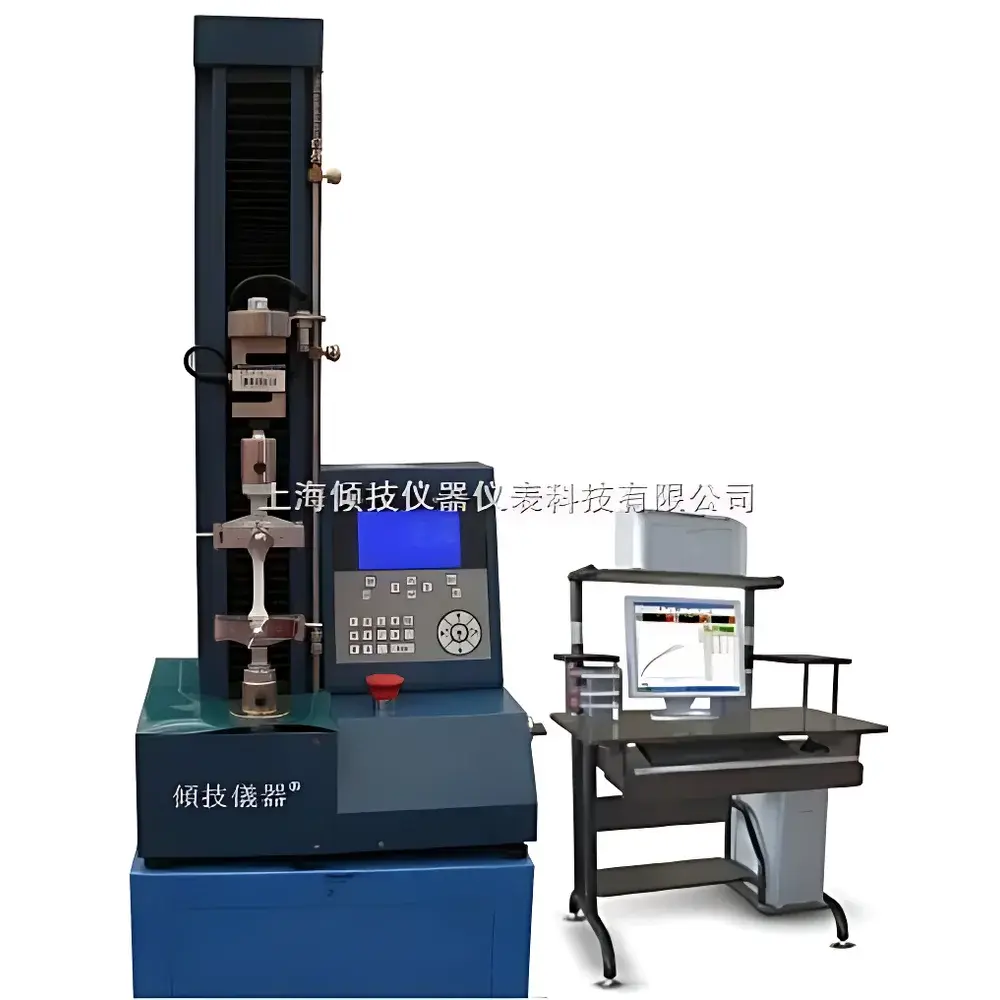
Qinsun QJ210 Universal Tensile Testing Machine for Woven Webbing
| Brand | Qinsun |
|---|---|
| Origin | Shanghai, China |
| Model | QJ210 |
| Maximum Load Capacity | 2500 N (configurable) |
| Load Cell Accuracy | 0.01% |
| Measurement Accuracy | < ±0.5% |
| Control Mode | Full CNC or PC-controlled with thermal printer interface |
| Valid Test Width | 120 mm |
| Effective Stroke | 300 mm (extendable) |
| Test Speed Range | 0.001–300 mm/min |
| Speed Accuracy | ±0.5% |
| Stroke Accuracy | ±0.5% |
| Displacement Accuracy | ±0.5% |
| Safety Features | Electronic stroke limit protection, emergency stop button |
| Unit Weight | ~45 kg |
Overview
The Qinsun QJ210 Universal Tensile Testing Machine is a precision-engineered electromechanical system designed specifically for mechanical property evaluation of flexible, high-elongation materials—particularly woven webbing used in safety harnesses, automotive seatbelts, lifting slings, military load-bearing gear, and textile-based PPE. It operates on the fundamental principle of uniaxial force application under controlled displacement or speed, measuring tensile strength, yield point, elongation at break, modulus of elasticity, and load-deformation behavior in accordance with standardized test protocols including ASTM D638, ISO 13934-1, ISO 20795-2, and GB/T 3923.1. Unlike legacy mechanical testers, the QJ210 integrates a high-resolution load cell (0.01% full-scale accuracy), closed-loop servo control, and real-time digital signal acquisition to ensure repeatable, traceable, and audit-ready results across R&D labs, QC departments, and third-party certification facilities.
Key Features
- Modular load frame architecture with extruded aluminum enclosure and industrial-grade powder-coated finish—optimized for lab durability and ergonomic access.
- High-fidelity 2500 N capacity load cell with temperature-compensated strain gauge technology and built-in calibration memory; supports interchangeable sensor modules for extended range applications (e.g., 500 N or 5000 N variants).
- Full CNC operation via 5.7-inch TFT LCD touchscreen interface: direct parameter input (test speed, pre-load, break detection threshold), real-time plotting of force vs. displacement and stress vs. strain curves, and on-screen statistical summary (peak load, % elongation, secant modulus).
- PC-integrated control via USB 2.0 or RS-232 serial interface—compatible with Windows 10/11 and supports automated test sequencing, multi-sample batch processing, and raw data export in CSV, XML, and PDF report formats.
- Precision ball-screw actuator with integrated optical encoder ensures smooth, backlash-free motion across the full 0.001–300 mm/min speed range, with speed stability maintained within ±0.5% of setpoint—even during dynamic ramping or dwell phases.
- Dual-channel safety architecture: hardware-based electronic stroke limiter (programmable upper/lower bounds) and redundant emergency stop circuit meeting IEC 60204-1 functional safety requirements.
Sample Compatibility & Compliance
The QJ210 accommodates flat, woven, knitted, or braided webbing specimens up to 120 mm wide and 300 mm active gauge length—ideal for ISO 13934-1 Type A clamping configurations. Standard pneumatic or mechanical wedge grips (optional) ensure uniform stress distribution without slippage or premature failure at clamping zones. The system complies with ISO/IEC 17025 documentation requirements for testing laboratories and supports GLP/GMP-aligned audit trails when operated in PC mode—including user login logs, method version history, calibration certificate timestamps, and electronic signatures per FDA 21 CFR Part 11 Annex 11 guidelines. All firmware and software are validated against EN 61000-6-3 (EMC) and CE-marked for Class I laboratory use.
Software & Data Management
The embedded firmware and optional QinsunTest Pro v4.2 software provide comprehensive data governance tools: automatic zero-point drift compensation, auto-scaling graph axes, configurable pass/fail criteria with audible visual alerts, and statistical process control (SPC) chart generation (X-bar/R, Cp/Cpk). Raw time-series data (force, displacement, time) is timestamped at 1 kHz sampling rate and stored with metadata (operator ID, sample ID, environmental conditions if linked to optional external hygrothermograph). Exported reports conform to ISO 14289-1 (PDF/A-2u) archival standards and include digital signature fields for QA sign-off. Audit logs retain all parameter changes, test aborts, and recalibration events for full traceability.
Applications
- Tensile strength and elongation verification of polyester, nylon, polypropylene, and Dyneema® webbing per ANSI Z359.1 and EN 364.
- Creep and stress-relaxation profiling under constant load for regulatory submission to OSHA and EU Notified Bodies.
- Adhesion strength assessment of coated or laminated webbing substrates using peel or shear fixtures.
- Quality conformance testing for automotive Tier-1 suppliers adhering to VW 60310, Ford WSS-M3Q372-A, and GMW15724 specifications.
- R&D validation of novel fiber architectures—including hybrid weaves, heat-set treatments, and plasma surface modification—against baseline performance metrics.
FAQ
What standards does the QJ210 support out-of-the-box?
It natively implements test methods from ASTM D638, ISO 13934-1, ISO 20795-2, GB/T 3923.1, and JIS L1096—custom method templates can be imported via XML configuration files.
Can the stroke height be extended beyond 300 mm?
Yes—optional high-stroke column kits increase effective travel to 600 mm or 900 mm while maintaining structural rigidity and alignment tolerance per ISO 7500-1 Class 0.5.
Is calibration traceable to national metrology institutes?
All factory calibrations are performed using NIST-traceable deadweight standards and documented in ISO/IEC 17025-accredited calibration certificates.
Does the system support multi-language UI and reporting?
The embedded display supports English, Chinese, Spanish, German, and French; PC software allows localized report templates with bilingual header/footer fields.
What maintenance intervals are recommended?
Load cell verification every 6 months, ball-screw lubrication annually, and full mechanical inspection per ISO 17025 internal audit schedule (typically quarterly).



