
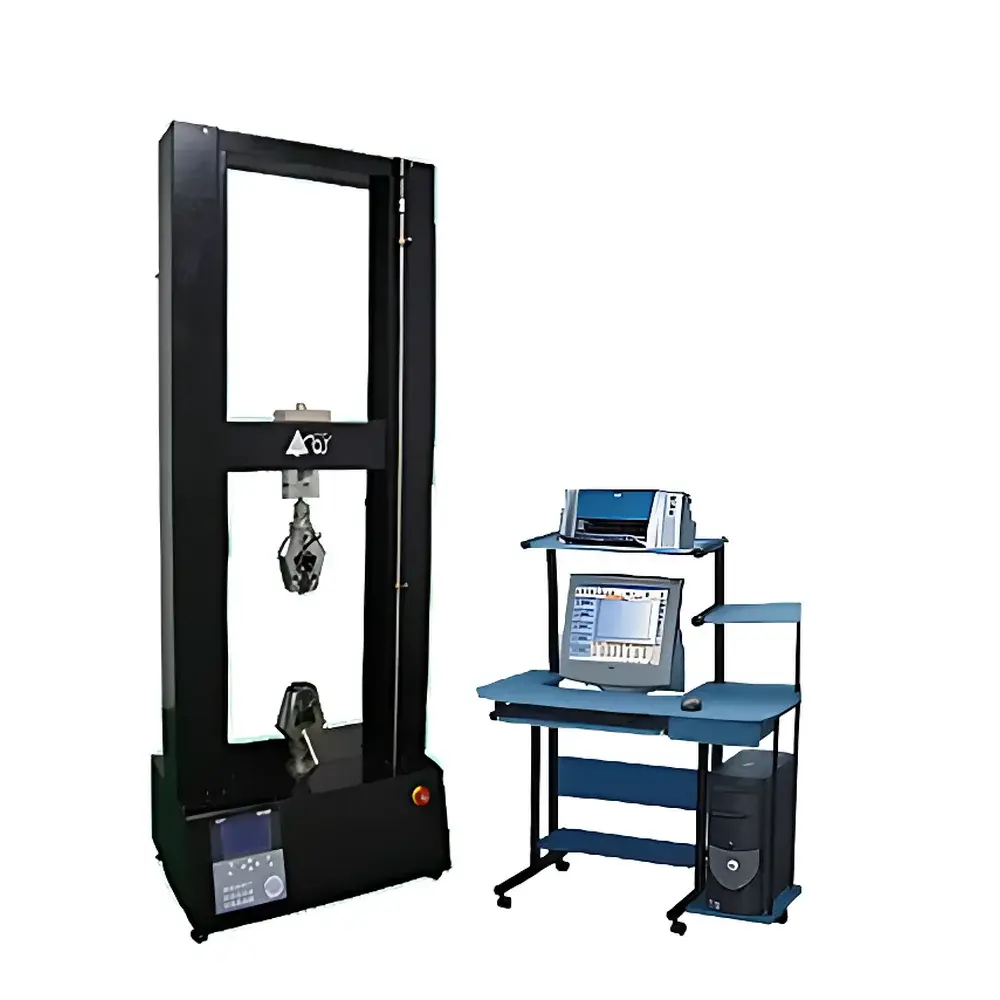
Qinsun QJ211 Universal Tensile Testing Machine for Rigid Plastics
| Brand | Qinsun |
|---|---|
| Model | QJ211 |
| Maximum Load Capacity | 30 kN |
| Accuracy Class | 0.5 |
| Effective Test Width | 420 mm |
| Effective Stroke | 800 mm |
| Speed Range | 0.001–500 mm/min |
| Speed Accuracy | ±0.5% of reading |
| Load Accuracy | ±0.5% of reading |
| Load Resolution | 500,000 counts (full-scale, no range switching) |
| Displacement Accuracy | ±0.5% of reading |
| Strain Measurement Accuracy | ±0.5% of reading |
| Motor Power | 750 W |
| Net Weight | 145 kg |
| Safety Features | Electronic travel limit, overload protection (110% F.S.), manual/auto return, jog-controlled crosshead movement |
| Compliance | Designed to meet ISO 527-1/2, ASTM D638, and GB/T 1040.1–1040.5 requirements for rigid plastic tensile testing |
Overview
The Qinsun QJ211 Universal Tensile Testing Machine is an electromechanical force-testing system engineered for high-reproducibility mechanical characterization of rigid thermoplastics, thermosets, and composite sheets under uniaxial tension per international standards. It operates on a servo-controlled closed-loop architecture, utilizing a precision ball-screw-driven crosshead and high-stability load cell technology to deliver traceable force measurement across its full 30 kN capacity. The system complies with the fundamental metrological requirements defined in ISO 7500-1 (static calibration of force-proving instruments) and supports standardized test protocols including ISO 527-1 and -2 (plastics — determination of tensile properties), ASTM D638 (standard test method for tensile properties of plastics), and China’s GB/T 1040 series. Its 0.5-class accuracy rating ensures compliance with GLP-aligned laboratory quality systems where documented measurement uncertainty and instrument qualification are mandatory.
Key Features
- High-resolution load measurement: 500,000 internal data points over full scale (30 kN), eliminating range-switching artifacts and enabling seamless transition from low-force modulus evaluation to high-load yield and break point detection.
- Wide dynamic speed range: Programmable crosshead velocity from 0.001 to 500 mm/min with ±0.5% linearity—critical for capturing strain-rate-sensitive behavior in polycarbonate, ABS, and reinforced polyamide specimens.
- Robust mechanical architecture: Heavy-duty cast-iron frame (145 kg net weight) with dual-column alignment and preloaded linear guides ensures minimal deflection and long-term dimensional stability during cyclic or creep-loading sequences.
- Integrated safety subsystems: Dual-mode electronic travel limits, 110% overload cutoff, emergency stop circuitry, and programmable auto-return functionality meet IEC 61000-6-2/6-4 electromagnetic compatibility and functional safety expectations for lab-based mechanical testers.
- Operator-centric motion control: Independent fast/slow jog modes for crosshead positioning, plus momentary push-button actuation—enabling precise specimen alignment without reliance on software interfaces.
Sample Compatibility & Compliance
The QJ211 accommodates standard tensile specimens per ISO 527 Type 1A (dog-bone), ASTM D638 Type I, and GB/T 1040.2 Type 1 dumbbell geometries, with an effective test width of 420 mm and 800 mm vertical stroke accommodating both short-gauge and extended-length configurations. Grip options—including wedge-action pneumatic, hydraulic, and screw-tightened mechanical jaws—are compatible with rigid plastic bars, molded plaques, extruded profiles, and laminated composites up to 25 mm thick. All hardware and firmware design elements align with ISO/IEC 17025:2017 clause 6.4 (equipment verification) and support IQ/OQ documentation packages required for regulated environments. While not FDA-certified as standalone medical device test equipment, its measurement traceability path (via NIST-traceable load cell calibration certificates) satisfies audit requirements under 21 CFR Part 11 when paired with compliant data acquisition software.
Software & Data Management
The QJ211 operates with Qinsun’s proprietary Windows-based test control suite, supporting real-time force–displacement–time acquisition at up to 100 Hz sampling rate. Raw data export is available in CSV and Excel-compatible formats; all test records include embedded metadata (operator ID, timestamp, environmental conditions via optional external sensor input, calibration certificate IDs). Audit trail functionality logs all parameter modifications, test start/stop events, and user logins—meeting ALCOA+ principles (Attributable, Legible, Contemporaneous, Original, Accurate, Complete, Consistent, Enduring, Available) for GMP/GLP-regulated labs. Optional API integration enables bidirectional communication with LIMS platforms using RESTful endpoints and JSON payloads.
Applications
- Tensile modulus, yield strength, ultimate tensile strength, and elongation at break determination for injection-molded ABS, PC, POM, and glass-filled polypropylene components.
- Quality control screening of incoming raw materials against supplier specifications per ISO 10365 or internal material release criteria.
- Comparative aging studies evaluating embrittlement after thermal, UV, or hydrolytic exposure per ISO 4582 or ASTM G154.
- Development-stage mechanical validation of biopolymer blends (e.g., PLA/PBAT) where low-speed creep response (<0.1 mm/min) and high-resolution strain tracking are essential.
- Failure analysis of brittle fracture mechanisms in transparent acrylic sheets and impact-modified polystyrene housings.
FAQ
Does the QJ211 comply with ASTM D638 and ISO 527?
Yes—the machine’s force accuracy (±0.5%), displacement fidelity, and speed control performance satisfy the instrumentation requirements specified in Sections 7 and 8 of ASTM D638 and Clauses 6.2–6.4 of ISO 527-1:2019.
Can it perform compression or flexural tests?
The base configuration is optimized for tensile testing of rigid plastics; however, optional compression platens and three-point bending fixtures are available as add-on modules—each requiring separate mechanical verification per ISO 12135 and ISO 178.
Is third-party calibration certification included?
A factory-issued calibration report traceable to CNAS-accredited standards is supplied; users must schedule annual recalibration through an ISO/IEC 17025-accredited provider to maintain measurement integrity.
What grip types are recommended for unreinforced rigid plastics?
For smooth-surface specimens (e.g., PMMA, PS), serrated-faced mechanical grips with adjustable clamping pressure are preferred to prevent slippage and premature edge failure.
How is data integrity ensured during long-duration tests?
The controller employs non-volatile memory buffering and automatic power-fail recovery—preserving all acquired data points even during unexpected mains interruption.



