
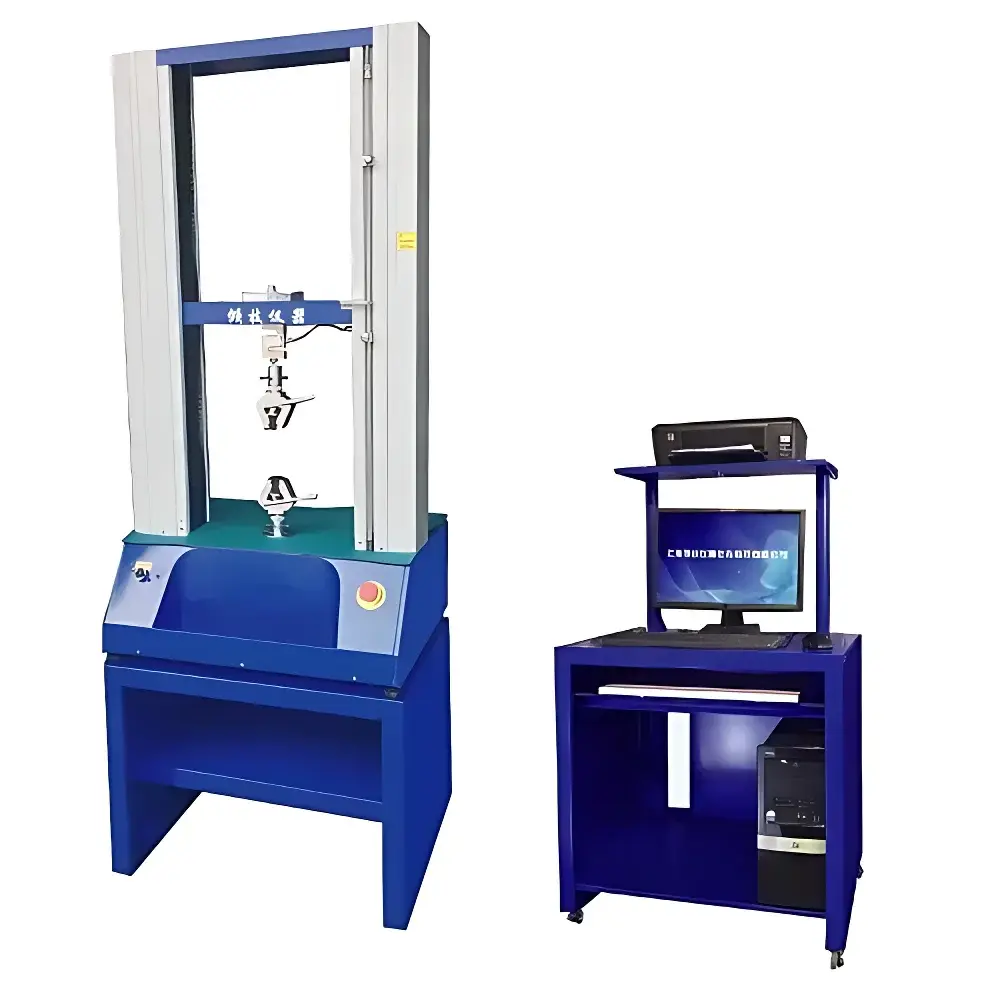
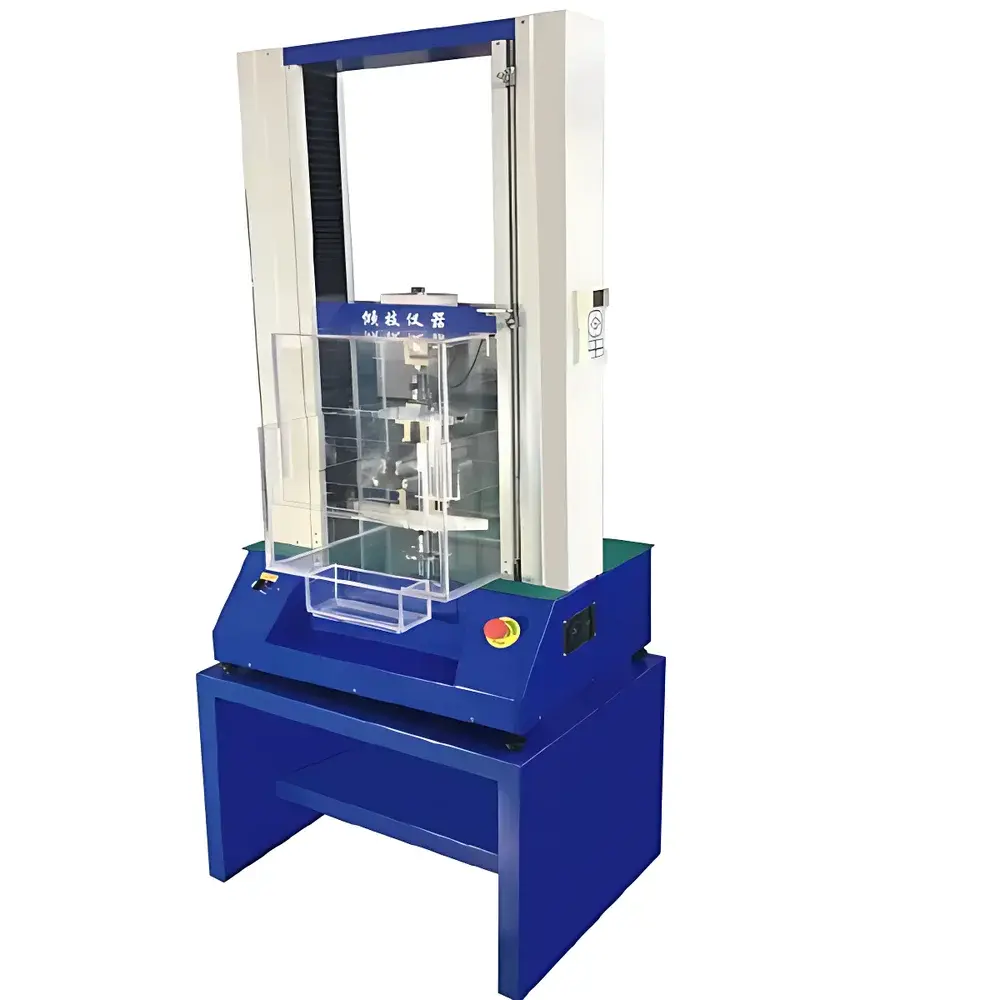
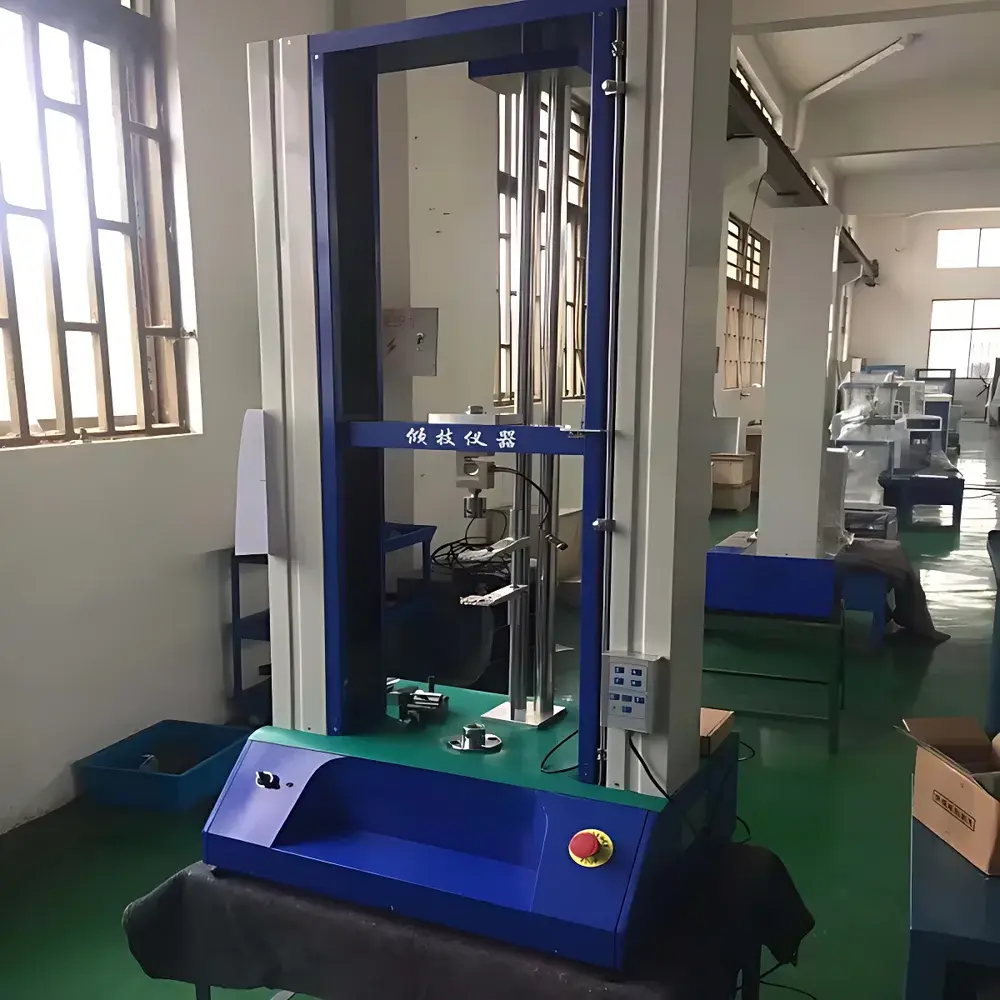
Qinsun QJ211S-40KN Electronic Tensile Testing Machine
| Brand | Qinsun |
|---|---|
| Origin | Shanghai, China |
| Manufacturer Type | Authorized Distributor |
| Country of Origin | China |
| Model | QJ211S-40KN |
| Instrument Type | Electronic Tensile Testing Machine |
| Maximum Test Load | 40 kN |
| Force Measurement Range | 0–40 kN (full-scale, selectable) |
| Force Accuracy | ±0.5% of reading |
| Test Stroke | 800 mm |
| Displacement Resolution | ±0.5% of indicated value |
| Effective Test Width | 400 mm |
| Effective Test Space | 500 mm |
| Test Speed Range | 0.01–50,000 mm/min (standard configuration: 300 mm/min) |
| Speed Accuracy | ±0.5% of indicated value |
| Position Measurement Accuracy | ±0.5% of indicated value |
| Strain Measurement Accuracy | ±0.5% of indicated value |
| Motor Power | 400 W |
| Net Weight | 145 kg |
Overview
The Qinsun QJ211S-40KN Electronic Tensile Testing Machine is a precision-engineered universal testing system designed for static mechanical property evaluation under controlled uniaxial loading conditions. Based on servo-controlled electromechanical actuation and high-fidelity load cell transduction, it complies with fundamental principles defined in ISO 6892-1 (metallic materials – tensile testing), ASTM D638 (plastics – tensile properties), ASTM D412 (vulcanized rubber), and ISO 1798 (flexible cellular polymeric materials). The machine delivers traceable force measurement across its full 40 kN capacity, enabling standardized determination of yield strength, ultimate tensile strength, elongation at break, modulus of elasticity, and Poisson’s ratio. Its rigid dual-column frame, integrated crosshead guidance, and real-time closed-loop control architecture ensure high reproducibility and minimal compliance error—critical for R&D validation, quality control release testing, and regulatory submission support in GLP- and GMP-aligned environments.
Key Features
- High-resolution force measurement system with 500,000-count internal resolution, no range switching required—maintains consistent sensitivity from 0.2% to 100% of full scale (FS)
- Dual-mode speed control: programmable test velocity from 0.01 to 50,000 mm/min, with standard calibration verified at 300 mm/min per ISO 527-1
- Electromechanical overload protection: automatic shutdown triggered at 110% of maximum rated load (44 kN), safeguarding both operator and sensor integrity
- Motorized crosshead with independent fast/slow jog modes and precise point-to-point positioning—enabling rapid specimen setup and repeatable return-to-start functionality
- Digital electronic limit switches integrated into vertical travel path, providing hardware-level overtravel prevention independent of software control
- Modular fixture interface compatible with standardized wedge-action grips, pneumatic clamps, peel fixtures, and custom adapters for ASTM D903 (peel), D1876 (T-peel), and D3330 (adhesive shear) protocols
- Robust structural design: cast-iron base, hardened steel columns, and preloaded ball-screw drive delivering long-term dimensional stability and minimal axial deflection
Sample Compatibility & Compliance
The QJ211S-40KN accommodates specimens ranging from fine polymer filaments (diameter ≥ 0.1 mm) to structural metal plates (thickness ≤ 25 mm, width ≤ 400 mm). It supports standardized specimen geometries per ISO 527-2 (Type 1A/1B), ASTM E8/E8M (tension coupons), and ISO 37 (rubber dumbbells). Optional accessories extend capability to flexural testing (three- and four-point bending per ISO 178), tear propagation (ASTM D624), and cyclic fatigue (with optional load cell feedback loop integration). All mechanical and electrical subsystems conform to CE marking requirements under the Machinery Directive 2006/42/EC and Low Voltage Directive 2014/35/EU. Force calibration traceability follows ISO/IEC 17025-accredited procedures, with documentation supporting FDA 21 CFR Part 11-compliant audit trails when paired with validated software.
Software & Data Management
The system operates with Qinsun’s proprietary PC-based control and analysis suite, compliant with Windows 10/11 (64-bit) environments. Software features include real-time multi-channel data acquisition (load, displacement, extensometer input), automated test sequence scripting, and post-test parameter extraction per ISO 527 Annex B. Raw data export is supported in CSV, Excel (.xlsx), and universal .tdms formats; all files retain embedded metadata including timestamp, operator ID, environmental conditions (if connected to optional hygrothermograph), and calibration certificate references. Audit trail functionality logs user actions, method changes, and result modifications—meeting ALCOA+ principles for data integrity. Optional IQ/OQ/PQ documentation packages are available for pharmaceutical and medical device clients requiring GxP validation.
Applications
- Quality assurance of extruded polymer profiles, injection-molded components, and composite laminates in automotive and aerospace supply chains
- Mechanical characterization of geotextiles and waterproof membranes per EN ISO 10319 and ASTM D4595
- Tensile and peel strength verification of pressure-sensitive adhesives used in medical device assembly
- Validation of wire rope, cable jacketing, and braided textile performance under ISO 10485 and IEC 60811-501
- Academic research on strain-rate-dependent behavior of hydrogels, elastomers, and biodegradable polymers
- Regulatory testing for UL 94 flammability-rated materials requiring mechanical integrity assessment pre- and post-flame exposure
FAQ
What standards does the QJ211S-40KN comply with for force calibration?
Force calibration is performed per ISO 376:2019 using class AA reference standards traceable to NIM (China National Institute of Metrology); certificates include uncertainty budgets and temperature-compensation coefficients.
Can the system be integrated into an existing LIMS or MES environment?
Yes—via OPC UA or TCP/IP API interface; Qinsun provides documented RESTful endpoints for bidirectional data exchange, including test initiation, status polling, and result ingestion.
Is an extensometer included as standard equipment?
No—a non-contact video extensometer (QVX-200) or clip-on mechanical extensometer (QEX-100) is available as an optional accessory, calibrated separately per ISO 9513.
What maintenance intervals are recommended for routine operation?
Lubrication of ball screw and column guides every 500 operational hours; annual recalibration of load cell and position encoder is advised for ISO/IEC 17025 compliance.
Does the machine support cyclic loading or creep testing?
Basic sinusoidal waveform generation is supported in software; for true creep/stress-relaxation protocols, a dedicated controller module (QTC-200) must be added to enable closed-loop hold-time control and thermal drift compensation.



