
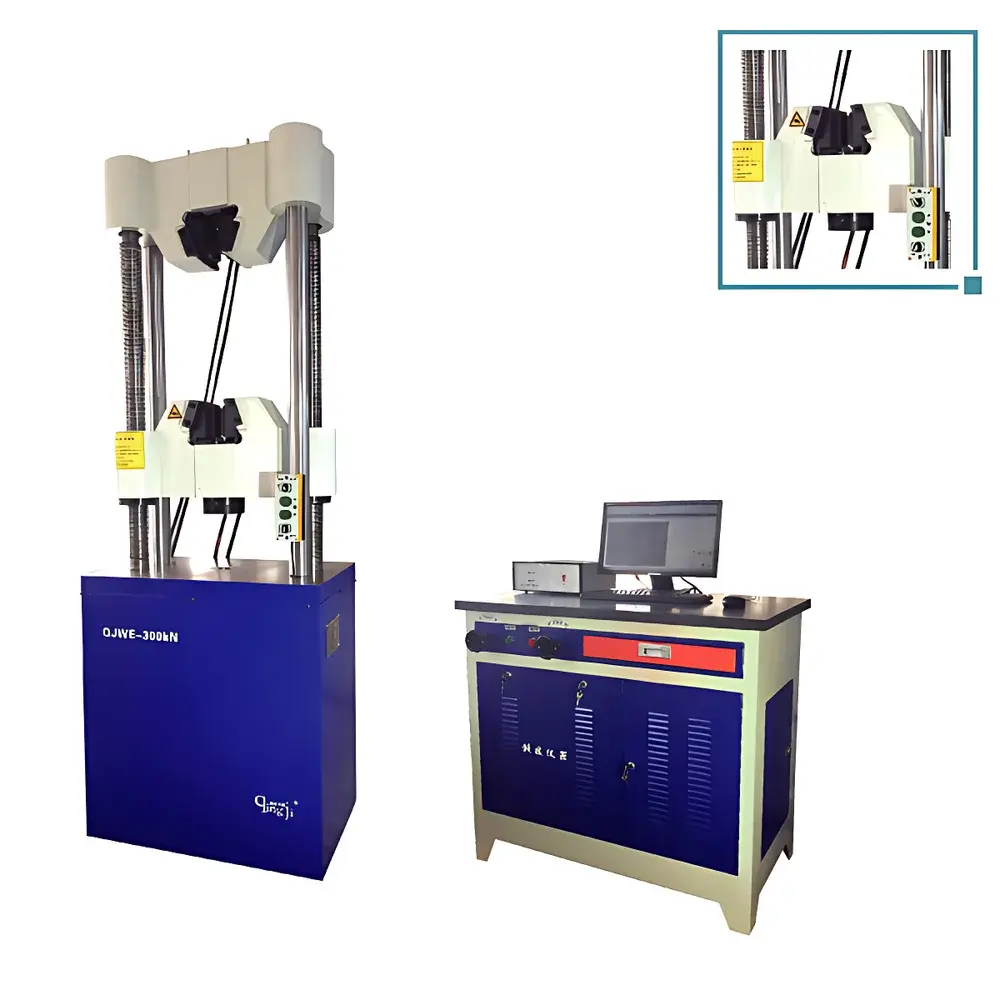
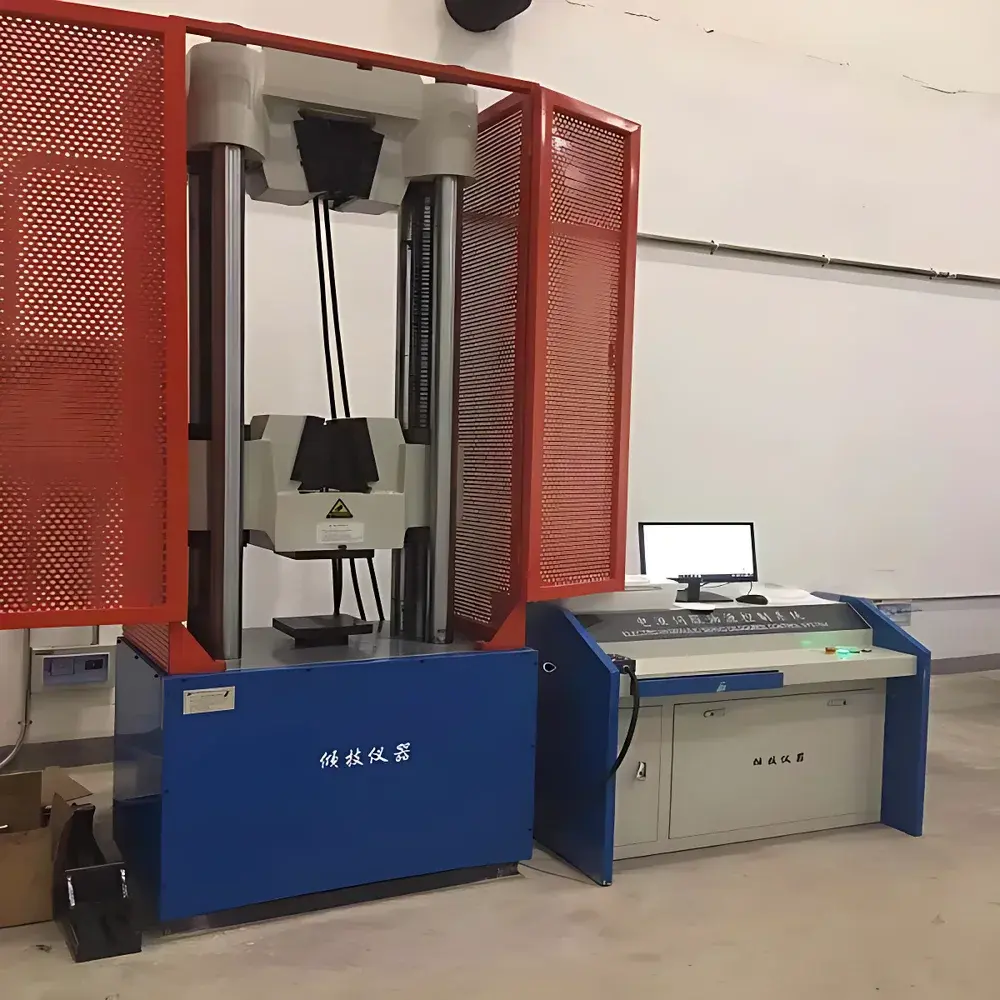
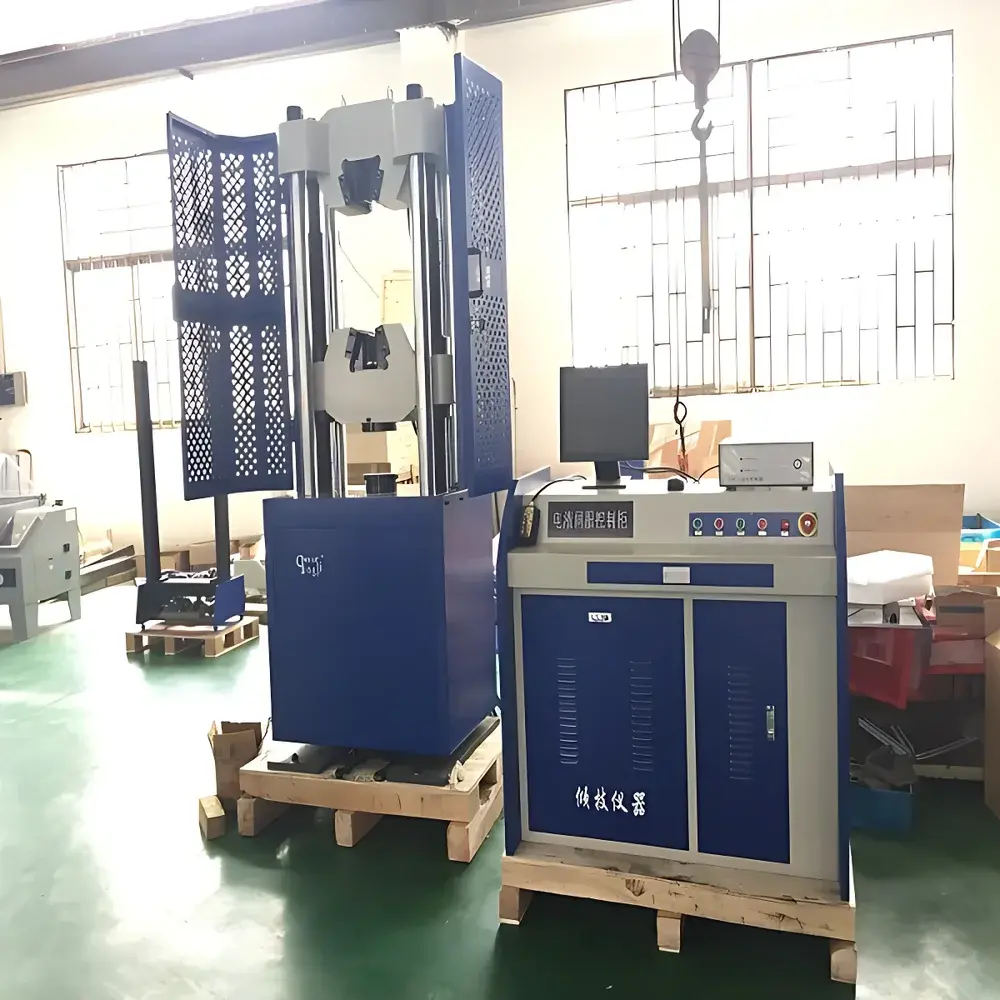
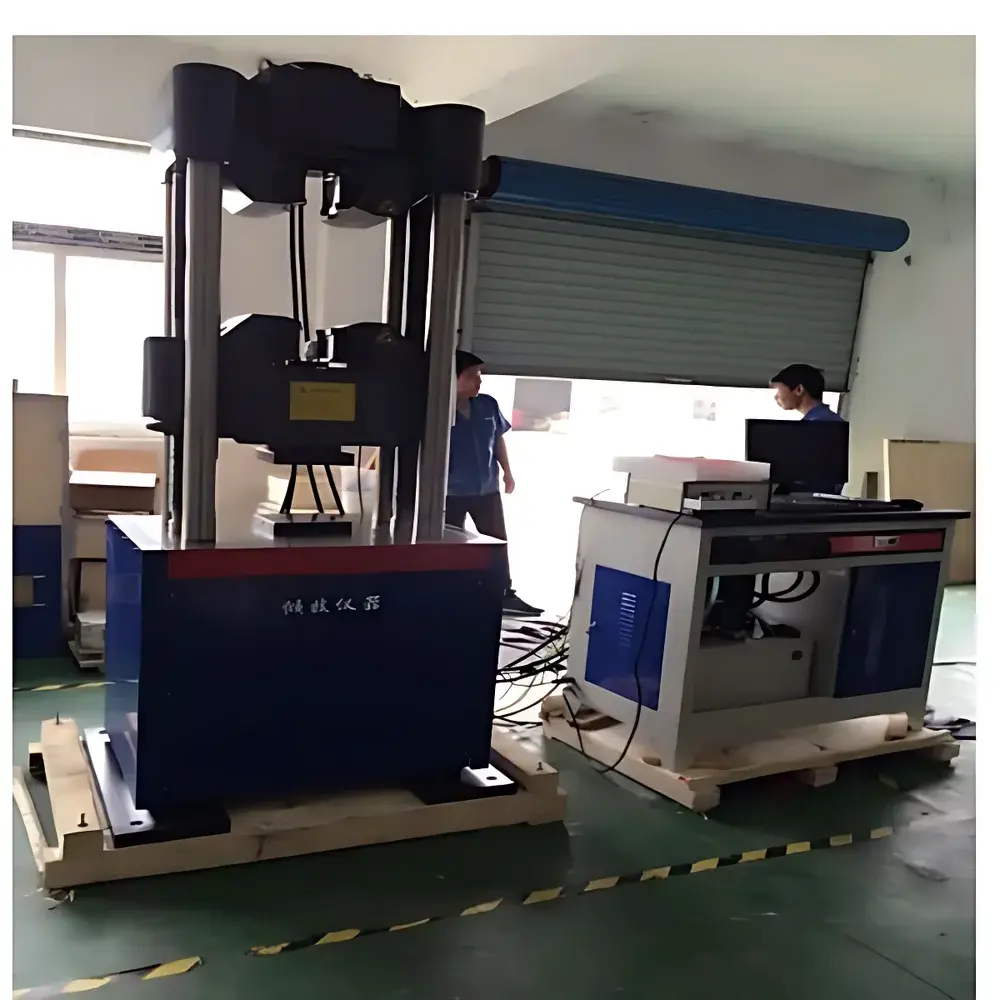
Qinsun QJWE Series Servo-Hydraulic Universal Testing Machine
| Brand | Qinsun |
|---|---|
| Origin | Shanghai, China |
| Model | QJ-WE |
| Price Range | USD 7,000 – 14,000 |
| Type | Servo-Hydraulic Universal Testing Machine |
| Load Capacity | 0.02–2000 kN |
| Load Accuracy | ±0.5% |
| Stroke | 150–170 mm |
| Max Compression Space | 480–510 mm |
| Max Tensile Space | 480–610 mm |
| Round Specimen Grip Range | φ10–70 mm |
| Flat Specimen Grip Thickness | 0–40 mm |
| Bending Support Span | 100–500 mm |
| Shear Specimen Diameter | φ10–30 mm |
| Dimensions (W×D×H) | 800×520×1850 to 950×650×2220 mm |
| Motor Power | 1.5–2.1 kW, 3-phase |
| Weight | 1650–2500 kg |
Overview
The Qinsun QJWE Series Servo-Hydraulic Universal Testing Machine is an industrial-grade static mechanical testing system engineered for high-force structural evaluation of metallic and non-metallic materials under controlled loading conditions. Based on the principle of servo-controlled hydraulic actuation, it delivers precise force application via a digitally regulated proportional valve system coupled with a load cell–based closed-loop feedback architecture. The machine operates in accordance with fundamental mechanics-of-materials test standards—including ASTM E4, ASTM E8/E8M (tension), ASTM E9 (compression), ASTM E290 (bend), and ISO 6892-1—enabling traceable, repeatable determination of yield strength, ultimate tensile strength, modulus of elasticity, elongation at break, and Poisson’s ratio. Its oil-cylinder-underneath configuration provides vertical space flexibility, while the rigid four-column frame ensures minimal deflection during high-load testing up to 2000 kN.
Key Features
- Servo-hydraulic actuation with fully digital closed-loop control, enabling programmable loading rates from 0.01 mm/min to 100 mm/min and multi-step stress/strain/force profiles
- High-accuracy load measurement using imported strain-gauge-based load cells calibrated to ±0.5% of full scale, compliant with ISO 7500-1 Class 1 requirements
- Adjustable test zones: compression space up to 510 mm, tensile space up to 610 mm, and bending span configurable between 100–500 mm
- Multi-format gripping system supporting round specimens (φ10–70 mm), flat specimens (up to 40 mm thick), and standardized shear coupons (φ10–30 mm)
- Integrated displacement transducer and extensometer interface (optional) for simultaneous axial deformation monitoring with resolution ≤0.5% of full scale
- Robust cast-iron base and reinforced steel frame designed for long-term stability under cyclic and static high-load operation
- Three-phase motor drive (1.5–2.1 kW) with low-noise hydraulic power unit and temperature-stabilized oil reservoir
Sample Compatibility & Compliance
The QJWE platform accommodates a broad spectrum of specimen geometries and material classes—including structural steel, aluminum alloys, titanium, reinforced concrete, fiber-reinforced polymers, and cementitious composites. It supports standard test specimen configurations per ASTM, ISO, and GB/T specifications. All mechanical measurements are traceable to national metrological standards; load cell calibration certificates are provided with each system. The machine meets mechanical safety requirements outlined in ISO 12100 and EN 698, and its control software architecture supports audit-ready data integrity practices aligned with GLP and GMP environments where applicable.
Software & Data Management
The embedded control and acquisition software enables real-time synchronization of load, displacement, and (when equipped) strain signals at up to 1 kHz sampling rate. Test sequences can be predefined using step-based or ramp-based protocols, including hold periods, cyclic loading, and conditional termination triggers. Data export formats include CSV, XLSX, and XML for integration into LIMS or enterprise QA systems. All test files retain metadata such as operator ID, environmental conditions (optional sensor input), calibration timestamps, and instrument configuration logs. Audit trail functionality complies with basic 21 CFR Part 11 principles—user authentication, electronic signatures, and immutable record retention are supported through optional configuration modules.
Applications
- Mechanical property certification of structural components in aerospace, rail, and energy sectors
- Quality assurance testing of welded joints, fasteners, and castings per ISO 15614 or AWS D1.1
- Compliance verification for civil engineering materials—including rebar, prestressed concrete tendons, and grouted duct systems
- R&D validation of novel composite laminates and additive-manufactured metal parts
- Third-party laboratory accreditation testing under CNAS, ILAC-MRA, or A2LA scopes
- Educational use in university materials science and mechanical engineering laboratories
FAQ
What standards does the QJWE comply with for load accuracy verification?
The system adheres to ISO 7500-1 Class 1 requirements for static force measurement, with load cells factory-calibrated and certified to ±0.5% of full scale.
Can the machine perform cyclic fatigue testing?
No—the QJWE is designed for quasi-static loading only; it does not support high-frequency dynamic or true fatigue cycling (e.g., ASTM E466). For such applications, a dedicated electrodynamic or servo-hydraulic fatigue system is recommended.
Is extensometer compatibility available as a factory option?
Yes—both clip-on and non-contact video extensometers can be integrated via standardized analog/digital I/O ports and configured within the control software.
What maintenance intervals are recommended for hydraulic system integrity?
Oil filtration and level checks are advised every 500 operational hours; full hydraulic fluid replacement and valve recalibration are recommended annually or after 2000 test cycles, whichever occurs first.
Does the system support remote diagnostics or firmware updates?
Yes—via secure Ethernet connection, authorized service engineers can initiate remote session-based diagnostics and apply verified firmware patches without on-site intervention.



