
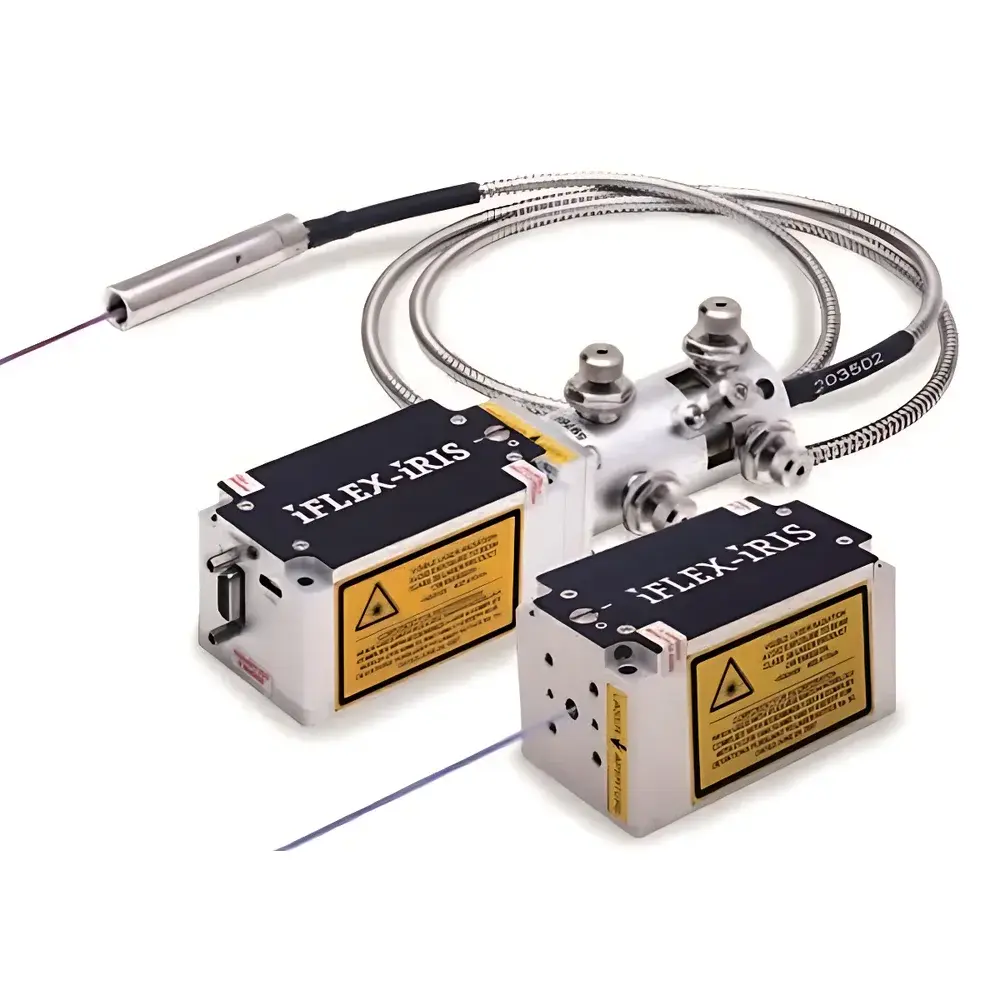
Qioptiq iFLEX-iRIS Series Low-Noise Semiconductor Laser Module
| Brand | Qioptiq |
|---|---|
| Origin | United Kingdom |
| Manufacturer Type | Authorized Distributor |
| Import Status | Imported |
| Model | iFLEX-iRIS |
| Core Technology | Single-Mode Polarization-Maintaining Fiber-Coupled Diode Laser |
| RMS Intensity Noise | <0.05% (10 Hz–10 MHz) |
| Beam Quality (M²) | <1.1 |
| Power Stability (8 h) | <±0.5% |
| Beam Pointing Stability | <1 µrad/°C |
| Dimensions | 70 × 40 × 38 mm |
| Modulation Options | TTL, Analog, Dual-Mode |
| Output | Collimated Free-Space or SM/PM Fiber-Coupled |
Overview
The Qioptiq iFLEX-iRIS series is a high-performance, fiber-coupled semiconductor laser module engineered for applications demanding exceptional intensity stability, minimal beam pointing drift, and diffraction-limited spatial coherence. Operating on the principle of edge-emitting diode lasing with intracavity noise suppression and active thermal stabilization, the iFLEX-iRIS leverages closed-loop temperature control (via integrated thermoelectric cooler and high-resolution thermistor feedback) and optimized cavity design to suppress mode competition and carrier-density fluctuations—primary contributors to intensity noise in standard diode lasers. This architecture enables RMS intensity noise below 0.05% over a 10 Hz–10 MHz bandwidth, making it suitable for photon-starved or coherence-sensitive optical measurements where signal-to-noise ratio directly determines measurement fidelity.
Key Features
- Ultra-low intensity noise: RMS <0.05% (10 Hz–10 MHz), validated per ISO 11554 Annex D protocols for laser intensity noise characterization
- Diffraction-limited beam quality: M² <1.1, ensuring efficient coupling into single-mode fibers and high-resolution imaging optics
- High long-term power stability: <±0.5% over 8 hours under constant ambient conditions (23 ± 1°C, no air drafts)
- Exceptional beam pointing stability: <1 µrad/°C, critical for alignment-sensitive platforms such as confocal microscopes and holographic interferometers
- Compact OEM form factor: 70 × 40 × 38 mm footprint, designed for integration into space-constrained instrumentation
- Flexible modulation architecture: Supports TTL digital modulation (up to 500 kHz), analog current modulation (DC–100 kHz), and synchronized dual-mode operation for complex pulse shaping
- Fiber delivery options: Standard output via single-mode (SM) or polarization-maintaining (PM) fiber with FC/APC connector; free-space collimated variants available upon request
- Customization capability: Wavelength selection across visible and NIR ranges (e.g., 405 nm, 488 nm, 532 nm, 640 nm, 785 nm); optional beam shaping (circularization, top-hat profile) and multi-wavelength integration
Sample Compatibility & Compliance
The iFLEX-iRIS is compatible with biological specimens, fluorescent dyes (e.g., FITC, PE, APC), quantum dots, and scattering colloids without inducing phototoxicity or thermal artifacts attributable to intensity instability. Its low-noise output meets requirements for quantitative fluorescence lifetime imaging (FLIM), Förster resonance energy transfer (FRET), and dynamic light scattering (DLS) per ISO 22412:2017. The module complies with IEC 60825-1:2014 (laser safety class classification), RoHS 2015/863/EU, and CE marking directives. When operated within specified environmental limits (15–35°C ambient, <70% non-condensing humidity), it supports GLP-compliant instrument qualification and is routinely deployed in ISO 17025-accredited laboratories for method validation in life science instrumentation.
Software & Data Management
The iFLEX-iRIS interfaces via industry-standard 0–5 V analog and 3.3/5 V TTL signals, enabling seamless integration with third-party DAQ systems (e.g., National Instruments PXI, Thorlabs Kinesis) and microscope control suites (e.g., MicroManager, MetaMorph). Optional Qioptiq Laser Control Software provides real-time monitoring of diode current, TEC voltage, case temperature, and output power (via integrated photodiode feedback). Audit trails—including timestamped parameter changes, thermal setpoint logs, and modulation history—are exportable in CSV format and support FDA 21 CFR Part 11 compliance when deployed on validated Windows-based host systems with electronic signature controls.
Applications
- Flow cytometry: Enables high-sensitivity detection of rare cell populations through stable excitation of tandem dyes and reduced background variance
- Confocal and super-resolution microscopy: Delivers consistent photon flux for precise localization and quantitative colocalization analysis
- DNA sequencing platforms (e.g., Illumina SBS chemistry): Supports base-calling accuracy by minimizing intensity-induced phasing errors
- Dynamic light scattering (DLS): Reduces autocorrelation function uncertainty in hydrodynamic size distribution calculations
- Holographic optical trapping and optogenetics: Provides stable trap stiffness and reliable neuronal activation kinetics
- Spectroscopic ellipsometry and chip-based biosensors: Ensures repeatability in thin-film thickness and binding affinity quantification
- Environmental monitoring systems: Used in portable Raman spectrometers and LIDAR prototypes requiring low-drift excitation sources
FAQ
What is the typical RMS noise bandwidth specification for the iFLEX-iRIS?
The RMS intensity noise is measured over 10 Hz to 10 MHz, with values consistently below 0.05% under standard operating conditions.
Can the iFLEX-iRIS be integrated into a multi-laser combiner system?
Yes—custom multi-wavelength modules with dichroic combining and individual modulation channels are available under OEM agreements.
Is PM fiber coupling available for all wavelengths?
Polarization-maintaining fiber coupling is standard for 488 nm, 532 nm, 640 nm, and 785 nm variants; availability for other wavelengths depends on diode vendor specifications and requires pre-order verification.
Does the module include internal power monitoring?
Yes—an integrated monitor photodiode provides real-time feedback with ±2% linearity over the full output range, referenced to factory calibration data.
What thermal management interface does the iFLEX-iRIS use?
It employs a PID-controlled thermoelectric cooler (TEC) with a high-stability NTC thermistor (±0.02°C resolution) and supports external temperature setpoint programming via analog voltage input.




