
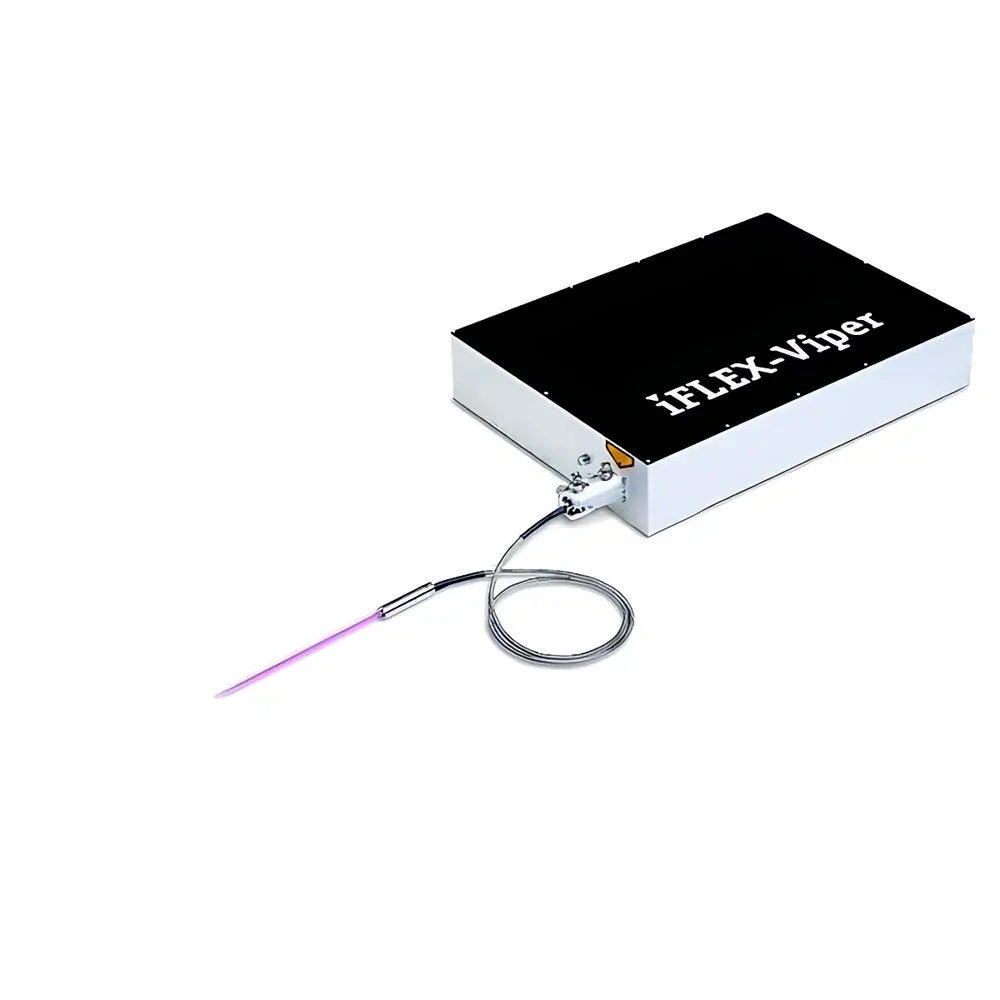
Qioptiq iFLEX-Viper Multi-Wavelength Laser Engine
| Brand | Qioptiq |
|---|---|
| Origin | United Kingdom |
| Model | iFLEX-Viper |
| Type | Solid-State Laser Engine |
| Output Configuration | Coaxially Combined Multi-Wavelength Beam |
| Control Architecture | Fully Independent Per-Wavelength Modulation & Power Regulation |
| Thermal Management | Active Temperature Stabilization (No Mode Hopping) |
| Power Stability | Closed-Loop Feedback Controlled |
| Beam Pointing Stability | <1 µrad/°C |
| Intensity Noise | <0.03% RMS (10 Hz–10 MHz) |
| Compliance | CDRH Compliant, OEM-Ready, FDA 21 CFR Part 11–Ready Software Interface Support |
| Fiber Coupling | Optimized for kineFLEX Single-Mode Polarization-Maintaining (SM PM) Fiber Delivery |
Overview
The Qioptiq iFLEX-Viper is a high-integration, solid-state multi-wavelength laser engine engineered for precision optical instrumentation in life science and industrial metrology applications. Unlike conventional multi-laser assemblies relying on passive beam combiners or acousto-optic tunable filters (AOTFs), the iFLEX-Viper employs a monolithic optomechanical architecture that co-aligns up to five discrete laser sources—each operating at a distinct wavelength—into a single, diffraction-limited, coaxial output beam. This design eliminates inter-channel pointing drift and spatial mode mismatch, ensuring consistent illumination geometry across all wavelengths. The system operates on the principle of independent diode-pumped solid-state (DPSS) or semiconductor laser emission, with each channel thermally isolated and actively stabilized to suppress mode hopping and wavelength drift. Its closed-loop power regulation delivers long-term intensity stability (<±0.5% over 8 hours), while sub-microradian beam pointing stability enables reliable integration into confocal microscopes, wafer inspection platforms, and fluorescence lifetime imaging systems without realignment.
Key Features
- Fully independent per-channel control: Individual analog/digital modulation (TTL, analog voltage, USB) for each wavelength—enabling synchronized or asynchronous switching, pulse shaping, and intensity ramping.
- Coaxial, polarization-maintained beam combining: All wavelengths propagate collinearly with preserved linear polarization states, critical for polarization-sensitive assays and interference-based measurements.
- No-user-alignment optomechanical design: Monolithic kinematic mount and permanent factory alignment eliminate field recalibration requirements—ensuring consistent beam overlap across instrument lifetime.
- Active thermal stabilization: Precision thermoelectric coolers (TECs) maintain diode and crystal temperatures within ±0.05 °C, guaranteeing wavelength stability better than ±5 pm and eliminating spectral mode jumps.
- Low-noise operation: Intensity noise floor <0.03% RMS (10 Hz–10 MHz bandwidth), optimized for photon-counting detection and quantitative fluorescence quantification.
- OEM-optimized footprint: Compact 120 × 90 × 45 mm housing with standardized mounting interfaces and low-power 24 V DC input—designed for seamless integration into automated analytical platforms.
Sample Compatibility & Compliance
The iFLEX-Viper is compatible with standard single-mode polarization-maintaining (SM PM) fiber delivery via the kineFLEX coupling interface, supporting fiber lengths from 1 m to 10 m with FC/APC or SMA905 connectors. Its output maintains M² 20 dB after fiber launch—enabling quantitative reproducibility in cell imaging, microarray scanning, and semiconductor defect analysis. The system conforms to IEC 60825-1:2014 Class 3B/4 laser safety standards and carries full CDRH certification for U.S. deployment. For regulated environments, its digital control interface supports audit-trail-capable software integration (e.g., μ-Manager™, LabVIEW™ with NI-DAQmx drivers), satisfying GLP/GMP documentation requirements under FDA 21 CFR Part 11 when deployed with validated host software.
Software & Data Management
The iFLEX-Viper communicates via USB 2.0 (CDC class) or RS-232, exposing a deterministic command set for wavelength selection, power setting (0–100% in 0.1% increments), modulation mode (CW/pulsed), and status monitoring (temperature, current, power feedback). SDKs are provided for Python, MATLAB, C/C++, and LabVIEW, enabling full synchronization with camera triggers, stage motion controllers, and spectroscopic acquisition hardware. All parameter changes are timestamped and logged internally; optional external logging via host PC ensures traceability for ISO/IEC 17025-compliant calibration records. Firmware updates preserve user-defined configuration profiles, minimizing requalification effort during instrument maintenance cycles.
Applications
- Confocal and super-resolution fluorescence microscopy requiring rapid, artifact-free multi-color excitation.
- Automated cell sorting and flow cytometry systems demanding stable, switchable excitation bands (e.g., 405/488/561/640 nm).
- Wafer-level metrology and photomask inspection where beam pointing stability directly impacts measurement repeatability.
- Microfluidic assay readers integrating multiple excitation wavelengths into compact cartridge-based platforms.
- Time-resolved fluorescence lifetime (FLIM) and Förster resonance energy transfer (FRET) studies requiring precise inter-channel timing synchronization.
- OEM integration into clinical diagnostic instruments compliant with IVD regulatory pathways (IVDR Annex II).
FAQ
Is the iFLEX-Viper compatible with existing microscope filter cubes and dichroics?
Yes—the coaxial output preserves standard beam diameter (Ø1.2 mm) and divergence (<1.5 mrad), matching common epifluorescence and confocal optical train specifications.
Can individual wavelengths be modulated at different frequencies simultaneously?
Yes—each channel features independent analog modulation inputs supporting DC–500 kHz bandwidth, enabling multiplexed lock-in detection schemes.
What is the maximum allowable fiber length for kineFLEX coupling without significant polarization degradation?
Up to 5 m of kineFLEX SM PM fiber maintains PER >18 dB; longer lengths require polarization compensation optics in the receiving instrument.
Does the system support remote firmware updates and diagnostic reporting?
Yes—USB-connected units accept signed firmware binaries; internal diagnostics report thermal margin, driver health, and power feedback deviation in real time.
Is OEM mechanical and electrical integration documentation available?
Yes—full mechanical drawings (STEP/IGES), pinout schematics, thermal derating curves, and EMI test reports are provided under NDA for qualified partners.




