
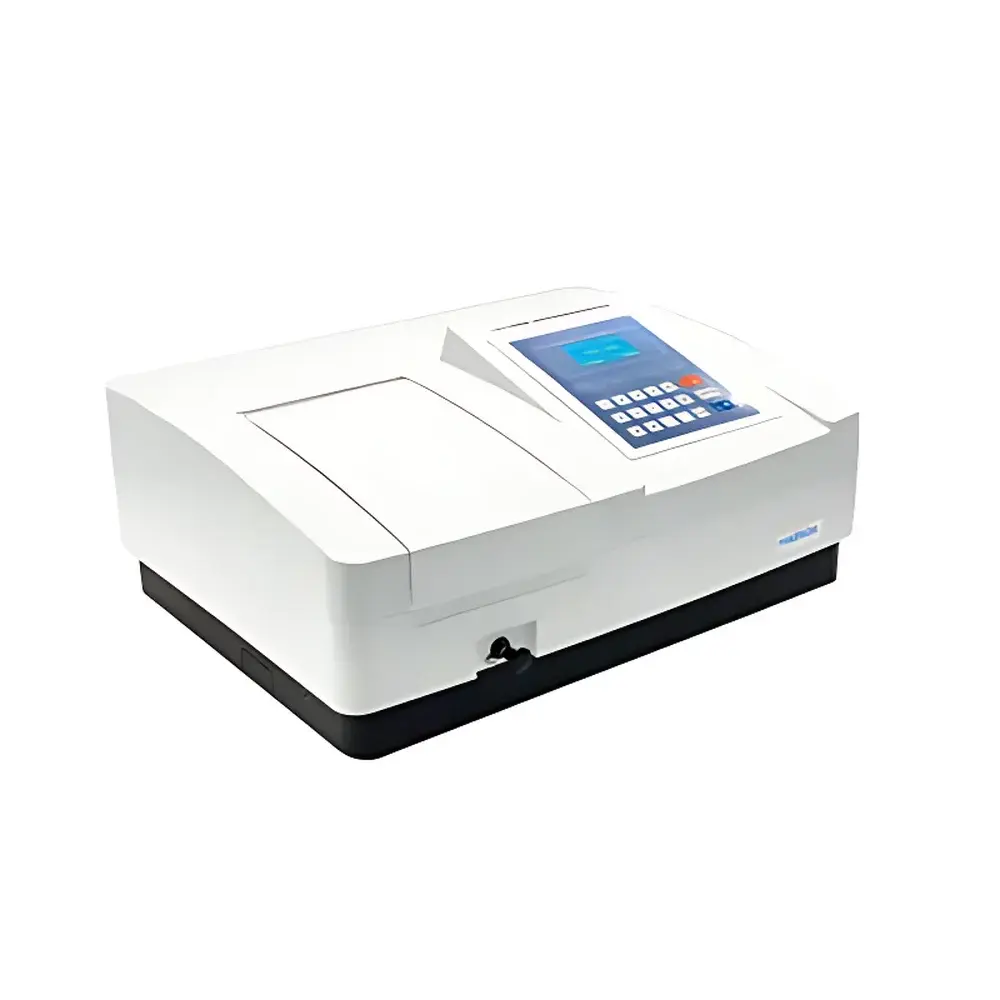
Mapada V-1600PC Visible Spectrophotometer
| Brand | Mapada |
|---|---|
| Origin | Shanghai, China |
| Manufacturer Type | Direct Manufacturer |
| Product Origin | Domestic (China) |
| Model | V-1600PC |
| Price Range | USD 1,400–2,800 |
| Optical Design | Pseudo-Double-Beam |
| Detector | Silicon Photodiode (Imported) |
| Wavelength Range | 320–1100 nm |
| Wavelength Accuracy | ±0.5 nm |
| Spectral Bandwidth | 4 nm |
| Wavelength Repeatability | ≤0.2 nm |
| Display | 128 × 64 Dot-Matrix LCD |
| Measurement Modes | Transmittance (T), Absorbance (A), Concentration (C), Energy (E) |
| Display Range | 0–200% T, –0.3 to 3.0 A |
| Light Source | Long-Life Tungsten Halogen Lamp |
| Wavelength Setting | Motorized Auto-Scanning |
| Data Interface | USB Type-B |
| Printer Interface | Parallel Port |
| Power Supply | AC 220 V / 50 Hz or AC 110 V / 60 Hz |
| Dimensions (W×D×H) | 490 × 360 × 240 mm |
| Net Weight | 12 kg |
Overview
The Mapada V-1600PC Visible Spectrophotometer is a precision optical instrument engineered for quantitative and qualitative analysis in the visible and near-ultraviolet spectral region. Based on the pseudo-double-beam optical architecture, it mitigates baseline drift and photometric noise by continuously referencing the light path against a stabilized reference beam—without requiring mechanical choppers or dual detectors. This design delivers high photometric stability and reproducibility across extended measurement sessions, making it suitable for routine quality control, educational laboratories, and research applications where cost-effective reliability is essential. Operating within a wavelength range of 320–1100 nm, the instrument employs a 1200 lines/mm holographic grating and an imported silicon photodiode detector to ensure consistent spectral resolution and linearity. Its fixed 4 nm spectral bandwidth complies with standard methodologies for colorimetric assays, enzyme kinetics, and concentration determinations per ISO 6726, ASTM E275, and USP .
Key Features
- Pseudo-double-beam optical system with real-time reference beam compensation for enhanced photometric stability and reduced lamp aging effects
- Motorized automatic wavelength scanning and calibration—eliminates manual adjustment and improves inter-day repeatability
- Integrated tungsten halogen lamp with intelligent lamp life monitoring; socket-type lamp housing enables tool-free replacement without optical realignment
- 128 × 64 dot-matrix LCD display supporting simultaneous visualization of absorbance spectra, kinetic time-course plots, and standard curve regression (linear, quadratic, and cubic fitting)
- Onboard data storage for up to 100 user-defined calibration curves and 200 measurement datasets—no external PC required for basic operation
- Wide sample compartment accommodating cuvettes from 5 mm to 100 mm pathlength, including rectangular quartz, glass, and plastic cells
- Film-type membrane keypad with tactile feedback for intuitive, wear-resistant operation in high-throughput environments
- USB 2.0 interface compliant with USB CDC class drivers—enables direct communication with Windows-based host systems without proprietary dongles
Sample Compatibility & Compliance
The V-1600PC supports standard 10 mm square cuvettes as well as variable-pathlength cells (5, 20, 50, and 100 mm), facilitating both high-sensitivity trace analysis and low-absorbance transmission measurements. It is compatible with common solvent systems—including water, ethanol, acetone, and phosphate-buffered saline—provided refractive index differences remain within ±0.05 units relative to air. The instrument meets electromagnetic compatibility requirements per IEC 61326-1:2013 (industrial environment) and safety standards per IEC 61010-1:2010. While not certified for GMP-regulated production environments, its firmware supports audit-trail-capable data export (via Mapada ScanPro software), enabling alignment with GLP documentation practices and internal SOPs for method validation.
Software & Data Management
The included Mapada ScanPro professional software (v3.2+) provides full remote control and advanced post-processing capabilities. It supports spectral acquisition at up to 1 nm intervals, time-resolved kinetic scans with user-defined sampling intervals (0.1–60 s), multi-wavelength quantitation across up to 10 wavelengths simultaneously, and automated peak identification with baseline correction algorithms. All raw data files are saved in ASCII-delimited (.txt) and CSV formats for seamless import into MATLAB, Python (NumPy/Pandas), or LIMS platforms. Software-generated reports include instrument ID, operator name, date/time stamps, calibration history, and measurement metadata—facilitating traceability under ISO/IEC 17025 Clause 7.8. The USB interface operates in HID-compliant mode, eliminating the need for signed drivers on Windows 10/11 and macOS 12+ systems.
Applications
- Quantitative determination of transition metal ions (e.g., Fe²⁺/Fe³⁺, Cu²⁺, Cr⁶⁺) using established colorimetric reagents such as 1,10-phenanthroline or diphenylcarbazide
- Enzyme activity assays (e.g., LDH, ALP, AST) via NAD(P)H oxidation/reduction monitoring at 340 nm
- Pharmaceutical excipient purity screening and dissolution profile verification in non-UV regions (e.g., tartrazine at 425 nm)
- Water quality testing per APHA Standard Methods 4500-P E (phosphate) and 4500-NO₂⁻ B (nitrite) protocols
- Food industry applications including chlorophyll-a/b quantification in plant extracts and anthocyanin profiling in fruit juices
- Academic teaching labs for Beer–Lambert law verification, equilibrium constant determination (e.g., FeSCN²⁺), and spectral deconvolution exercises
FAQ
Is the V-1600PC compliant with FDA 21 CFR Part 11?
No—the instrument’s embedded firmware and ScanPro software do not provide electronic signature capability, role-based access control, or immutable audit trails required for Part 11 compliance. However, exported CSV data may be incorporated into validated third-party LIMS or ELN systems.
Can the V-1600PC measure below 320 nm?
No—it lacks a deuterium lamp and is optimized exclusively for the visible and near-NIR range (320–1100 nm). For UV measurements down to 190 nm, consider the Mapada UV-1800 series.
What is the photometric accuracy specification?
At 0.5 A (using neutral density filters traceable to NIST SRM 930e), the typical photometric accuracy is ±0.005 A; at 1.0 A, it is ±0.008 A—verified per ASTM E275 Annex A1.
Does the instrument support RS-232 or Ethernet connectivity?
No—only USB Type-B (data) and parallel port (printer) interfaces are provided. Network integration requires external USB-to-Ethernet adapters configured at the host OS level.
How often should wavelength calibration be performed?
Factory calibration remains stable for ≥12 months under normal lab conditions (20–25 °C, <60% RH, no vibration). Annual verification using holmium oxide or didymium glass reference filters is recommended per ISO/IEC 17025 Clause 6.4.6.




