
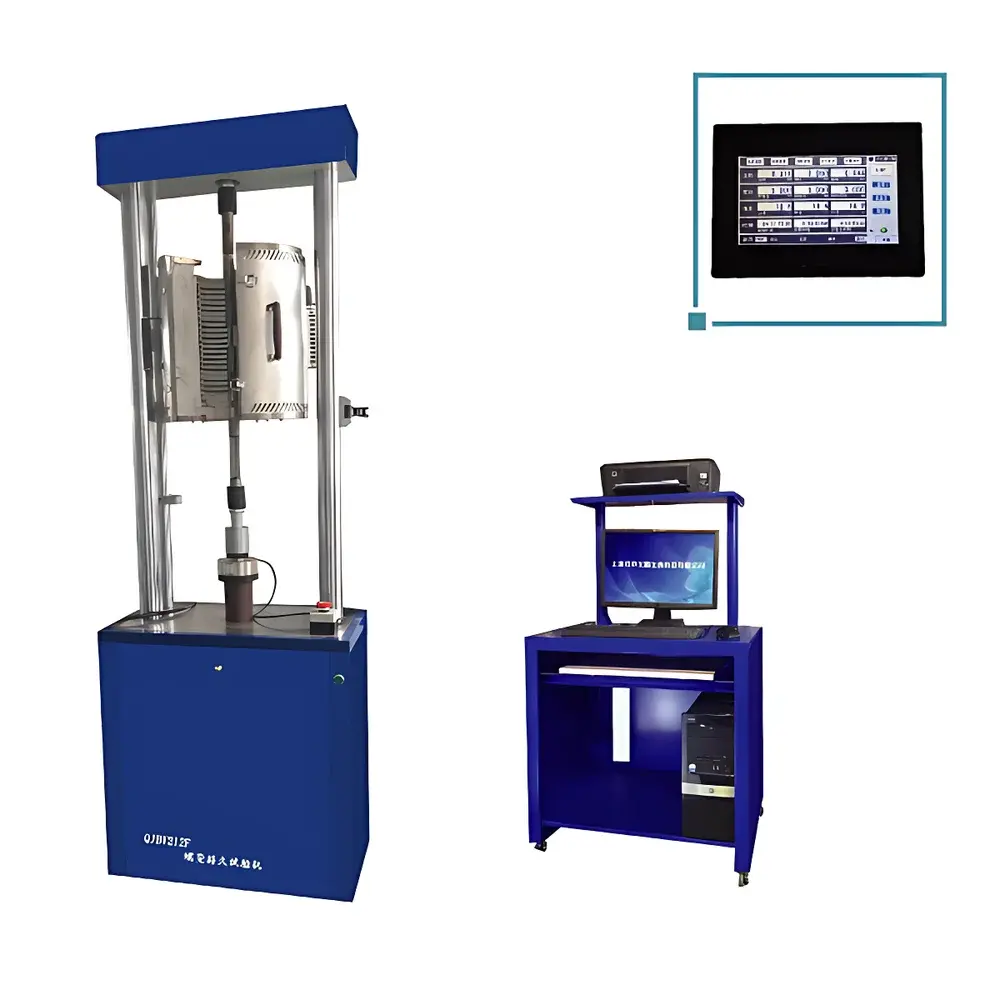
QJ Tech QJBV212F High-Temperature Creep Testing Machine
| [Brand | QJ Tech |
|---|---|
| Origin | Shanghai, China |
| Model | QJBV212F |
| Max Test Load | 10–100 kN (selectable) |
| Load Accuracy | ±0.5% of reading (≥1% FS) |
| Load Control Stability | ±1% of set value |
| Crosshead Speed | 0.01–180 mm/min |
| Stroke | 200 mm |
| Strain Measurement | Imported linear encoder |
| Strain Range | Up to 25 mm |
| Strain Accuracy | ±0.5% |
| Furnace ID | φ50 mm |
| Furnace Length | 450 mm |
| Temperature Range | RT to 1200 °C |
| Temperature Uniformity | ±0.5 °C |
| Isothermal Zone Length | >150 mm |
| Power Supply | 3 kW |
| Weight | 850 kg] |
Overview
The QJ Tech QJBV212F High-Temperature Creep Testing Machine is a precision-engineered electromechanical system designed for standardized uniaxial creep and stress-rupture testing of metallic materials under sustained mechanical load and elevated temperature conditions. It operates on the fundamental principle of controlled constant-load or constant-stress application while monitoring time-dependent axial deformation—enabling quantification of primary, secondary (steady-state), and tertiary creep stages. The system integrates a high-rigidity load frame, servo-controlled loading actuator, calibrated high-temperature furnace with uniform thermal gradient control, and synchronized digital displacement and temperature acquisition. Its architecture conforms to internationally recognized metallurgical test standards including ASTM E139, ISO 204, GB/T 2039, and HB 5150–5151, making it suitable for qualification testing in aerospace component certification, power-generation alloy validation, and nuclear material long-term behavior assessment.
Key Features
- Modular load capacity configuration: Selectable maximum loads of 10 kN, 20 kN, 30 kN, 50 kN, or 100 kN—each calibrated per ISO 7500-1 Class 0.5 requirements.
- High-fidelity load control: Closed-loop servo system with ±1% setpoint accuracy and 0.1 N resolution ensures stable stress maintenance over durations ranging from hours to thousands of hours.
- Precision thermal environment: Cylindrical resistance furnace (φ50 mm × 450 mm) delivers programmable temperature profiles from ambient to 1200 °C, with ±0.5 °C stability and >150 mm isothermal zone verified per ASTM E220.
- Non-contact strain measurement: Dual-channel optical encoder system mounted on the loading train provides traceable axial deformation data up to 25 mm full scale with ±0.5% linearity error.
- Robust mechanical design: Heavy-duty cast-iron base (850 kg total mass) minimizes vibrational coupling and thermal drift during long-duration tests.
- Compliance-ready hardware interface: Analog and digital I/O ports support integration with third-party data loggers and LIMS systems compliant with FDA 21 CFR Part 11 audit trail requirements.
Sample Compatibility & Compliance
The QJBV212F accommodates standard creep specimens per ASTM E139 geometry specifications—including round-bar (typically Ø6–12 mm) and flat-strip configurations—for ferrous alloys (e.g., low-alloy steels, stainless grades), nonferrous metals (e.g., Ti-6Al-4V, Inconel 718), and intermetallic compounds. Specimen gripping utilizes water-cooled wedge-type fixtures to isolate thermal expansion effects at the grip–furnace interface. All operational parameters—including load ramping, dwell periods, temperature ramps, and hold steps—are programmable to meet mandatory sequences defined in GB/T 2039-1997, HB 5151-1996, and ISO 204:2021. Calibration certificates for load cell, encoder, and thermocouple channels are provided with each system shipment, supporting GLP/GMP laboratory accreditation processes.
Software & Data Management
The system ships with QJ-CreepControl v3.x—a Windows-based deterministic real-time control and acquisition platform. It supports dual-loop PID regulation (load + temperature), automatic zero-drift compensation, and scheduled multi-step test protocols. Raw data streams (load, displacement, furnace zone temperatures, cold-junction compensation values) are recorded at user-defined intervals (10 ms to 10 s) in ASCII CSV format with embedded metadata (operator ID, sample ID, standard reference, calibration expiry). Built-in analysis modules generate Larson–Miller parameter plots, Monkman–Grant relationships, and minimum creep rate derivatives. Export functionality includes direct output to Excel, MATLAB (.mat), and standardized ASTM E139-compliant XML reports. Audit trails record all parameter modifications, user logins, and calibration events—fully compliant with ISO/IEC 17025 documentation requirements.
Applications
- Qualification of turbine disk and blade alloys operating above 0.4 Tm (melting temperature ratio) in gas turbine engines.
- Long-term integrity assessment of pressure vessel steels used in fossil and nuclear power plants (ASME Section II, Part D).
- Development and verification of constitutive models for finite element simulation of hot-forming processes.
- Interlaboratory comparison studies coordinated under CNAS or ILAC MRA frameworks.
- Research into microstructural evolution mechanisms (e.g., dislocation climb, cavity nucleation) via post-test SEM/TEM specimen analysis.
FAQ
What standards does the QJBV212F comply with for creep testing?
It meets JJG 276–1988, GB/T 2039–1997, HB 5150–1996, HB 5151–1996, ASTM E139, and ISO 204 requirements.
Can the system perform both creep and stress-rupture (rupture life) tests?
Yes—programmable hold modes allow continuous load application until specimen failure, enabling full rupture life characterization.
Is furnace temperature uniformity validated across the gauge length?
Yes—the >150 mm isothermal zone is certified using three-point thermocouple mapping per ASTM E220 prior to shipment.
Does the system support automated data export for regulatory submission?
Yes—CSV and XML exports include timestamps, calibration IDs, and operator credentials required for FDA 21 CFR Part 11 and ISO/IEC 17025 submissions.
What maintenance is required for long-term reliability?
Annual recalibration of load cell and encoder is recommended; furnace elements and thermocouples are field-replaceable consumables supplied by QJ Tech.



