
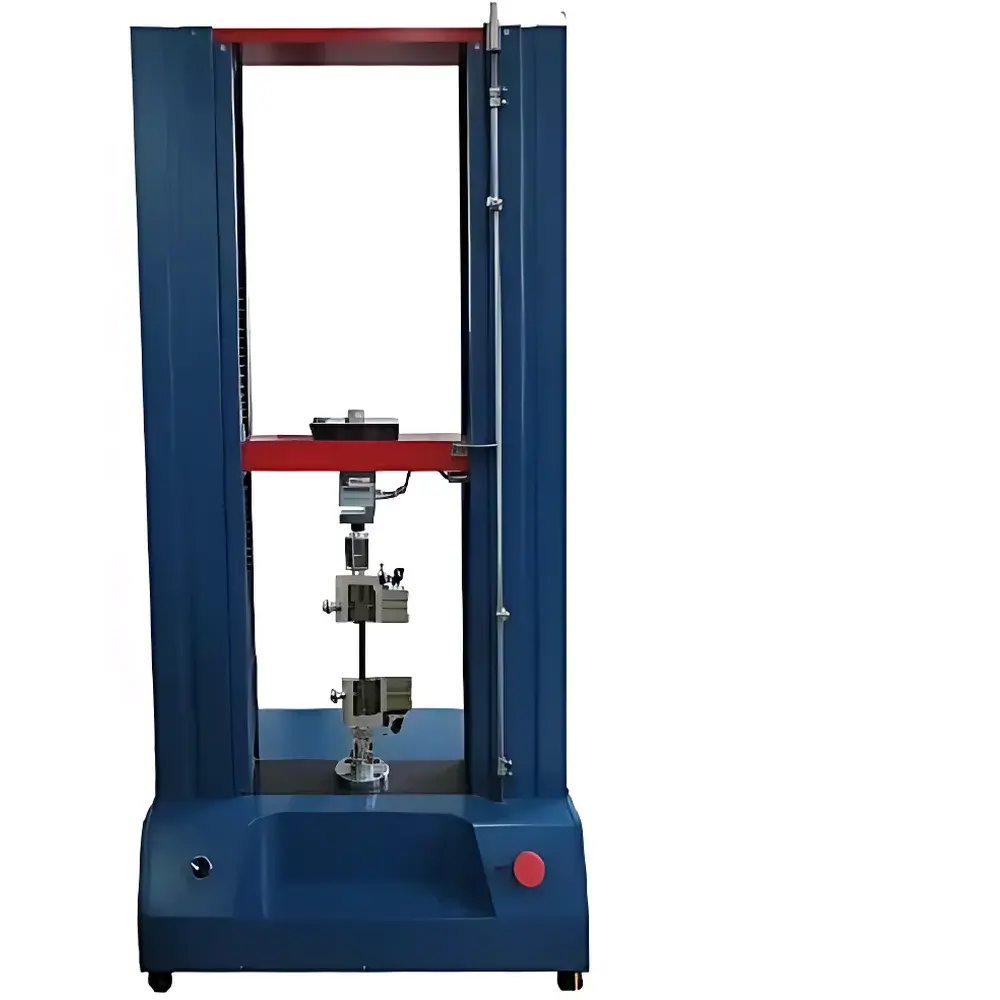
QJ211 Universal Testing Machine (UTM) for Wire Tensile Testing
| Brand | Qinsun |
|---|---|
| Origin | Shanghai, China |
| Model | QJ211 |
| Max Load Capacity | 30 kN (configurable) |
| Load Cell Accuracy | 0.01% FS |
| Measurement Accuracy | < ±0.5% |
| Control System | Windows-based PC control with real-time data acquisition |
| Valid Test Width | ~420 mm |
| Effective Stroke | ~800 mm |
| Test Speed Range | 0.001–500 mm/min |
| Speed Accuracy | ±0.5% |
| Displacement Accuracy | ±0.5% |
| Deformation Measurement Accuracy | ±0.5% |
| Safety Features | Electronic travel limit protection, emergency stop button |
| Unit Weight | ~140 kg |
| Compliance | ISO 6892-1, ASTM E8/E21, JIS Z2241, DIN 50125 |
Overview
The QJ211 Universal Testing Machine (UTM) is a precision-engineered electromechanical system designed specifically for static mechanical characterization of metallic wires, strands, and small-diameter ductile specimens. Built upon a dual-column rigid frame architecture with high-stiffness crosshead guidance and servo-controlled AC motor actuation, the instrument operates on the principle of controlled uniaxial force application—measuring load, displacement, and strain simultaneously to derive fundamental mechanical properties including tensile strength, yield strength (offset method), elongation at break, modulus of elasticity, and reduction in area. Its modular design supports standardized test configurations per international material testing protocols, enabling repeatable, traceable, and auditable results in quality control laboratories, R&D facilities, and third-party certification centers.
Key Features
- High-resolution load measurement using a 0.01% full-scale accuracy load cell, calibrated to NIST-traceable standards.
- Real-time synchronized acquisition of force, displacement, and optional extensometer-derived strain signals at up to 1 kHz sampling rate.
- Windows-based proprietary software with intuitive GUI for test method configuration, real-time curve overlay, and post-test analysis—including automatic yield point detection, tangent modulus calculation, and proof stress determination.
- Adjustable crosshead speed range from 0.001 mm/min (creep-sensitive quasi-static loading) to 500 mm/min (high-speed rupture assessment), with closed-loop velocity control maintaining ±0.5% deviation across the entire range.
- Dual-mode safety architecture: hardware-based electronic travel limits prevent over-travel damage; software-enforced soft limits provide programmable stroke boundaries prior to test initiation.
- Modular fixture interface compatible with wedge-action grips, pneumatic clamps, and custom-designed wire anchoring fixtures for diameters ranging from 0.1 mm to 6.0 mm.
Sample Compatibility & Compliance
The QJ211 accommodates round, stranded, and flattened metallic wire specimens conforming to ASTM A370 (steel products), ISO 15630-3 (reinforcing steels), and EN 10002-1 (tensile testing of metals). It supports standard gauge lengths (e.g., 50 mm, 100 mm, 200 mm) and meets dimensional requirements for ISO 6892-1 Type II specimens. All test procedures are fully compliant with GLP documentation practices and support 21 CFR Part 11–ready audit trails when operated under validated software configurations. Calibration certificates include uncertainty budgets aligned with ISO/IEC 17025 requirements, ensuring metrological traceability for ISO/IEC 17025-accredited labs.
Software & Data Management
The embedded Windows OS platform runs Qinsun’s UTMControl Suite v4.x—a deterministic, multi-threaded application supporting concurrent test execution, batch processing, and template-driven method recall. Raw data files (.qdt) store time-stamped analog channel values with metadata (operator ID, sample ID, environmental conditions). Export formats include CSV, XML, PDF reports with embedded stress–strain curves, and ASTM E1432-compliant certificate templates. The software implements role-based access control (RBAC), electronic signatures, and immutable audit logs for all critical actions—including parameter edits, calibration events, and report generation—to satisfy FDA 21 CFR Part 11 and EU Annex 11 regulatory expectations.
Applications
- Tensile evaluation of stainless steel, galvanized, and phosphor-bronze wires used in medical guidewires, spring manufacturing, and cable assemblies.
- Compression testing of coiled wire segments and helical springs under axial loading per ASTM D1641.
- Bending fatigue simulation via low-cycle tension–compression cycling (e.g., 10²–10⁴ cycles) with programmable waveform profiles.
- Peel and shear strength validation of insulated wire coatings per ASTM D903 and IEC 60811-503.
- Quality conformance verification against supplier specifications in incoming inspection workflows.
- Material lot release testing supporting ISO 9001:2015 Clause 8.6 and AS9100D requirements.
FAQ
Does the QJ211 support automatic yield strength calculation per ISO 6892-1 Annex C?
Yes—the software implements both the 0.2% offset method and the total extension method (method B), with configurable strain rate ramping and auto-detection thresholds.
Can third-party extensometers be integrated?
Yes—via analog voltage input (±10 V) or digital LVDT interface; supported protocols include ASTM E83 Class B and ISO 9513 Class 1.
Is remote diagnostics and firmware update capability available?
Yes—through secure HTTPS-based web interface with TLS 1.2 encryption and authenticated SSH access for authorized service engineers.
What documentation is provided for IQ/OQ validation?
A complete validation package is included: URS, FDS, DQ protocol/report, IQ/OQ test scripts with pass/fail criteria, and calibration records traceable to national metrology institutes.
How is mechanical overload protection implemented beyond software limits?
Hardware interlocks disconnect motor drive power within 10 ms upon exceeding user-defined load thresholds, independent of PC responsiveness or software state.



