
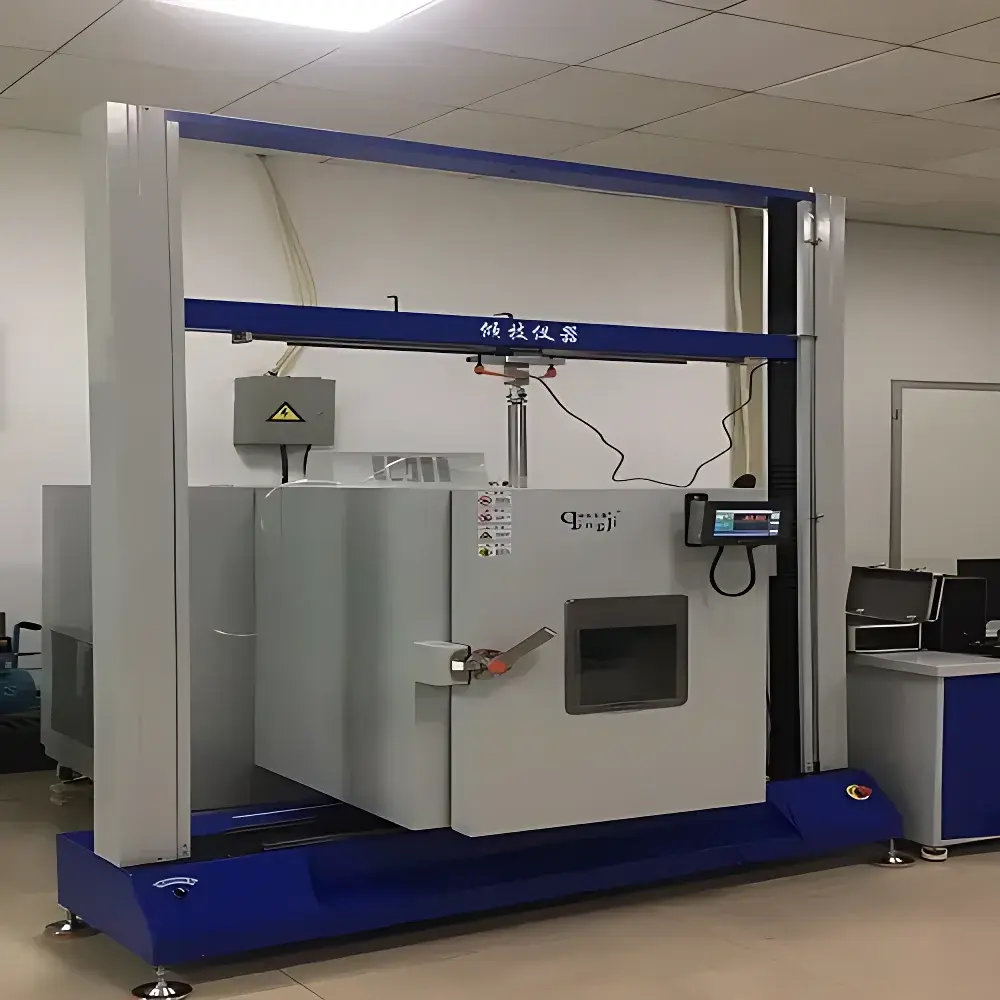
QJ211B High-Low Temperature Tensile Testing Machine
| Origin | Shanghai, China |
|---|---|
| Manufacturer Type | Authorized Distributor |
| Origin Category | Domestic (China) |
| Model | QJ211B |
| Price | USD 7,700 (approx.) |
| Instrument Type | Electromechanical Tensile Tester |
| Max Test Load | 30 kN |
| Load Range | 0–30 kN (fully adjustable) |
| Load Accuracy | ±1% FS or ±0.5% FS |
| Test Stroke | 420 mm |
| Displacement Resolution | ±0.5% of reading |
Overview
The QJ211B High-Low Temperature Tensile Testing Machine is an electromechanical universal testing system engineered for precise mechanical property evaluation of materials under controlled thermal environments. It integrates a high-stiffness dual-column frame with a modular environmental chamber capable of sustaining temperatures from –70 °C to +350 °C (constant-temperature hold at 350 °C), enabling static and quasi-static tensile, compression, flexure, peel, tear, shear, puncture, and low-cycle fatigue testing. The system operates on the principle of servo-controlled displacement actuation, where load is measured via high-precision S-type load cells (0.01% strain gauge resolution) and displacement is tracked using optical encoder feedback. Its architecture complies with fundamental metrological requirements outlined in ISO 7500-1 (class 1 or class 0.5 depending on configuration), ASTM E4, and GB/T 228.1—2021 for metallic materials and GB/T 1040.1—2018 for plastics. The base unit functions as a standalone ambient-temperature tester; the thermal chamber is detachable to maximize workspace flexibility and support non-thermal test protocols.
Key Features
- Modular thermal chamber with independent PID temperature control, achieving ±1 °C uniformity across the test zone at steady state and ramp rates ≥5 °C/min
- Electromechanical drive system with closed-loop servo motor control, supporting programmable crosshead speeds from 0.001 to 500 mm/min (optionally extended to 1000 mm/min)
- Dual-range load measurement: full-scale accuracy of ±0.5% FS (high-precision mode) or ±1% FS (standard mode), traceable to national calibration standards
- Displacement resolution of ±0.5% of indicated value, verified per ISO 204 and ASTM E83 Class B requirements
- Integrated safety architecture including electronic travel limits, emergency stop circuitry, and hardware-based overload cutoff
- Detachable environmental chamber design—removable without tools—to enable rapid reconfiguration for room-temperature testing or auxiliary fixture integration
- Robust structural frame (135 kg mass) with 420 mm effective test width and ~800 mm standard vertical test space (extendable upon request)
Sample Compatibility & Compliance
The QJ211B accommodates standardized specimens per ISO 6892-1 (tensile testing of metals), ASTM D638 (plastics), ASTM D882 (thin films), ISO 179 (impact-modified polymers), and JIS K7113 (rubber). Grip options include pneumatic wedge grips, hydraulic clamps, and specialized fixtures for film, fiber, wire, and composite laminates. Thermal chamber ports allow for in-situ extensometry and video-based strain mapping when paired with compatible accessories. System documentation supports GLP/GMP-aligned validation—full IQ/OQ documentation packages are available. Data acquisition meets FDA 21 CFR Part 11 requirements when operated with compliant software (audit trail, electronic signatures, role-based access control).
Software & Data Management
Control and analysis are executed via Windows-based proprietary software compliant with IEC 62591 (WirelessHART) and IEEE 1451.2 sensor interface standards. The platform supports multi-step test profiles (ramp-hold-ramp, cyclic loading, stress relaxation), real-time curve overlay, automatic yield point detection (0.2% offset method), and modulus calculation (secant, tangent, chord). Raw data export is available in CSV, XML, and universal .UDF formats. All test logs include embedded metadata: timestamp, operator ID, environmental chamber setpoint/actual, load cell serial number, calibration expiry date, and firmware revision. Audit trails record every parameter change, file save, and user login event—retained for ≥36 months unless purged per institutional retention policy.
Applications
- Thermo-mechanical characterization of aerospace alloys (e.g., Ti-6Al-4V, Inconel 718) across cryogenic to near-solution heat treatment temperatures
- Evaluation of polymer glass transition effects on tensile strength and elongation-at-break (e.g., PEEK, PEI, ETFE)
- Validation of adhesive bond integrity in automotive composites under thermal cycling conditions
- Quality control of medical device components (catheter tubing, suture materials) per ISO 10993-12 and USP
- Research into shape-memory alloy recovery behavior under constrained uniaxial loading
- Creep and stress-relaxation studies in elastomeric seals used in semiconductor process equipment
FAQ
What temperature stability is achievable at 350 °C?
At 350 °C constant-temperature operation, the chamber maintains ±1 °C spatial uniformity over a 100 × 100 × 100 mm test volume for ≥30 minutes, verified by NIST-traceable thermocouples.
Can the system be integrated with third-party extensometers?
Yes—via analog voltage output (±10 V) and digital TTL trigger interfaces; compatible with contact-type LVDTs, non-contact video extensometers (e.g., DIC systems), and laser interferometers meeting EN 10002-4 specifications.
Is calibration certification included with shipment?
Each unit ships with a factory calibration report per ISO/IEC 17025, covering load cell linearity, zero balance, repeatability, and displacement encoder verification—valid for 12 months from date of issue.
What is the recommended maintenance interval?
Preventive maintenance—including lubrication of lead screws, inspection of belt tension, and verification of thermal insulation integrity—is advised every 500 operational hours or biannually, whichever occurs first.
Does the software support automated reporting per ISO 17025 requirements?
Yes—the reporting module generates PDF test certificates containing uncertainty budgets, measurement traceability statements, environmental conditions, and signature fields for authorized personnel, fully aligned with ISO/IEC 17025:2017 clause 7.8.



