
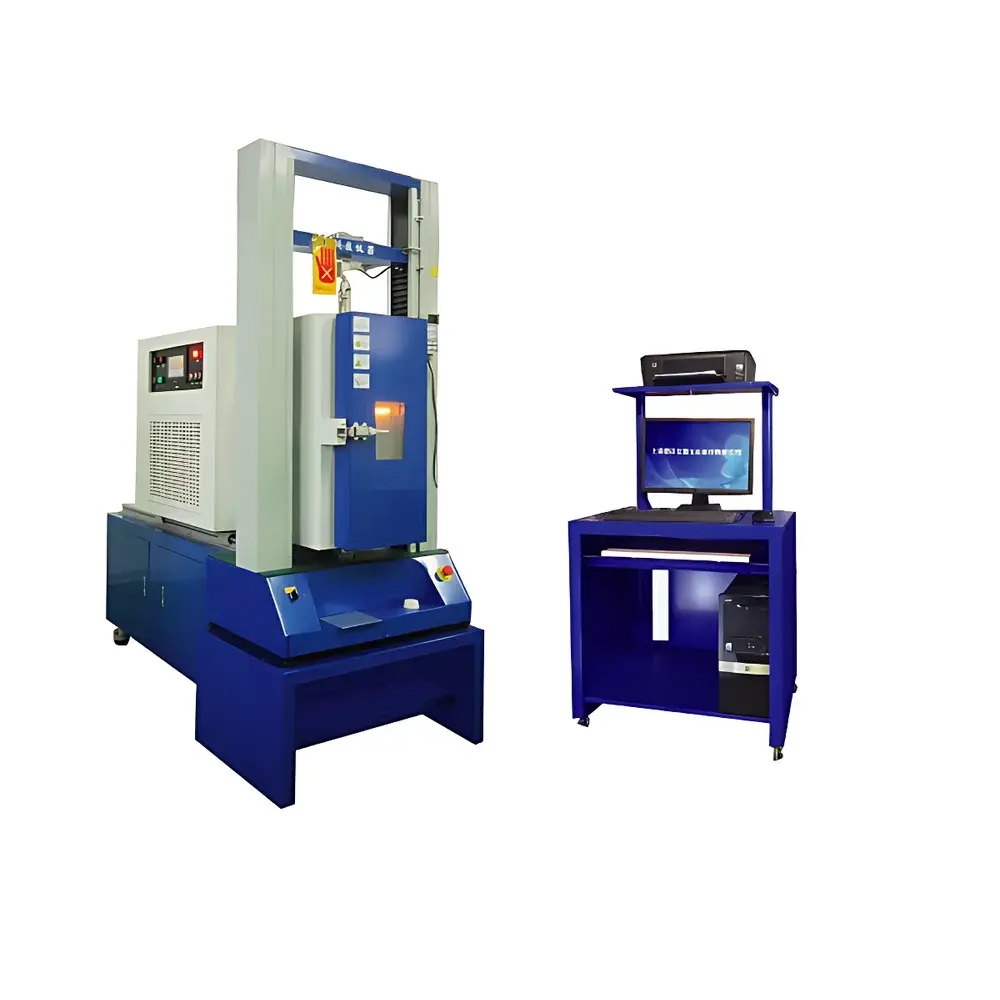
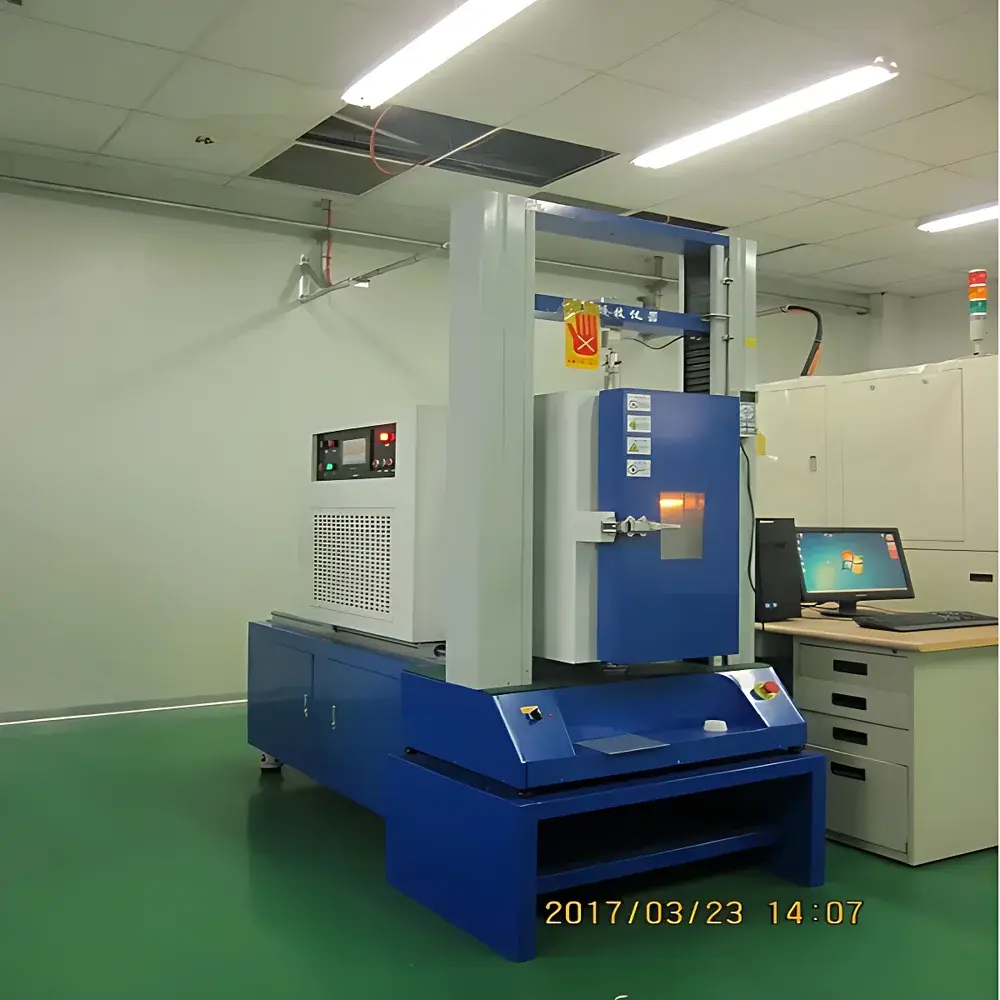
QJ211B High-Temperature Flexural Strength Testing Machine
| Origin | Shanghai, China |
|---|---|
| Manufacturer Type | Authorized Distributor |
| Origin Category | Domestic (China) |
| Model | QJ211B |
| Price | USD 9,400 (FOB Shanghai) |
| Temperature Range | −70 °C to +350 °C (stable at 350 °C) |
| Heating/Cooling Rate | ≥5 °C/min |
| Temperature Controller Resolution | 0.1 °C |
| Load Capacity | 0–30 kN (selectable) |
| Load Cell Accuracy | ±0.01% of full scale |
| Force Measurement Uncertainty | <±1% (or <±0.5% with calibration traceability) |
| Control Mode | Dual-mode — PC-based closed-loop control + digital panel interface |
| Effective Width | 420 mm |
| Usable Test Height | ~800 mm (extendable upon request) |
| Crosshead Speed Range | 0.001–500 mm/min (standard) |
| Speed Accuracy | ±0.5% of set value |
| Displacement Measurement Accuracy | ±0.5% of reading |
| Strain/Deformation Measurement Accuracy | ±0.5% of reading |
| Safety Features | Electronic travel limit switches, emergency stop button |
| Net Weight | 135 kg |
Overview
The QJ211B High-Temperature Flexural Strength Testing Machine is a dual-environment universal mechanical testing system engineered for precise flexural, tensile, compressive, and fatigue characterization of advanced structural materials under controlled thermal conditions. It integrates a high-stability electromechanical actuation frame with a programmable environmental chamber capable of sustained operation from −70 °C to +350 °C—enabling ASTM C1161, ISO 14704, GB/T 4741, and JIS R1601-compliant three-point and four-point bending tests on ceramics, refractories, composites, and high-performance alloys. The system employs a closed-loop servo-controlled crosshead driven by a precision ball-screw mechanism, delivering repeatable displacement resolution and force linearity across its full 30 kN load range. Its modular architecture allows rapid reconfiguration: the environmental chamber can be detached for ambient-temperature testing, increasing workspace flexibility and supporting multi-purpose lab utilization without hardware modification.
Key Features
- Thermally isolated high-temperature chamber with PID-controlled heating/cooling elements and uniformity ≤±2 °C across 100 mm test zone at 350 °C
- High-accuracy load cell calibrated to ISO 376 Class 0.5, traceable to NIM (National Institute of Metrology, China), with integrated temperature compensation
- Dual-control interface: Windows-based software suite with real-time data acquisition (1 kHz sampling) + front-panel digital controller for standalone operation
- Adjustable support span (10–300 mm) and loading nose geometry compliant with ASTM E292 and ISO 7438 for standardized flexure specimen alignment
- Robust cast-iron base and reinforced steel frame minimizing vibration transmission and ensuring long-term geometric stability (deflection <0.01 mm under 30 kN static load)
- Comprehensive safety architecture including dual-channel electronic limit switches, hardware-based emergency stop circuit, and over-travel cut-off logic
Sample Compatibility & Compliance
The QJ211B accommodates rectangular, cylindrical, and dog-bone specimens per ISO 6892-1, ASTM D790, and GB/T 2567. Standard fixtures support beam dimensions up to 15 mm × 15 mm × 120 mm for three-point bending; custom tooling is available for non-standard geometries including thin-film substrates and ceramic tiles. All thermal and mechanical measurements comply with ISO/IEC 17025 requirements for testing laboratories. Data integrity meets FDA 21 CFR Part 11 criteria when used with optional audit-trail-enabled software configuration, supporting GLP/GMP environments. Calibration certificates include uncertainty budgets aligned with EURAMET cg-18 guidelines.
Software & Data Management
Control and analysis are executed via QTest Pro v4.2—a validated, multi-language platform supporting automated test sequencing, real-time stress–strain curve generation, modulus calculation (secant/tangent), fracture toughness estimation (KIC), and Weibull statistical analysis for brittle materials. Raw data export is available in CSV, Excel, and XML formats; all files retain embedded metadata (operator ID, timestamp, environmental log, calibration ID). The system supports networked deployment with role-based user permissions, electronic signature capture, and encrypted local database storage. Optional cloud synchronization enables remote monitoring and centralized fleet management for multi-site QA/QC labs.
Applications
- High-temperature flexural strength evaluation of silicon carbide (SiC) and alumina ceramics for aerospace turbine components
- Creep-to-fracture behavior of carbon-fiber-reinforced polymer (CFRP) laminates under thermal cycling (−40 °C ↔ +150 °C)
- Interlaminar shear strength (ILSS) of thermoset composites at elevated service temperatures
- Thermal shock resistance quantification of refractory linings via sequential hot-cold flexure cycles
- Quality conformance testing of sintered metal parts per MIL-STD-810H Method 502.6 (temperature shock)
- Research-grade mechanical property mapping of functionally graded materials (FGMs) across thermal gradients
FAQ
Does the QJ211B meet ASTM E292 requirements for flexural fixture geometry?
Yes—the standard three-point bending fixture includes hardened steel rollers with 10 mm diameter and adjustable span, certified to ASTM E292 dimensional tolerances and surface finish specifications (Ra ≤ 0.4 µm).
Can the system perform low-cycle fatigue tests at 300 °C?
Yes—when configured with optional high-temperature extensometry and thermal shielding, the QJ211B supports sinusoidal or trapezoidal waveforms at frequencies up to 5 Hz and total strain ranges of ±0.5%, with thermal drift compensation enabled.
Is ISO 17025-compliant calibration documentation included with shipment?
Yes—each unit ships with a factory calibration report including as-found/as-left data, measurement uncertainty budgets, and traceability to national standards (NIM Certificate No. CNAS-L0521).
What is the recommended maintenance interval for the environmental chamber?
Chamber heater elements and insulation integrity should be verified every 12 months or after 2000 thermal cycles; full preventive maintenance—including load cell recalibration and screw lubrication—is advised annually per the operator manual.



