
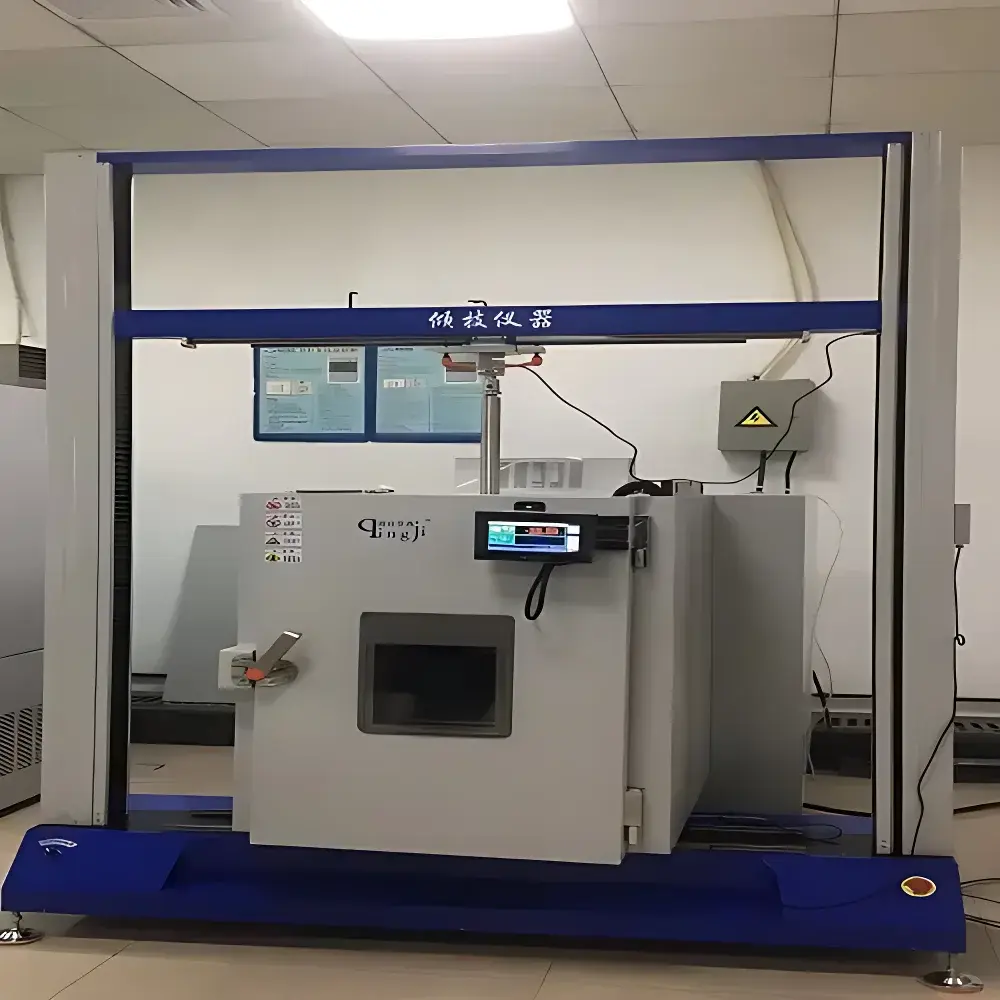
QJ211F Plastic Flexural Creep Testing Machine
| Origin | Shanghai, China |
|---|---|
| Manufacturer Type | Authorized Distributor |
| Origin Category | Domestic (China) |
| Model | QJ211F |
| Price | USD 7,650 (FOB Shanghai) |
| Load Capacity Options | 5 kN, 10 kN, 20 kN, 50 kN |
| Force Measurement Range | 0.4–100% FS (single-range, no auto-ranging) |
| Force Resolution | 1/240,000 full scale |
| Force Accuracy | ±0.5% of reading |
| Crosshead Speed Range | 0.001–500 mm/min (infinitely variable) |
| Speed Accuracy | ±0.5% |
| Displacement Measurement Range | 0–999 mm |
| Displacement Resolution | 0.001 mm |
| Displacement Accuracy | ±0.5% |
| Extensometer Gauge Length | 50 mm (standard), customizable |
| Extensometer Output Range | 0–5 mm (standard), customizable |
| Strain Measurement Resolution | 0.008 mm |
| Strain Accuracy | ±0.5% |
| Control Modes | Constant Load, Constant Deformation, Constant Rate of Load Increase, Constant Rate of Deformation |
| Compliance | GB/T 16491, GB/T 2611, GB/T 11546.1–2008, GB/T 15048–1994, GB/T 20672–2006, GB/T 1040.1–2018, GB/T 1041–1992, GB/T 9341–2000 |
Overview
The QJ211F Plastic Flexural Creep Testing Machine is a high-precision electromechanical universal testing system engineered for standardized creep and static mechanical characterization of polymeric materials under sustained flexural loading. Unlike tensile or compressive creep configurations, this instrument implements a three-point bending geometry per ISO 178 and ASTM D790 principles—applying controlled moment to a rectangular or dumbbell-shaped specimen supported at two lower points while a central loading nose imposes downward displacement. The machine operates on a closed-loop servo-controlled architecture, enabling precise regulation of load, displacement, and strain rates across extended timeframes—from minutes to thousands of hours—to quantify time-dependent viscoelastic deformation in thermoplastics, thermosets, elastomers, and rigid foams. Its design adheres to the fundamental mechanics of beam theory (Euler–Bernoulli assumptions), where flexural stress σf = (3PL)/(2bd²) and strain εf = (6δd)/L² are derived from applied load (P), span length (L), specimen width (b), thickness (d), and mid-span deflection (δ). This enables direct correlation between measured deflection-time curves and material-specific creep compliance J(t) = ε(t)/σ₀.
Key Features
- Modular load frame with reinforced steel crosshead and precision-ground guide columns ensuring axial alignment stability during long-duration creep tests.
- High-resolution digital load cell (5–50 kN options) calibrated to national metrological standards, delivering force resolution down to 0.0004% FS and traceable accuracy per GB/T 16491 Class 0.5.
- AC servo motor-driven ball-screw actuation system with backlash-free transmission, supporting ultra-low-speed creep protocols (0.001 mm/min) with ±0.5% speed fidelity over full range.
- Dual-channel real-time data acquisition: synchronized sampling of load, crosshead displacement, and extensometer-derived strain at up to 100 Hz—critical for capturing transient viscoelastic responses.
- Thermal compatibility: frame and fixture interface designed for integration with environmental chambers (−70°C to +300°C), enabling ISO 293 and ASTM D618-compliant conditioning prior to test initiation.
- Interchangeable bending fixtures (span lengths: 16, 25, 40, 64, 100 mm) compliant with GB/T 9341–2000 and ISO 178 requirements for specimen aspect ratio control.
Sample Compatibility & Compliance
The QJ211F accommodates standard plastic specimens per ISO 178 (e.g., 80 × 10 × 4 mm bars) and ASTM D790 (63.5 × 12.7 × 3.2 mm), as well as custom geometries for foam cores (per GB/T 20672–2006) and laminated composites. It supports both unnotched and notched configurations for fracture-mechanics-informed creep crack growth analysis. All test procedures conform to internationally recognized standards: GB/T 11546.1–2008 (equivalent to ISO 899-1), GB/T 15048–1994 (compression creep of rigid foams), and GB/T 1041–1992 (compressive behavior). The system’s measurement uncertainty budget satisfies GLP audit requirements, with documented calibration certificates traceable to CNAS-accredited laboratories. Force and displacement transducers are verified annually per JJG 139–2014 (Chinese verification regulation for universal testing machines).
Software & Data Management
The embedded Windows-based control software provides ISO/IEC 17025-aligned test sequencing, including multi-step creep hold protocols (e.g., ramp-to-load → dwell → unload → recovery), automatic zero-drift compensation, and real-time compliance curve plotting (log J(t) vs. log t). Raw data export is available in CSV and XML formats with embedded metadata: operator ID, environmental conditions (temperature/humidity if chamber-integrated), calibration dates, and instrument serial numbers. Audit trail functionality logs all user actions—including parameter modifications and manual overrides—with timestamps and digital signatures, satisfying FDA 21 CFR Part 11 electronic record requirements when deployed in regulated QC environments. Data integrity is preserved via cyclic redundancy checksums and optional encrypted database storage.
Applications
This system is routinely deployed in polymer R&D labs and quality control departments for: evaluating long-term dimensional stability of automotive interior trim under thermal cycling; validating creep resistance of PEEK and PEI components in aerospace housings; assessing cold-flow behavior of PVC window profiles per EN 12608; quantifying time-dependent stiffness loss in polyurethane insulation foams; benchmarking bio-based PLA formulations against petrochemical alternatives under ISO 899-1; and generating master curves for time–temperature superposition (TTS) modeling using Williams–Landel–Ferry (WLF) formalism. It also supports ASTM D6272 (flexural properties of plastics) and ISO 1209 (flexural behavior of rigid cellular plastics), extending utility beyond pure creep into routine mechanical screening.
FAQ
What standards does the QJ211F support for flexural creep testing?
It fully complies with GB/T 11546.1–2008 (ISO 899-1), GB/T 9341–2000 (ISO 178), and ASTM D790 for initial modulus and strength; creep-specific protocols follow ISO 899-1 Annex A for constant-load bending.
Can the system perform both short-term flexural tests and multi-day creep tests?
Yes—the same hardware platform executes ASTM D790-type 1-minute modulus tests and ISO 899-1 1000-hour creep holds, with automatic transition between high-speed acquisition (for elastic response) and low-frequency logging (for long-term drift monitoring).
Is extensometer integration mandatory for creep compliance calculation?
While crosshead displacement suffices for coarse compliance estimates, a clip-on extensometer (50 mm gauge length, 0.008 mm resolution) is required for ISO 899-1–compliant J(t) derivation, as it eliminates frame compliance artifacts inherent in machine displacement measurements.
How is thermal expansion compensated during elevated-temperature creep tests?
The system accepts external temperature input from chamber sensors; software applies linear CTE corrections to displacement data for polymers with known coefficients (e.g., 70 µm/m·°C for PS), ensuring true strain fidelity above 23°C.
Does the software support automated report generation per ISO/IEC 17025 requirements?
Yes—predefined templates include uncertainty budgets, calibration status flags, environmental condition stamps, and digital signature fields, exportable as PDF/A-1b for archival compliance.



