
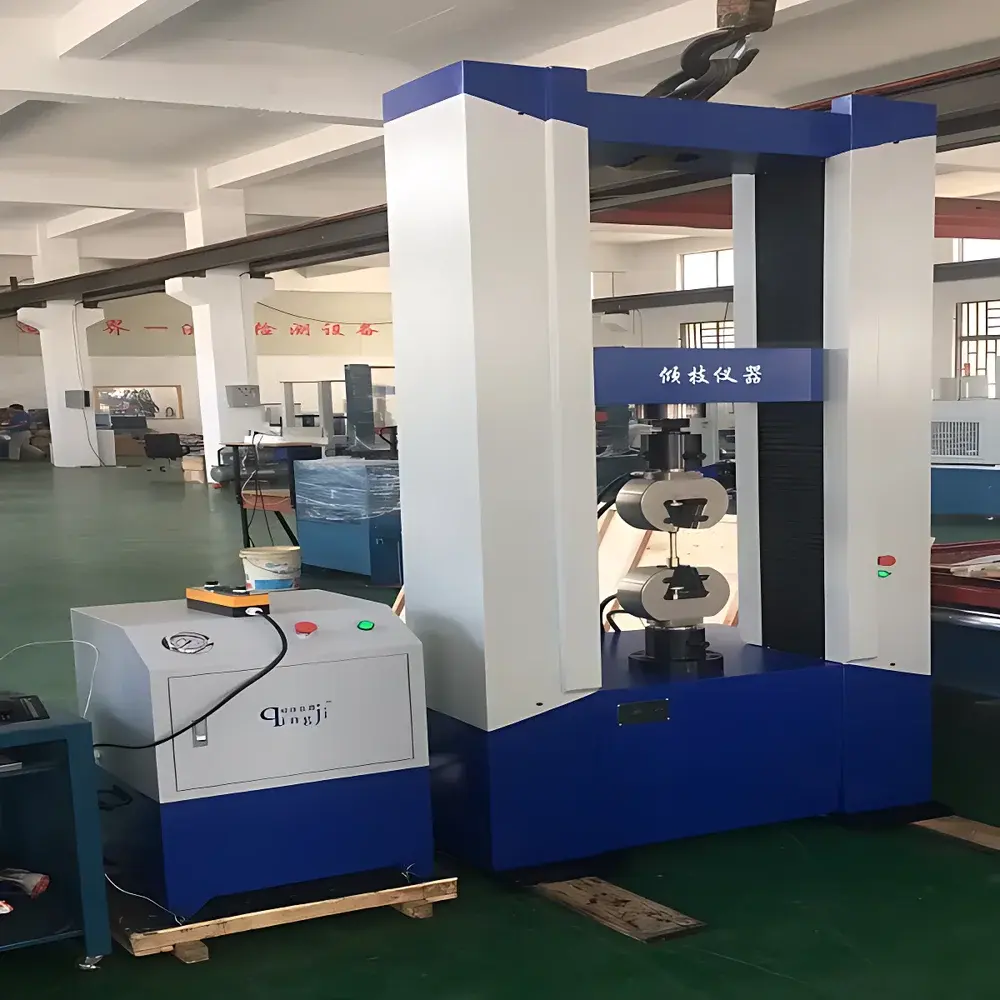
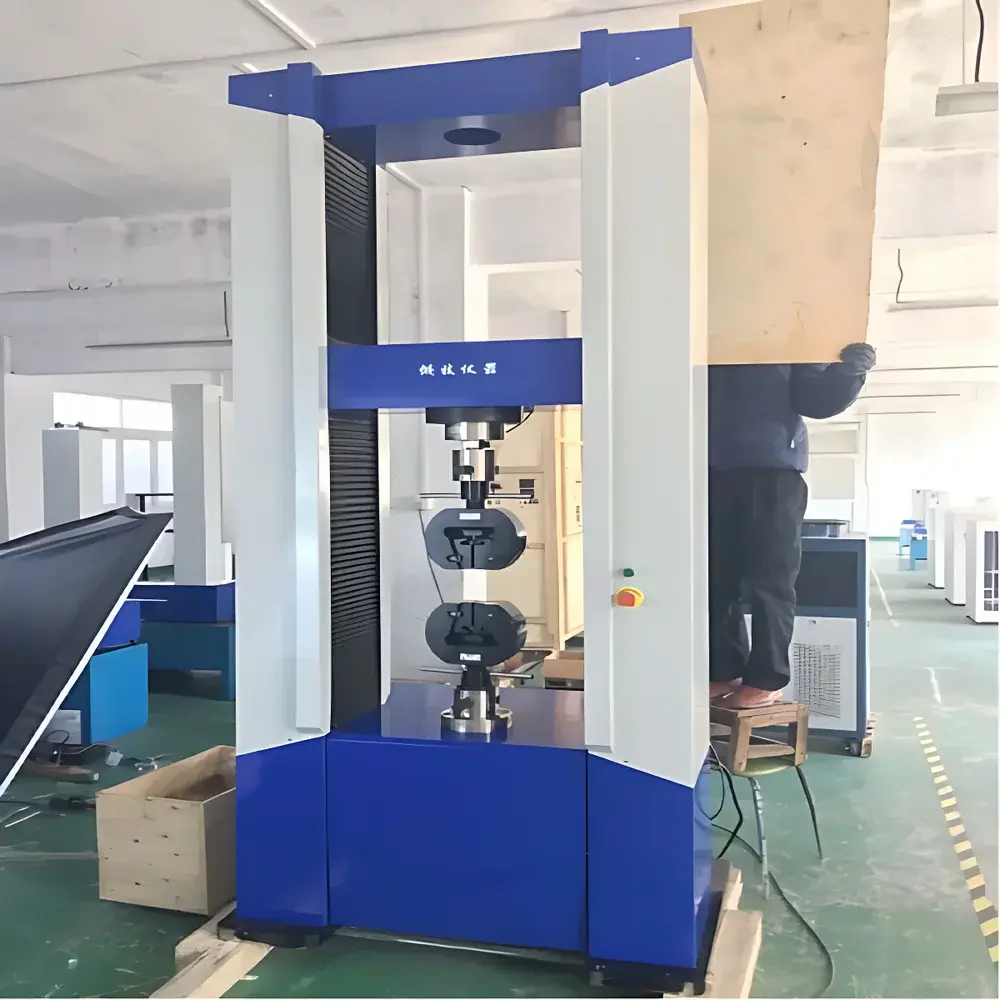
QJ212 Universal Testing Machine for Reinforcing Steel Bars
| Brand | Qinsun |
|---|---|
| Origin | Shanghai, China |
| Type | Electromechanical Universal Testing Machine |
| Load Capacity | 0.01–500 kN |
| Load Accuracy | ±0.5% |
| Effective Test Width | 500 mm |
| Max. Tensile Travel | 600 / 800 mm |
| Test Speed Range | 0.001–1000 mm/min |
| Speed Accuracy | ±1% of indicated value |
| Displacement Measurement Accuracy | ±0.5% of indicated value |
| Strain/Deformation Measurement Accuracy | ±0.5% of indicated value |
| Resolution | 1/250,000 full scale (constant across entire range) |
| Safety Features | Electronic limit protection, overload protection at 110% of full scale, manual & programmable return, dual-speed crosshead control |
| Dimensions (W×D×H) | 1000 × 680 × 2450 mm |
| Weight | 1250 kg |
Overview
The QJ212 Universal Testing Machine is an electromechanical static testing system engineered for high-precision mechanical characterization of reinforcing steel bars and other structural metallic materials. Designed in accordance with the fundamental principles of uniaxial force application under controlled displacement or load control, it complies with core mechanical testing methodologies defined in ISO 6892-1 (tensile testing of metallic materials), ASTM E8/E8M, EN 10002-1, and GB/T 228.1. The system employs a closed-loop servo-controlled drive mechanism coupled with high-stiffness load frame architecture to ensure minimal deflection during high-load testing (up to 500 kN), enabling reliable determination of yield strength, ultimate tensile strength, elongation at break, reduction of area, Young’s modulus, and strain-hardening behavior. Its modular load cell integration, combined with real-time digital signal conditioning, supports consistent traceability and repeatability required for quality assurance in rebar manufacturing, civil engineering QA/QC laboratories, and third-party certification bodies.
Key Features
- Electromechanical actuation system with precision ball-screw transmission and AC servo motor, delivering smooth, low-noise operation across the full speed range (0.001–1000 mm/min)
- Constant-resolution force measurement at 1 part in 250,000 over the entire 0.01–500 kN capacity — no range switching or recalibration required
- Dual-mode control architecture supporting both load-controlled and displacement-controlled test profiles, including ramp-hold, cyclic loading, and stepwise fatigue protocols
- Integrated electronic safety interlocks: programmable upper/lower travel limits, hardware-based overload cutoff (110% FS), and emergency stop circuit compliant with IEC 60204-1
- Motorized crosshead with independent fast/slow speed modes and jog functionality for rapid specimen alignment and post-test reset
- Rigid C-frame construction (1250 kg mass) minimizing frame compliance; optimized column spacing (500 mm effective width) accommodates standard rebar specimens up to 32 mm diameter
- Windows-based control software with real-time multi-curve plotting, dynamic scaling, overlay comparison, and customizable report templates
Sample Compatibility & Compliance
The QJ212 is validated for standardized tensile testing of hot-rolled ribbed steel bars (e.g., HRB400, HRB500 per GB/T 1499.2), welded wire mesh, prestressed strands, and anchor systems. Specimen geometries conforming to ISO 6892-1 Type 2 (parallel length ≥ 200 mm) or ASTM E8M rectangular coupons are fully supported. The machine meets mechanical and electrical safety requirements per CE Machinery Directive 2006/42/EC and electromagnetic compatibility standards EN 61326-1. While not inherently 21 CFR Part 11-compliant, audit-ready data export (CSV, XML, PDF) and full metadata logging (operator ID, timestamp, calibration certificate ID, environmental conditions) enable integration into GLP/GMP workflows when deployed with validated software configurations.
Software & Data Management
Control and analysis are performed via proprietary Windows-native software featuring intuitive wizard-driven test setup, real-time parameter monitoring, and synchronized acquisition of force, displacement, and optional extensometer signals. All raw data—including time-stamped analog waveforms and processed engineering stress-strain curves—are stored in encrypted binary archives with SHA-256 checksum verification. Users may perform post-test operations including curve traversal, baseline correction, yield point detection (0.2% offset method), modulus calculation (secant/tangent), and fracture analysis. Export formats include CSV (for Excel/LabVIEW import), vector-based PDF reports (with embedded calibration certificates), and PNG/SVG plots. Audit trails record all user actions, parameter modifications, and data edits—supporting regulatory review where documented data integrity is mandatory.
Applications
- Tensile property validation of deformed steel reinforcement bars per GB/T 1499.2, ASTM A615/A615M, and BS 4449
- Compression testing of concrete-filled steel tubes and grouted couplers
- Bending (3-point/4-point) evaluation of bar ductility and surface crack initiation
- Shear and bond strength assessment of rebar-concrete interfaces using specialized fixtures
- Low-cycle fatigue characterization of spliced joints under simulated seismic loading
- Quality conformance testing in precast plant laboratories and national construction material inspection centers
FAQ
What international standards does the QJ212 support out-of-the-box?
The system includes pre-configured test methods for ISO 6892-1, ASTM E8/E8M, EN 10002-1, JIS Z 2241, and GB/T 228.1 — with automatic calculation of all standard-defined parameters.
Is extensometer integration supported?
Yes — the controller provides analog input channels compatible with clip-on, video, or laser extensometers (e.g., ISO 9513 Class 1); strain measurement accuracy remains ±0.5% of reading when calibrated.
Can test sequences be automated for batch processing?
Absolutely — users can define multi-step programs (e.g., preload → ramp to yield → hold → ramp to fracture) and queue dozens of specimens with auto-start triggers based on load or displacement thresholds.
What maintenance intervals are recommended for long-term accuracy?
Load cell verification every 12 months (or per ISO 7500-1 Class 1), screw lubrication every 6 months, and annual mechanical alignment check using certified gauge blocks and dial indicators.
Does the system support remote diagnostics or networked operation?
The controller features Ethernet TCP/IP interface; remote desktop access (via IT-approved secure gateway) enables off-site troubleshooting and firmware updates without physical presence.



