
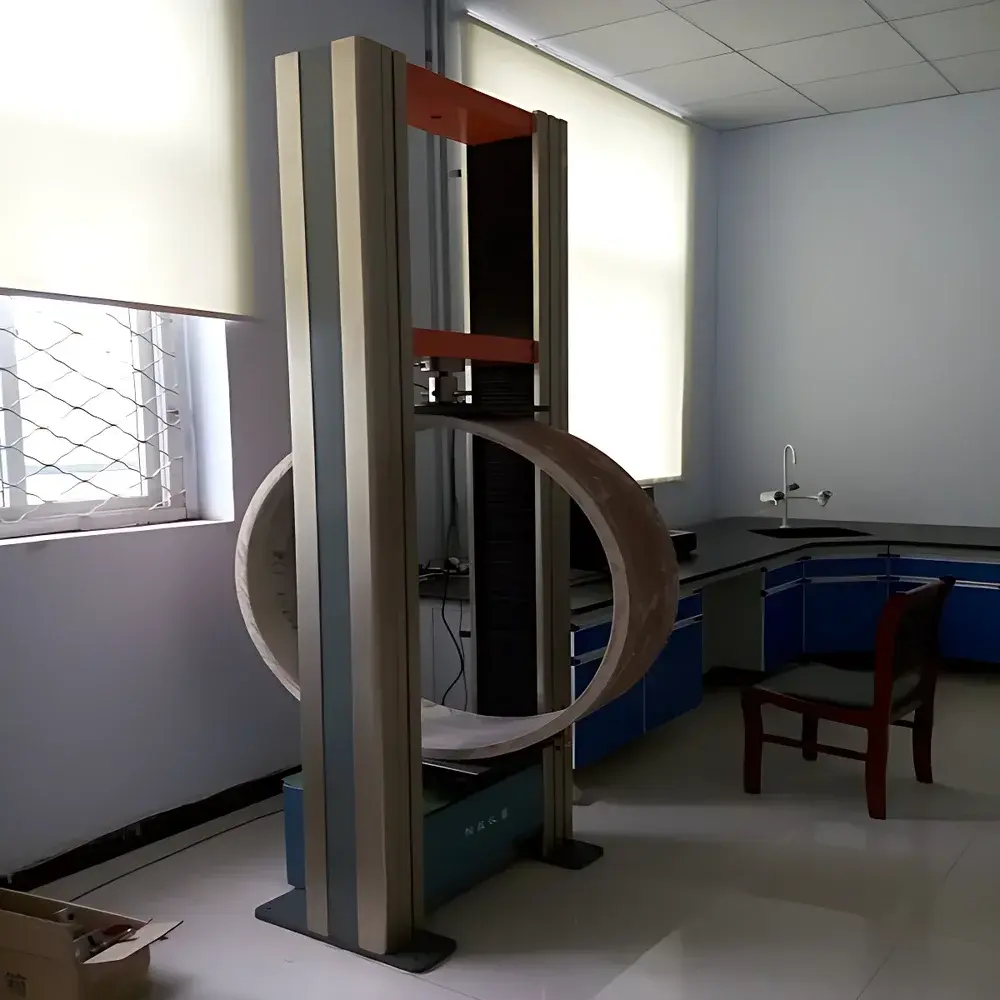
QJ215 Prestressed Corrugated Duct Compression Tester
| Origin | Shanghai, China |
|---|---|
| Manufacturer Type | Authorized Distributor |
| Origin Category | Domestic (China) |
| Model | QJ215 |
| Price | USD 8,600 (FOB Shanghai) |
| Load Capacity | 50–500 kN |
| Max. Specimen Diameter | ≤Φ5000 mm |
| Accuracy Class | Class 1 / Class 0.5 |
| Test Speed Range | 0.01–1000 mm/min (Standard: 300 mm/min) |
| Load Accuracy | ±1% (±0.5%) of reading |
| Speed Accuracy | ±0.5% (±0.15%) of reading |
| Displacement Resolution | 0.01 mm |
Overview
The QJ215 Prestressed Corrugated Duct Compression Tester is a high-stiffness, dual-column or multi-column universal testing system engineered for structural mechanical characterization of large-diameter tubular specimens—specifically pre-stressed concrete ducts, corrugated metal conduits, fiber-reinforced polymer (FRP) pipes, and composite conduit systems used in bridge, tunnel, and post-tensioning infrastructure applications. It operates on the principle of controlled axial compression loading to determine ring stiffness (EN 13476-3, ASTM D2412), compressive yield strength, load-deflection behavior, and deformation stability under sustained or quasi-static loads. Designed to comply with international standards governing civil engineering materials testing—including ISO 9001 quality-managed calibration protocols—the system delivers repeatable, traceable, and auditable mechanical data required for third-party certification, QA/QC release, and regulatory documentation in construction material supply chains.
Key Features
- Modular frame architecture supporting both four-post and six-post configurations for enhanced lateral rigidity during high-load (>300 kN) ring compression tests on large-diameter ducts (up to Φ5000 mm).
- Dual-range load cell options (50/100/200/300/500 kN) with selectable accuracy classes (Class 1 per ISO 7500-1 or Class 0.5 for metrological-grade validation).
- Precision ball-screw-driven crosshead actuation with closed-loop servo control, achieving speed resolution down to 0.01 mm/min and repeatability within ±0.15% of setpoint across full 0.01–1000 mm/min range.
- Integrated internal diameter deformation measurement system with non-contact LVDT or contact-type displacement transducers, enabling direct acquisition of radial deflection for EN 13476-3-compliant ring stiffness calculation (kN/m²).
- Full-system computer control via embedded industrial PC running Windows-based test software with real-time force–displacement–time plotting, automatic parameter extraction (e.g., yield point, peak load, residual deformation), and configurable pass/fail logic based on specification thresholds.
Sample Compatibility & Compliance
The QJ215 accommodates a broad spectrum of tubular geometries: smooth-wall HDPE/PVC ducts, helical or annular corrugated steel conduits (ASTM A979/A1064), glass-fiber-reinforced cement (GRC) pipes, and hybrid FRP-concrete composite sleeves. Its open-throat design and adjustable support platens allow centering and axial alignment of specimens up to 5 m in length and 5 m in outer diameter. The system supports compliance testing per EN 13476-3 (ring stiffness), ASTM D2412 (pipe crush resistance), GB/T 9647 (Chinese national standard for thermoplastic pipes), and ISO 13968 (plastic pipes under uniform load). Calibration certificates are issued per ISO/IEC 17025-accredited procedures, and mechanical verification follows ISO 7500-1 Annex B for static load verification.
Software & Data Management
The proprietary test software provides bilingual (English/Chinese) GUI with role-based user access control, audit trail logging, and electronic signature capability compliant with FDA 21 CFR Part 11 requirements for regulated environments. All raw data—including time-stamped force, displacement, strain (if extensometer-equipped), and environmental metadata—are stored in encrypted binary format with XML export for LIMS integration. Reports generate automatically in PDF or Excel formats, embedding calibrated curves, statistical summaries (mean, SD, CV%), and conformance statements against selected standards. Data integrity safeguards include write-once storage mode, tamper-evident hashing, and version-controlled firmware updates traceable to NIST-traceable reference standards.
Applications
- Ring stiffness evaluation of pre-stressed concrete ducts used in post-tensioned bridge girders and segmental tunnel linings.
- Crush resistance validation of galvanized steel corrugated conduits per AASHTO M202 specifications.
- Mechanical qualification of HDPE drainage pipes subjected to backfill loading in municipal infrastructure projects.
- Compressive modulus and failure mode analysis of GRP/FRP conduit systems under combined thermal–mechanical service conditions.
- Research-grade cyclic compression testing of novel composite ducts incorporating carbon nanotube reinforcement or shape-memory polymer layers.
FAQ
What standards does the QJ215 support for ring stiffness testing?
EN 13476-3, ASTM D2412, ISO 13968, and GB/T 9647 are fully supported through pre-configured test methods and report templates.
Can the system perform tensile testing on duct reinforcement wires or anchorage components?
Yes—when equipped with wedge-action tensile grips and appropriate load cells, the QJ215 functions as a full-capability universal tester per ISO 6892-1 for metallic and polymeric fasteners.
Is third-party calibration and ISO/IEC 17025 certification available?
Yes—factory calibration includes traceable certificates from CNAS-accredited laboratories; on-site recalibration services are offered globally with documented uncertainty budgets.
How is data integrity ensured for QA/QC audits?
All test sessions generate immutable audit logs with operator ID, timestamp, instrument ID, calibration status, and digital signatures—all exportable in CSV/XML for GLP/GMP review.
What maintenance intervals are recommended for long-term reliability?
Lubrication of lead screws and inspection of load cell mounting bolts every 6 months; annual verification of displacement encoder linearity and load cell hysteresis per ISO 7500-1.



