
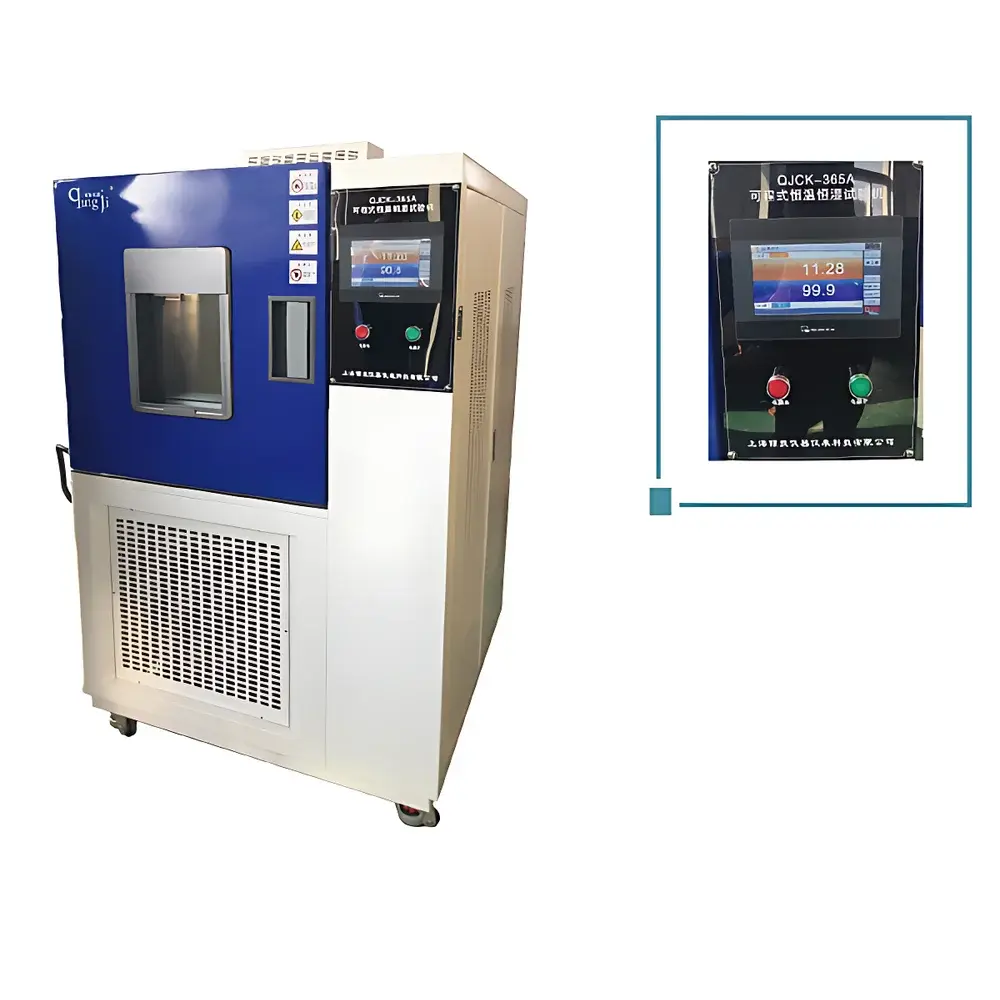
QJCK High-Low Temperature and Humidity Environmental Test Chamber with Integrated Mechanical Testing Capability
| Origin | Shanghai, China |
|---|---|
| Manufacturer Type | Authorized Distributor |
| Origin Category | Domestic (PRC) |
| Model | QJCK |
| Price | USD 4,600 (approx.) |
Overview
The QJCK High-Low Temperature and Humidity Environmental Test Chamber is a dual-function integrated system engineered for concurrent environmental conditioning and mechanical property evaluation of materials under controlled thermal and hygrothermal stress. Unlike conventional standalone environmental chambers, this unit is structurally and functionally coupled with a universal testing frame—enabling real-time tensile, compression, flexural, peel, tear, shear, puncture, and low-cycle fatigue tests across a wide temperature range from –70 °C to +350 °C, with humidity control capability (optional configuration). The system operates on the principle of combined environmental simulation and servo-controlled electromechanical force application, adhering to fundamental thermomechanical test protocols defined in ISO 11359, ASTM D638/D790/D3410, and GB/T 1040/1447/1449. Its modular design permits rapid detachment of the environmental chamber section, converting the platform into a standard ambient-temperature mechanical tester—maximizing laboratory space utilization and operational flexibility.
Key Features
- Wide operational temperature range: –70 °C to +350 °C (constant-temperature hold at 350 °C verified per IEC 60068-2-1/2); optional humidity control (10–98% RH) available upon specification
- Thermal ramp rate ≥5 °C/min (measured per ISO 16750-4, average over full range)
- High-resolution digital temperature controller with 0.1 °C setpoint resolution and PID-based adaptive tuning
- Integrated 30 kN load frame with ±0.01% full-scale load cell accuracy (traceable to NIST-equivalent national standards)
- Test speed range: 0.001–500 mm/min (extendable to 1000 mm/min in high-speed configurations), with speed accuracy maintained within ±0.5%
- Displacement and strain measurement accuracy: ±0.5% of reading, compliant with ASTM E83 Class B-2 extensometer requirements
- Dual-mode operation: fully computer-controlled via Ethernet-linked software interface; local digital panel with manual override capability
- Robust safety architecture including dual-channel electronic travel limits, hardware emergency stop circuitry, and over-temperature cut-off protection
- Effective test zone dimensions: 420 mm (width) × 800 mm (height), extendable vertically per user requirement
Sample Compatibility & Compliance
The QJCK chamber accommodates specimens up to 30 kN axial load capacity, supporting standardized geometries per ASTM, ISO, and GB formats—including dog-bone tensile bars, rectangular flexural beams, cylindrical compression samples, and laminated composites. Its thermal uniformity meets ±1.5 °C (at 350 °C) and ±0.8 °C (at –40 °C) across the working volume (per IEC 60068-3-5), validated using calibrated PT100 sensor arrays. The system supports GLP-compliant testing workflows through audit-trail-enabled software logging (21 CFR Part 11-ready configuration available), and conforms to electromagnetic compatibility (EMC) requirements per EN 61326-1. All structural components are fabricated from stainless steel 304 and insulated with low-outgassing polyurethane foam to ensure long-term stability under thermal cycling.
Software & Data Management
The proprietary test control software provides synchronized acquisition of load, displacement, temperature, and (when equipped) relative humidity data at up to 1 kHz sampling rate. Real-time curve overlays, multi-step thermal-mechanical profiles (e.g., “hold at –40 °C → ramp to 120 °C → apply 5 kN tensile load”), and automated pass/fail evaluation against user-defined acceptance criteria are supported. Raw data exports to CSV, Excel, and universal .tdms formats; report templates comply with ISO/IEC 17025 documentation requirements. Software validation documentation (IQ/OQ/PQ protocols) and electronic signature modules are provided for regulated environments.
Applications
This system is routinely deployed in R&D and QC laboratories for evaluating polymer thermo-mechanical transitions (Tg, Tm), elastomer hysteresis under thermal cycling, composite interlaminar shear strength at elevated temperatures, solder joint reliability in electronics packaging, and aerospace-grade adhesive bond durability across humidity gradients. It is also used in automotive material qualification per GMW15007, Ford CETP, and VW TL226, as well as in battery module thermal runaway propagation studies under controlled ambient conditions.
FAQ
Does the QJCK chamber support humidity control?
Yes—humidity functionality (10–98% RH, ±2% RH accuracy) is available as an optional add-on module, requiring dedicated steam generator and dehumidification subsystems.
Can test data be exported for regulatory submission?
Yes—the software supports ALCOA+ compliant data integrity: attributable, legible, contemporaneous, original, accurate, complete, consistent, enduring, and available per FDA guidance.
What calibration standards apply to the load cell and temperature sensors?
Load cells are factory-calibrated per ISO 376 Class 0.5; temperature sensors are traceable to CNAS-accredited reference standards with documented uncertainty budgets.
Is on-site installation and commissioning included?
Yes—comprehensive setup, mechanical alignment verification, thermal uniformity mapping, and operator training are provided at no additional cost under standard warranty terms.
What is the expected service life under continuous thermal cycling?
With routine maintenance (insulation integrity checks, refrigerant pressure monitoring, and bearing lubrication every 12 months), the system demonstrates >15,000 cycles between major overhauls, per accelerated life testing per IEC 60068-2-6.



