
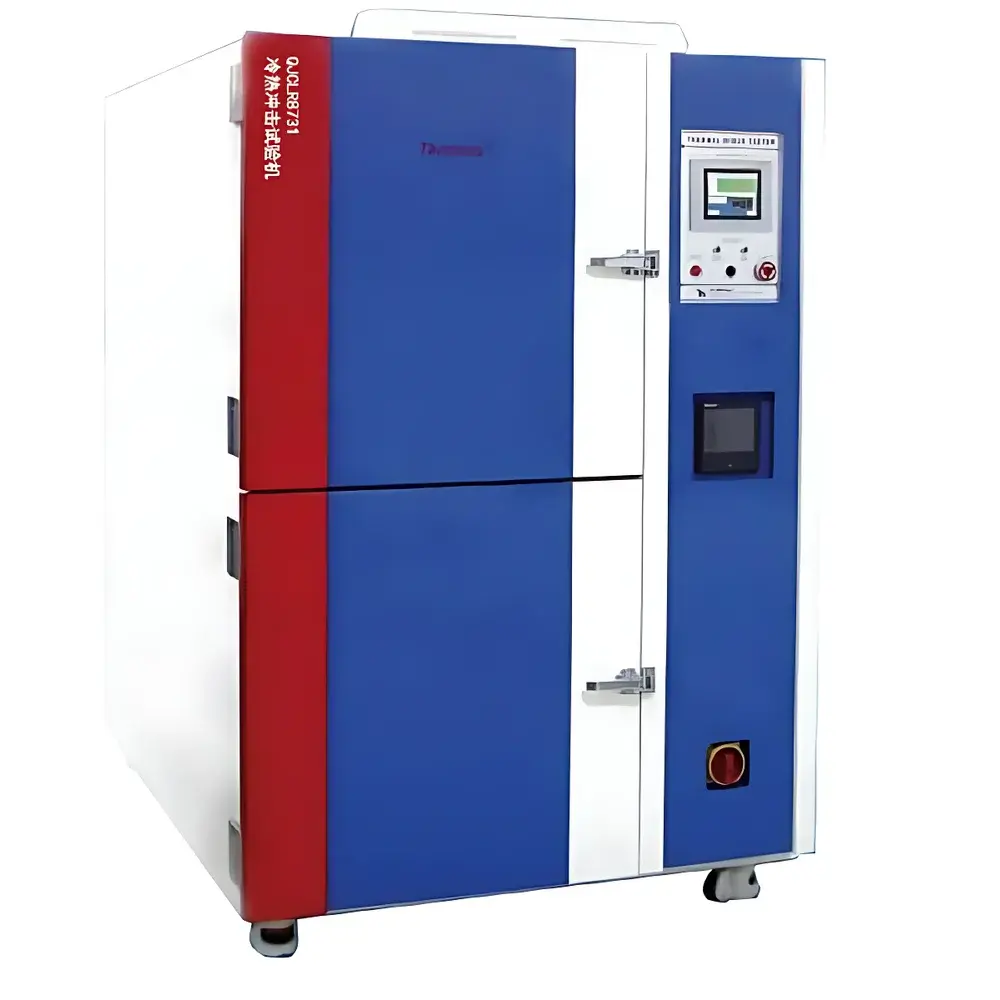
QJCLR8731 Thermal Shock Test Chamber (Three-Zone Configuration)
| Origin | Shanghai, China |
|---|---|
| Manufacturer Type | Authorized Distributor |
| Origin Category | Domestic (PRC) |
| Model | QJCLR8731 |
| Price | USD 9,400 (FOB Shanghai) |
| High-Temperature Zone Range | +80 °C to +200 °C |
| Low-Temperature Zone Range | −10 °C to −70 °C (configurable down to −75 °C) |
| Thermal Shock Range | +80 °C to +200 °C |
| Temperature Stability | ±2 °C |
| Temperature Uniformity | ±2 °C |
| Heating Rate | ≥2 °C/min (typical, from ambient to +200 °C) |
| Cooling Rate | ≥2 °C/min (typical, from ambient to −70 °C) |
| Recovery Time | ≤5 min |
| Soak Time Control | Programmable per zone |
| Controller | 7.5″ TFT LCD touch interface with bilingual (English/Chinese) GUI, 256-color display, adjustable backlight, real-time data logging |
| Safety Protections | Compressor high-pressure cut-off, over-temperature protection, motor overload relay, fan failure detection, non-fuse circuit breaker |
| Standard Accessories | Two stainless-steel sample racks, one Ø50 mm cable port |
Overview
The QJCLR8731 Thermal Shock Test Chamber is a three-zone (hot–cold–transfer) environmental test system engineered for rapid, repeatable thermal cycling of materials and components under extreme temperature transitions. It operates on the principle of mechanical transfer—where test specimens are physically moved between independently controlled high-temperature and low-temperature chambers via a pneumatic or servo-driven lift mechanism—enabling true step-change thermal shock without residual chamber air mixing. This architecture delivers higher thermal gradient fidelity and faster transition times than two-chamber or single-chamber forced-air alternatives. Designed for accelerated reliability assessment in R&D and quality assurance workflows, the QJCLR8731 supports evaluation of solder joint integrity, coating adhesion, seal performance, PCB delamination risk, and polymer embrittlement under repeated thermal stress. Its operational envelope aligns with widely adopted qualification protocols for electronics, aerospace hardware, automotive ECUs, and medical device enclosures.
Key Features
- Three-zone configuration with independent PID-controlled hot chamber (+80 °C to +200 °C), cold chamber (−10 °C to −70 °C, optionally −75 °C), and insulated transfer zone
- High-reliability mechanical transfer mechanism with position feedback and fail-safe interlocks to prevent door misalignment during specimen movement
- 7.5-inch industrial-grade TFT LCD controller with real-time trend graphs, multi-segment ramp-soak profiles, and event-triggered data capture
- Comprehensive safety architecture including compressor discharge pressure monitoring, dual-stage over-temperature cutoffs, and redundant fan current sensing
- Stainless-steel interior construction with seamless welds and silicone-free insulation for long-term corrosion resistance and low outgassing
- Integrated Ø50 mm feedthrough port with removable gasket and optional brass compression fitting for sensor lead routing or vacuum line integration
Sample Compatibility & Compliance
The QJCLR8731 accommodates standard test specimens up to 450 mm × 450 mm × 450 mm (W×D×H) on two included 304 stainless-steel sample racks. It supports both bare components and fully assembled units—including PCB assemblies, molded connectors, battery modules, and sealed optical housings—provided they fit within dimensional and mass limits (max. 25 kg per rack). The chamber meets core requirements of GB/T 2423.1–2021 (cold testing), GB/T 2423.2–2021 (dry heat), and GB/T 2423.22–2012 (thermal shock). It is also compatible with test execution per MIL-STD-810H Method 503.5, IEC 60068-2-14, and JESD22-A104E. While not certified to ISO/IEC 17025 as a calibration laboratory, its temperature uniformity (±2 °C) and stability (±2 °C) meet GLP-compliant validation thresholds when operated with external NIST-traceable reference sensors.
Software & Data Management
The embedded controller provides local profile programming, real-time parameter visualization, and automatic event logging (temperature setpoints, actual readings, door status, alarm triggers) to internal flash memory (≥10,000 records). USB export enables CSV-formatted time-series data import into MATLAB, Python pandas, or JMP for statistical process control (SPC) analysis. Optional Ethernet connectivity supports Modbus TCP integration into centralized MES or SCADA systems. Audit trail functionality records user login/logout events, parameter modifications, and manual overrides—supporting alignment with FDA 21 CFR Part 11 requirements when deployed in regulated manufacturing environments under documented SOPs.
Applications
- Accelerated life testing of surface-mount technology (SMT) solder joints per IPC-J-STD-020
- Evaluation of thermal expansion coefficient (CTE) mismatch effects in multilayer ceramic capacitors (MLCCs)
- Qualification of conformal coatings and potting compounds for automotive under-hood applications
- Validation of hermetic seal integrity in MEMS sensors and RF modules
- Material screening for cryogenic compatibility in satellite payload subsystems
- Process window definition for reflow soldering and vapor phase reflow ovens
FAQ
What is the typical thermal transition time between extreme temperatures?
Transition from +200 °C to −70 °C (or vice versa) across the specimen surface is typically completed within 15 seconds, with full thermal equilibrium at the specimen core achieved within 5 minutes (per GB/T 2423.22).
Can the chamber be validated for IQ/OQ/PQ protocols?
Yes—the unit includes mounting points for calibrated PT100 sensors and supports third-party validation using thermocouple mapping per ASTM E2297. Documentation templates for IQ/OQ are available upon request.
Is remote monitoring supported?
Standard USB data export is provided; optional RS485 or Ethernet modules enable integration with building management systems (BMS) or LabVIEW-based monitoring platforms.
What maintenance intervals are recommended?
Compressor oil and refrigerant filter driers should be replaced every 24 months; door gaskets inspected quarterly; and chamber interior cleaned with isopropyl alcohol biannually to prevent residue buildup.
Does the system comply with CE or UL safety directives?
The QJCLR8731 conforms to IEC 61000-6-2 (immunity) and IEC 61000-6-4 (emissions); UL/cUL listing is available for North American deployment under custom order with additional certification testing.
Related Products



