
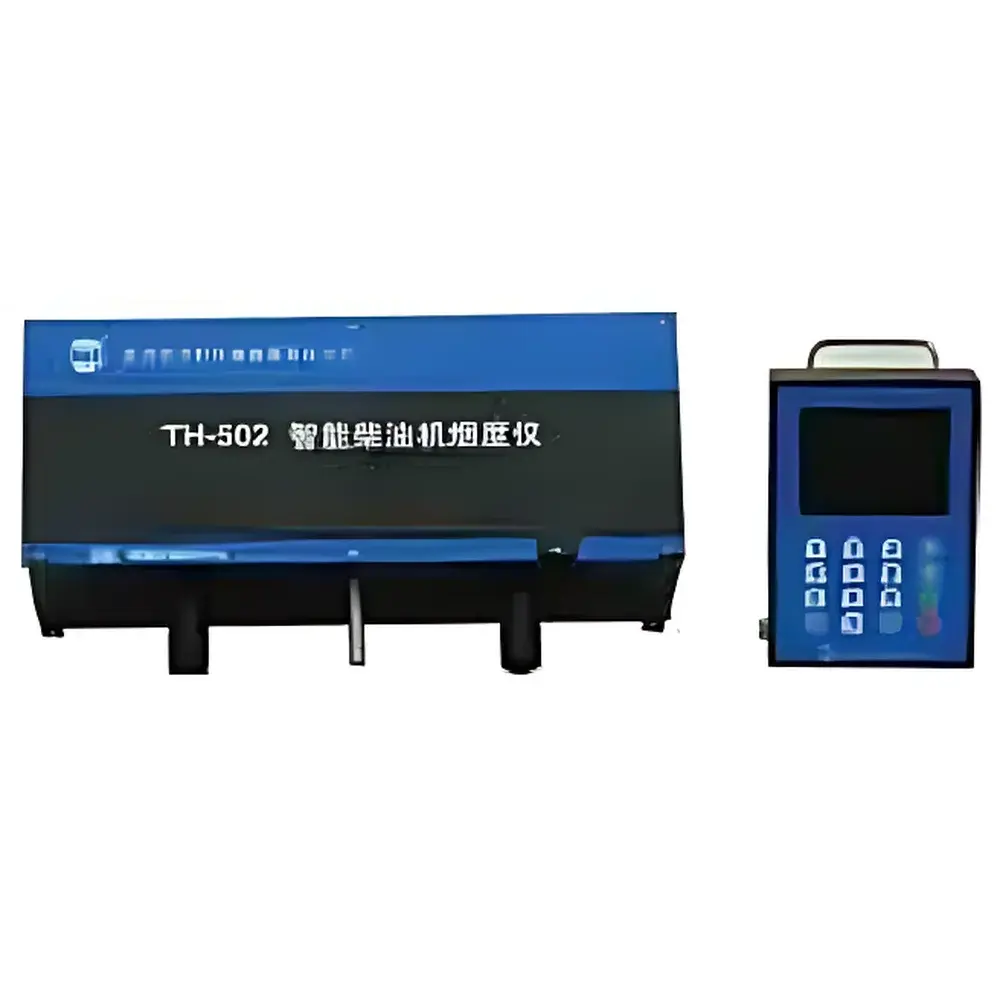
Tianhong TH-502(ZX) Online Diesel Vehicle Opacity Monitor
| Brand | Tianhong |
|---|---|
| Origin | Hubei, China |
| Model | TH-502(ZX) |
| Instrument Type | Online |
| Measurement Principle | Non-Dispersive Infrared (NDIR) Absorption |
| Max. Permissible Error | ±10% |
| Zero Drift | ±1% FS/24h |
| Span Drift | ±2% FS/24h |
| Repeatability | ±1% FS |
| Compliance | GB 3847–2005, HJ/T 395–2007, JJG 976–2010, Q/WTH 34–2012 |
Overview
The Tianhong TH-502(ZX) Online Diesel Vehicle Opacity Monitor is an industrial-grade, continuously operating emission monitoring system engineered for real-time measurement of exhaust smoke opacity from compression-ignition (diesel) engines. It operates on the principle of non-dispersive infrared (NDIR) absorption spectroscopy—specifically configured for broadband infrared attenuation analysis across a defined optical path—to quantify light extinction caused by suspended particulate matter (soot, ash, unburned hydrocarbons) in diesel exhaust streams. Unlike filter-based or scattering-based methods, this NDIR approach delivers high reproducibility under dynamic flow conditions and is inherently resistant to lens fouling when integrated with active optical protection systems. Designed for permanent installation at fixed-location monitoring points—including urban bus depots, freight terminal inspection lanes, vehicle inspection & maintenance (I/M) stations, and municipal environmental supervision centers—the TH-502(ZX) meets statutory requirements for regulatory compliance verification under Chinese national standards and supports long-term, unattended operation in ambient outdoor environments.
Key Features
- Modular dual-unit architecture: Separated optical sensing module and data processing/transmission unit enhance thermal stability, reduce electromagnetic interference, and simplify field maintenance.
- Dual air curtain technology: Two laminar airflow barriers isolate the optical path from hot, humid, and particle-laden exhaust gas—significantly extending sensor lifetime and minimizing optical window contamination.
- Thermally stabilized measurement chamber: Hermetically sealed, temperature-controlled detection cell prevents condensation, thermal drift, and ambient particulate ingress—ensuring consistent Beer-Lambert law compliance across seasonal operating conditions.
- Real-time dual-parameter output: Simultaneous display and transmission of opacity (%) and light absorption coefficient (m⁻¹), both traceable to national metrological standards per JJG 976–2010.
- Integrated automatic calibration: Onboard zero/span verification using certified reference filters enables scheduled or event-triggered recalibration without manual intervention.
- Robust data integrity architecture: Local storage capacity of 45,000 timestamped records (equivalent to ≥90 days at 1-min sampling interval), with cyclic overwrite protection and tamper-evident logging.
Sample Compatibility & Compliance
The TH-502(ZX) is validated for continuous opacity monitoring of undiluted diesel exhaust from medium- to heavy-duty vehicles operating under free-acceleration, steady-state, and transient driving cycles. It complies with mandatory Chinese regulatory frameworks including GB 3847–2005 (emission limits and test procedures for compression-ignition engines), HJ/T 395–2007 (technical specifications for opacity measurement equipment), and JJG 976–2010 (verification regulation for transmissivity-type opacity meters). Its measurement uncertainty profile—±10% maximum permissible error, ±1% zero drift, ±2% span drift over 24 h, and ±1% repeatability—is verified during factory calibration against NIM-traceable reference standards. While not certified to ISO 11614 or EN 15058, its optical design and signal processing align with internationally recognized principles for opacity quantification in stationary and mobile source monitoring.
Software & Data Management
Data acquisition, storage, and telemetry are managed via embedded Linux-based firmware supporting dual communication protocols: RS-485 Modbus RTU for local SCADA integration and GPRS-based TCP/IP transmission for remote server upload. Encrypted payload format includes device ID, UTC timestamp, opacity (%), k-value (m⁻¹), calibration status flag, ambient temperature/pressure (optional sensor input), and diagnostic codes. All transmitted records include digital signatures compliant with Q/WTH 34–2012 audit trail requirements. The onboard database implements write-once-read-many (WORM) logic for critical calibration and alarm events, satisfying basic GLP-aligned record retention expectations. Remote configuration and firmware updates are supported via authenticated HTTPS interface accessible through authorized environmental agency portals.
Applications
- Real-time opacity screening at municipal vehicle inspection stations for regulatory enforcement under China’s Motor Vehicle Emission Inspection System.
- Continuous emissions monitoring (CEM) for fleet operators managing urban bus lines, logistics hubs, and municipal sanitation vehicles.
- Supporting roadside emission surveillance programs where rapid pass/fail decisions are required during routine traffic checks.
- Data aggregation for city-level air quality modeling—especially in conjunction with meteorological and traffic flow datasets.
- Pre-compliance verification for retrofitting diesel particulate filters (DPFs) or selective catalytic reduction (SCR) systems.
FAQ
What measurement standard does the TH-502(ZX) follow for opacity reporting?
It reports opacity (%) and light absorption coefficient (k, m⁻¹) in strict accordance with GB 3847–2005 and HJ/T 395–2007 definitions, using a 1.0 m optical path length and 880 nm nominal wavelength band.
Can the instrument operate without external power backup?
No—it requires stable 220 VAC ±10%, 50 Hz supply; optional UPS integration is recommended for uninterrupted operation during grid fluctuations.
Is remote firmware update supported?
Yes, via secure HTTPS connection to authorized management servers; updates require cryptographic authentication and version rollback capability.
How often must the optical path be cleaned manually?
Under typical urban diesel fleet duty cycles, manual cleaning intervals exceed 6 months due to dual air curtain protection; visual inspection is advised quarterly.
Does the system support integration with third-party environmental data platforms?
Yes—through configurable Modbus register mapping and GPRS JSON/CSV payloads compatible with common EPA-equivalent data ingestion pipelines.







