
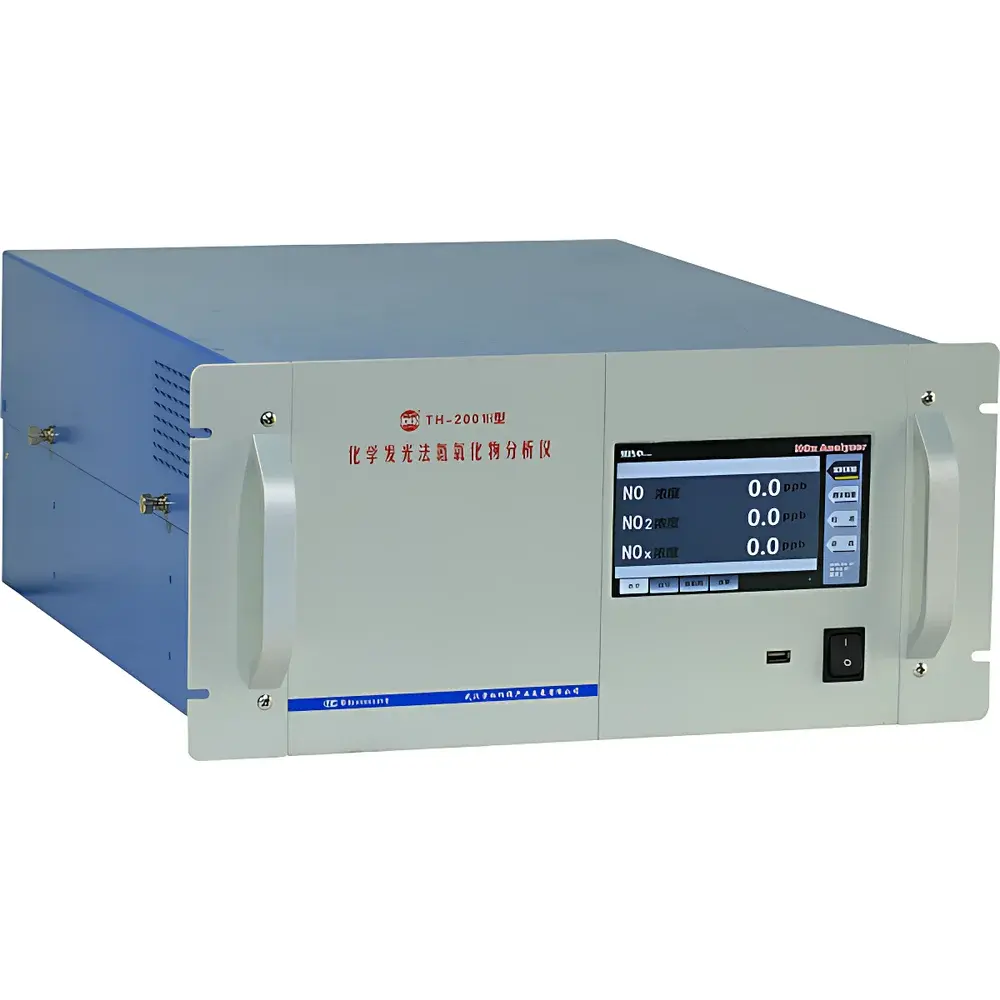
Yuhong TH-2001H Chemiluminescence NOₓ Analyzer
| Brand | Yuhong |
|---|---|
| Model | TH-2001H |
| Detection Principle | Chemiluminescence (CLD) |
| Measurement Species | NO, NO₂, NOₓ (NO + NO₂) |
| Display | 7-inch full-touch color LCD |
| Concentration Units | ppb, ppm, µg/m³, mg/m³ |
| Automatic Range Switching | Yes |
| Temperature & Pressure Compensation | Integrated |
| Data Logging Interval | 5-minute resolution |
| Storage Capacity | High-capacity internal memory |
| Sampling System | Dual-path, time-shared single-channel with electromagnetic valve switching |
| O₃ Generator | Patented micro-ozone generator (ZL201220024333.0) |
| NO₂-to-NO Converter | Integrated catalytic converter with patented NO₂ reduction and O₃ removal module (ZL201020245767.8) |
| Remote Capabilities | Remote calibration, real-time diagnostics, parameter monitoring |
| Alarm Functions | Multi-parameter configurable alarms |
| Compliance Support | Designed for continuous ambient air monitoring per EPA Method 42, ISO 7935:1990, and EN 14211:2012 |
Overview
The Yuhong TH-2001H Chemiluminescence NOₓ Analyzer is a high-stability, field-deployable instrument engineered for continuous, trace-level quantification of nitrogen monoxide (NO), nitrogen dioxide (NO₂), and total reactive nitrogen oxides (NOₓ) in ambient air and stack emissions. It operates on the well-established chemiluminescence detection principle: gaseous NO reacts stoichiometrically with ozone (O₃) to form electronically excited NO₂*, which emits photons at ~600–3000 nm upon relaxation. The resulting light intensity—measured by a low-noise photomultiplier tube (PMT)—is directly proportional to the NO concentration. To determine NO₂, sample air is split into two parallel paths via a precision electromagnetic valve. In the first path, NO is measured directly. In the second path, NO₂ is catalytically reduced to NO in a heated molybdenum or stainless-steel converter before entering the same reaction chamber. The difference between total NOₓ and NO yields NO₂ concentration. This dual-path, single-detection-cell architecture eliminates inter-channel calibration drift and ensures long-term measurement consistency without hardware duplication.
Key Features
- 7-inch capacitive touchscreen interface with intuitive Chinese menu navigation—designed for rapid operator training and minimal user error
- Real-time unit conversion across ppb, ppm, µg/m³, and mg/m³—automatically adjusted for standard temperature and pressure (STP) or user-defined conditions
- Integrated temperature and barometric pressure compensation algorithms compliant with ISO 4222 and EPA 40 CFR Part 53 requirements
- Adaptive signal-processing firmware that dynamically optimizes PMT gain, integration time, and background subtraction to maximize signal-to-noise ratio (SNR) and minimize response lag
- Patented dual-function catalytic converter (ZL201020245767.8) simultaneously reduces NO₂ to NO while scavenging residual O₃—preventing interference and extending converter lifetime
- Micro-ozone generator (ZL201220024333.0) delivers stable, low-drift O₃ output with <±1.5% 24-hour stability—critical for sub-ppb NO detection reproducibility
- Remote diagnostics and calibration support via Ethernet or optional 4G LTE module—enabling secure firmware updates, parameter audits, and zero/span verification without on-site service
Sample Compatibility & Compliance
The TH-2001H is validated for use with ambient air (0–100% relative humidity, -20°C to 50°C operating range), urban/industrial boundary layer samples, and diluted flue gas streams (with optional heated sampling line and particulate filter). Its measurement performance meets the data quality objectives defined in U.S. EPA Reference Method 42 for NOₓ, European Standard EN 14211:2012 (ambient air quality—specifications for automated measuring systems), and ISO 7935:1990 (stationary source emissions—determination of NOₓ by chemiluminescence). The system supports audit-ready data logging with time-stamped records, including raw PMT voltage, converter efficiency status, O₃ generator output, and environmental sensor readings—fully traceable for GLP/GMP and ISO/IEC 17025 laboratory accreditation workflows.
Software & Data Management
Embedded firmware provides local data storage at 5-minute intervals for ≥12 months (depending on configuration), with export options via USB flash drive or network transfer (CSV, XML, or MODBUS TCP). The analyzer supports optional PC-based control software compatible with Windows 10/11, offering graphical trend visualization, zoomable time-series plots, alarm event logs, and customizable report templates aligned with national air quality reporting formats (e.g., China’s HJ 653-2013, U.S. AQS-14). All configuration changes, calibration events, and diagnostic alerts are recorded with immutable timestamps and user IDs—ensuring compliance with FDA 21 CFR Part 11 electronic record integrity requirements when deployed in regulated environmental laboratories.
Applications
- Ambient air quality monitoring networks (AQN) for regulatory compliance and public health reporting
- Urban traffic pollution studies—high-temporal-resolution NO/NO₂ diurnal profiling
- Industrial fence-line monitoring and emission source attribution
- Research-grade atmospheric chemistry investigations requiring speciated NOₓ partitioning
- Calibration verification and intercomparison campaigns with other CLD, UV-Vis, or laser absorption analyzers
- Mobile monitoring platforms (e.g., vehicle-mounted AQMS) due to robust vibration resistance and low power consumption (<150 W)
FAQ
How does the TH-2001H achieve accurate NO₂ measurement without cross-sensitivity to ozone?
It employs a patented integrated converter (ZL201020245767.8) that both reduces NO₂ to NO and actively removes residual O₃ prior to detection—eliminating positive bias from ambient ozone intrusion.
Is the instrument suitable for unattended operation over extended periods?
Yes. With automatic zero/span scheduling, self-diagnostic routines, and remote access capability, it supports >30-day unattended deployment under routine maintenance intervals.
What data output protocols are supported?
Standard RS-232/485 serial, Ethernet (TCP/IP), and optional MODBUS RTU/TCP—compatible with SCADA, DAQ, and central AQMS platforms.
Does the analyzer require external ozone generation or calibration gases?
No external ozone source is needed—the built-in micro-ozone generator (ZL201220024333.0) provides all required oxidant; only certified NO and NO₂ span gases are required for calibration.
Can the TH-2001H be integrated into an existing automatic air quality monitoring system?
Yes. It conforms to the physical, electrical, and communication specifications outlined in HJ 653-2013 and EN 15267-3, enabling plug-and-play integration with multi-gas AQMS cabinets.
Related Products







