
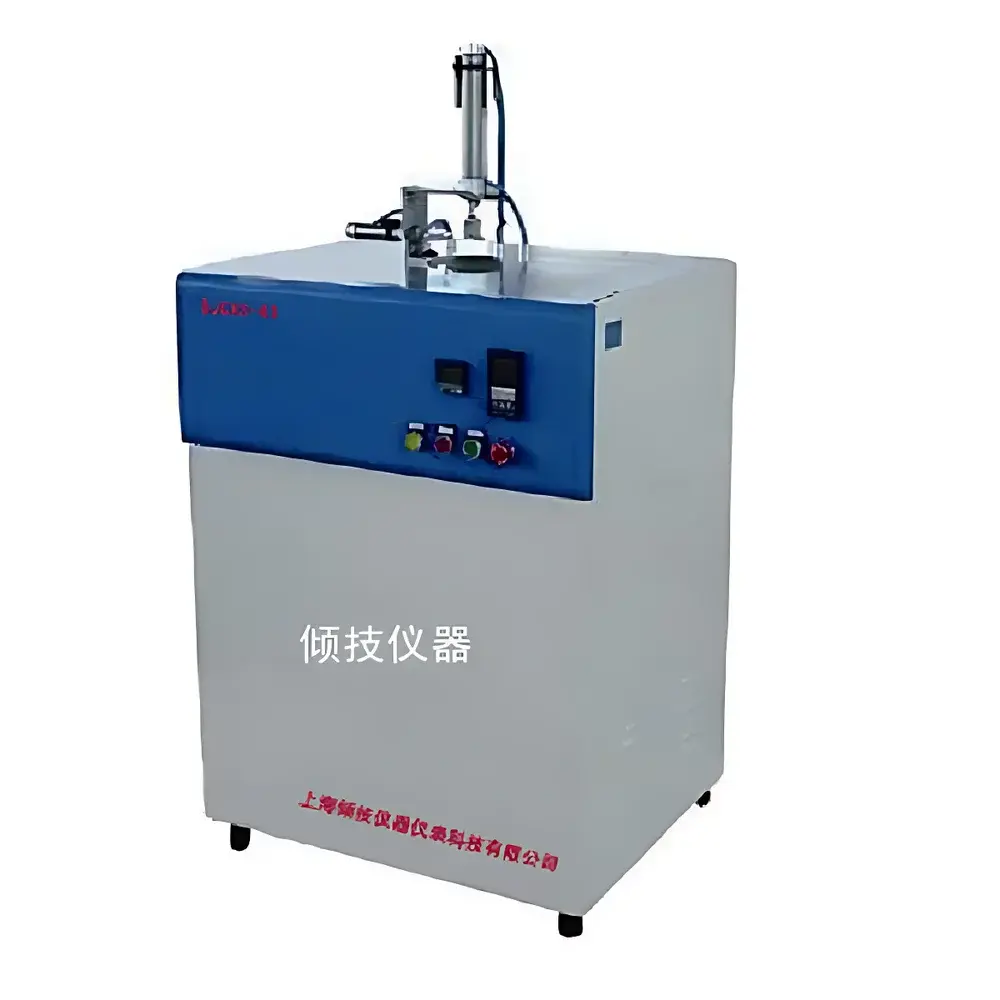
QJCXS-43 Rubber & Plastic Low-Temperature Brittleness Tester
| (Origin | Shanghai, China |
|---|---|
| Manufacturer Type | Authorized Distributor |
| Origin Category | Domestic (China) |
| Model | QJCXS-43 |
| Price | USD 9,100 |
| Test Temperature Range | −70 °C to 0 °C |
| Impact Velocity | 2.0 m/s ±0.2 m/s |
| Temperature Stability During Test (3 min) | ±0.5 °C |
| Impact Pin to Clamp Lower Edge Distance | 11.0 mm ±0.5 mm |
| Dimensions (W×D×H) | 700 mm × 700 mm × 1300 mm |
| Power Consumption | 1100 W) |
Overview
The QJCXS-43 Rubber & Plastic Low-Temperature Brittleness Tester is a precision thermal-mechanical instrument engineered for the standardized determination of the brittle temperature (Tb) of vulcanized rubber and elastomeric materials under controlled cryogenic conditions. Based on the principle of impact-induced fracture initiation, the device subjects pre-cooled specimens to a calibrated pendulum-driven impact at a defined velocity and measures the highest temperature at which brittle failure—characterized by visible cracks or complete rupture—occurs upon impact. This test method directly correlates with real-world low-temperature service limits, enabling comparative evaluation of formulation stability, polymer chain mobility, and crosslink density effects across rubber compounds and thermoplastic elastomers. Designed in strict compliance with GB/T 1682–2014 (revised version of GB 1682–1982), the system delivers repeatable, traceable results essential for material qualification, R&D benchmarking, and incoming QC protocols in rubber compounding, automotive sealing, cable sheathing, and medical elastomer manufacturing.
Key Features
- Programmable cryogenic chamber with dual-stage cascade refrigeration, achieving stable operation from −70 °C to 0 °C with ≤±0.5 °C deviation over 3-minute dwell time post-thermal equilibrium
- Electromechanically actuated impact mechanism delivering consistent 2.0 m/s ±0.2 m/s impact velocity—calibrated per ISO 179-1 requirements for pendulum-based impact testing
- Precision-machined specimen holder assembly ensuring repeatable positioning: impact pin center-to-clamp lower edge distance maintained at 11.0 mm ±0.5 mm
- Stainless-steel insulated chamber with digital PID temperature control, real-time logging, and over-temperature/over-pressure safety interlocks
- Modular design supporting rapid specimen exchange and minimal thermal recovery time between consecutive tests
- Compliance-ready architecture: supports audit trails, user access levels, and calibration certificate documentation aligned with GLP and internal QA procedures
Sample Compatibility & Compliance
The QJCXS-43 accommodates standard dumbbell-shaped or rectangular specimens (per GB/T 1682, ASTM D2137, and ISO 2872) cut from molded sheets or extruded profiles. Compatible materials include natural rubber (NR), styrene-butadiene rubber (SBR), nitrile rubber (NBR), ethylene propylene diene monomer (EPDM), thermoplastic polyurethane (TPU), and thermoplastic vulcanizates (TPV). The instrument meets all mechanical and thermal performance criteria specified in GB/T 1682–2014 and provides technical equivalence to ASTM D2137–22 (Standard Test Method for Rubber Property—Brittleness Point of Flexible Polymers and Elastomers) and ISO 2872:2021. While not inherently 21 CFR Part 11–compliant, its data output format (CSV/Excel-compatible timestamped logs) enables integration into validated LIMS or ELN environments under client-defined SOPs.
Software & Data Management
The QJCXS-43 operates via an embedded industrial-grade controller with a 7-inch resistive touchscreen interface. All test parameters—including setpoint temperature, dwell duration, impact count, and pass/fail designation per specimen—are stored locally with UTC timestamps and operator ID tagging. Data export is supported via USB 2.0 port in plain-text CSV format, facilitating direct import into statistical process control (SPC) platforms such as Minitab, JMP, or custom Python-based analysis pipelines. Optional firmware upgrade includes RS-232 and Modbus RTU interfaces for PLC-level integration in automated lab environments. Calibration records, maintenance logs, and temperature verification reports (using NIST-traceable PT100 sensors) are retained for ≥12 months and exportable on demand.
Applications
- Formulation development: Screening carbon black, plasticizer, and antioxidant effects on low-temperature flexibility of tire treads and sidewalls
- Quality assurance: Batch release testing of EPDM gaskets for HVAC systems operating below −40 °C
- Failure analysis: Correlating field cracking incidents in automotive fluid hoses with laboratory-determined Tb shifts
- Regulatory submission support: Generating reproducible brittleness data for ISO 10993–1 biocompatibility dossiers involving silicone elastomer implants
- Supplier qualification: Cross-laboratory comparison of Tb values across multiple compound suppliers under harmonized test conditions
- Process validation: Monitoring consistency of vulcanization parameters via Tb trend analysis across production runs
FAQ
What standards does the QJCXS-43 comply with?
It conforms fully to GB/T 1682–2014 and provides technical alignment with ASTM D2137–22 and ISO 2872:2021. Verification reports include traceability to national metrology institutes.
Can the instrument be used for non-rubber elastomers such as TPU or TPE?
Yes—provided specimens meet dimensional and surface finish requirements specified in Clause 6 of GB/T 1682, the system delivers valid Tb determinations for thermoplastic elastomers and liquid silicone rubbers.
Is remote monitoring or network connectivity available?
Standard configuration supports local USB data export. Ethernet or Wi-Fi modules are available as factory-installed options under custom order (lead time +4 weeks).
What maintenance intervals are recommended?
Refrigerant pressure and oil level inspection every 6 months; full system calibration and impact velocity verification annually or after 500 test cycles—whichever occurs first.
Does the warranty cover the refrigeration system?
Yes—the 12-month comprehensive warranty includes all electromechanical, thermal, and control subsystems. Extended service plans (2–5 years) with priority response and preventive maintenance visits are available.





